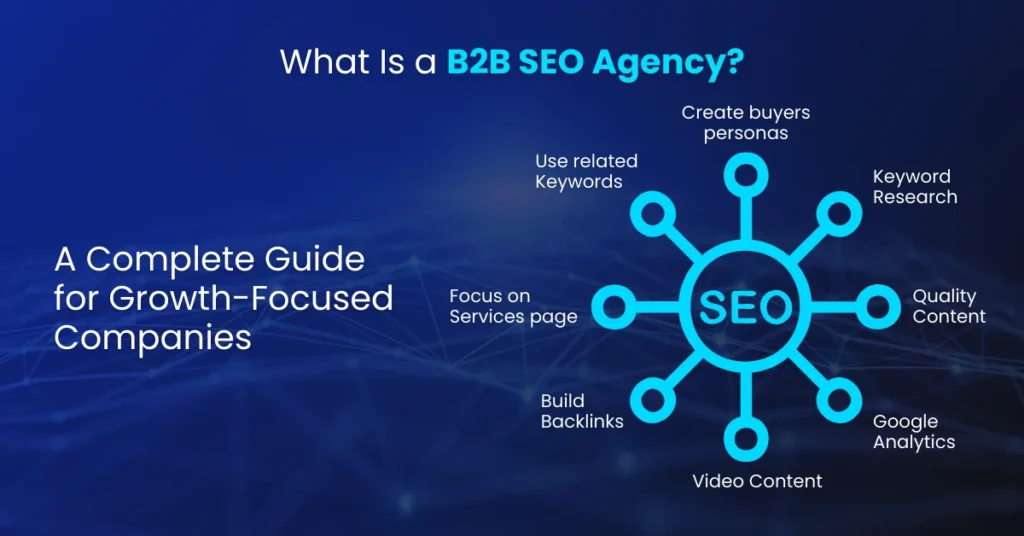

What Is a B2B SEO Agency? A Complete Guide for Growth-Focused Companies
B2B SEO Agency
Ali Hamza
A B2B SEO agency specializes in helping business-to-business companies rank higher in search engines and generate qualified leads through organic search. Unlike traditional SEO, B2B SEO focuses on longer sales cycles, multiple decision-makers, and revenue impact rather than traffic volume alone. These agencies handle keyword research, content strategy, technical optimization, and lead-focused conversion tracking to align organic search with your pipeline goals.
What Is a B2B SEO Agency?
A B2B SEO agency is a specialized marketing firm that optimizes websites and content for companies selling to other businesses. Its core job is straightforward: help your company rank for searches your ideal customers are actually making, then convert that traffic into qualified leads and revenue.
The key distinction from traditional SEO is audience and intent. In B2B, you’re not chasing individual consumers on impulse purchases. You’re competing for the attention of business decision-makers who are researching solutions, comparing options, and moving through a deliberate buying process that often spans 6 to 12 months.
This fundamental difference shapes everything a B2B SEO agency does from the keywords they target to the content they create to the metrics they track. A B2B agency understands that a founder researching CRM software or a procurement manager looking for supply chain solutions requires a different approach than someone searching “running shoes” on their phone.
B2B SEO Agency vs Traditional SEO Agency: Key Differences
What Does a B2B SEO Agency Do?
B2B SEO agencies deliver a range of services designed to build organic visibility and funnel qualified leads into your sales pipeline.
Here’s what that typically includes:
Keyword Research for B2B Audiences
Identifies search terms your target decision-makers use. This isn’t about volume alone, it’s about intent. An agency researches both top-of-funnel awareness keywords (“what is supply chain automation”) and bottom-of-funnel decision keywords (“best supply chain software for mid-market manufacturers”).
Content Strategy and Creation
Plans and produces content mapped to each stage of the buyer journey. This includes blog articles, whitepapers, case studies, webinar scripts, product comparison guides, and technical documentation. Every piece is aligned with search intent and funnel stage.
Technical SEO
Fixes the backend of your website to ensure search engines can crawl, understand, and index your content effectively. This includes site speed optimization, mobile responsiveness, schema markup implementation, XML sitemaps, and site architecture improvements.
Lead-Focused Conversion Optimization
Optimizes landing pages, CTAs, and forms to turn organic traffic into leads. B2B agencies track which pages drive MQLs, which content pieces appear in closed deals, and which keywords correlate with higher-quality leads.
Conversion Tracking and Attribution
Integrates your website analytics with CRM data so you can see which organic traffic channels and content pieces actually influence revenue. This is critical for justifying SEO investment in B2B.
Link Building and Authority Development
Earns backlinks from industry publications, association websites, and complementary companies. Unlike B2C link building, B2B prioritizes authority and relevance over volume. A single backlink from a trusted industry publication outweighs dozens from low-relevance sites.
On-Page and Off-Page Optimization
Improves title tags, meta descriptions, heading structure, and internal linking. Develops digital PR campaigns and thought leadership content to build your company’s domain authority.
Performance Analytics and Reporting
Provides transparent dashboards showing organic traffic, keyword rankings, lead volume, lead quality, and revenue attribution connecting every SEO metric back to business outcomes.
B2B SEO Agency vs Traditional SEO Agency: A Comparison
B2B SEO Agency vs Traditional SEO Agency: Key Differences
The comparison above illustrates the fundamental differences between B2B-specialized agencies and traditional agencies. When choosing a partner, this distinction matters enormously.
A traditional SEO agency optimizing for traffic volume will misalign your strategy from day one. A B2B-focused agency understands that your goal isn’t to rank for everything, it’s to rank for the searches your ideal customers make at moments when they’re genuinely evaluating solutions.
Why B2B Companies Need a Specialized SEO Agency
1. Poor Lead Quality from Generic Traffic
Running a generic SEO campaign attracts the wrong people. A blog post about “accounting software” reaches small businesses, individuals, and browsers with no buying power. A specialized B2B agency targets “accounting software for enterprise SaaS companies” or “multi-entity consolidation software for CFOs” attracting decision-makers who match your ideal customer profile.
The difference shows in your numbers. Generic traffic might deliver 500 visitors per month at a 2% conversion rate (10 leads). Targeted B2B traffic might deliver 50 visitors at a 30% conversion rate (15 leads). The second scenario wins on lead quality and sales team efficiency.
2. High Ad Costs Make SEO a Necessity
Paid ads for B2B keywords are expensive. A single click on a competitive PPC keyword can cost $15 to $50. Over time, your cost-per-lead approaches $310 to $600. Multiply that across your annual budget and paid ads become a growth bottleneck.
Organic search, by contrast, costs $85 to $200 per lead once established and continues to deliver leads month after month without recurring ad spend. For companies with average deal sizes above $50,000, organic SEO’s long-term ROI is simply superior. B2B agencies understand this equation and structure their approach accordingly.
3. Trust and Authority Challenges
B2B buyers are risk-averse. They’re evaluating your company against 3 to 7 competitors and need evidence that you’re trustworthy, competent, and a genuine authority in your space. Showing up in organic search results signals credibility. Showing up on page 5 of Google signals the opposite.
A B2B SEO agency builds your authority through high-quality content, strategic backlinks from respected publications, and thought leadership positioning. This combines with organic search visibility to create a powerful trust signal.
4. Complex Buyer Journeys
A B2B purchase involves a finance manager, an operations manager, possibly a VP, and maybe a technical evaluator. Each person searches different terms, needs different information, and appears at different stages of the buying process.
A specialized B2B SEO agency maps content to each persona and each stage of the journey. They ensure your company shows up when the operations manager searches “supply chain optimization best practices” (early awareness), when the finance team searches “ROI of supply chain software” (consideration), and when the procurement manager searches “pricing and implementation timeline” (decision).
How to Choose the Right B2B SEO Agency
Choosing a B2B SEO partner is one of the most important marketing decisions you’ll make. Here’s how to evaluate agencies objectively.
What Experience Matters Most?
Industry Knowledge: Agencies that have worked in your sector understand your customer, your terminology, and your competitive landscape. A B2B SaaS agency that’s worked with 20 cloud companies understands your product better than a generalist who’s worked across 100 industries.
Portfolio and Case Studies: Ask for references and detailed case studies. Look for evidence of:
- Companies similar to yours in size and sector
- Time-to-results (you should expect 4-6 months for initial traction, 9-12 months for significant ROI)
- Specific metrics: traffic growth, lead growth, lead quality improvements, revenue attribution
B2B SaaS Expertise (if applicable): If you’re a SaaS company, prioritize agencies with SaaS-specific experience. They understand product-led growth, free trial optimization, API documentation ranking, and developer audiences.
How Important Is Industry Knowledge?
Highly important. An agency unfamiliar with manufacturing might position your industrial automation software as a cost-cutting tool when your actual customers care about safety compliance. Industry expertise prevents these costly positioning misses.
Look for agencies that can:
- Explain your customer’s pain points back to you
- Identify competitors and their content strategies
- Understand your sales process and buyer journey
- Speak intelligently about your industry’s terminology and regulations
What KPIs Should You Track?
Focus on metrics tied to revenue, not vanity metrics. The right KPIs are:
Organic Traffic by Intent: Track traffic separately for top-of-funnel (awareness), middle-of-funnel (consideration), and bottom-of-funnel (decision) keywords. Volume alone is meaningless; you want to see growth in high-intent traffic.
Lead Volume and Quality: Track leads generated from organic search. More importantly, track lead quality. Are these SQLs or unqualified inquiries? Are they from your target industries and company sizes?
Conversion Rate: Measure the percentage of organic visitors who become leads. Industry benchmarks suggest 2-5% is typical; 5%+ is good; 10%+ is excellent.
Pipeline Contribution: Track which organic pages appear in opportunities that move through your funnel. This connects SEO to actual revenue.
Cost Per Lead: Calculate what you’re spending monthly on SEO divided by leads generated. Compare this to your PPC and other channels. B2B SEO should outperform paid over time.
Deal Velocity and Close Rate: The best metric: do deals influenced by SEO close faster or at higher rates than other channels? (They often do, because SEO brings people further along the buying journey.)
B2B Tech SEO Agency: Is It Different?
Yes and it’s worth understanding the distinction if you’re in software, SaaS, fintech, or tech-enabled services.
SaaS SEO requires specialized knowledge:
- Technical Documentation Ranking: SaaS companies need API docs, developer guides, and integration documentation to rank. This requires different optimization than marketing content.
- Product-Led Growth Integration: Many SaaS companies have free trials or freemium models. SEO agencies need to understand how to rank for “product X tutorial” and “product X integration” to support product adoption.
- Multiple Product Personas: A single SaaS company might serve end-users, developers, ops teams, and security teams. Content strategy must address each.
- Integrations and Partnerships: SEO for “Product X + Salesforce integration” or “API + your platform” support your partner ecosystem.
- Answer Engine Optimization (AEO): As AI assistants like ChatGPT and Claude influence searches, tech agencies must optimize content to appear in AI citations and summaries, not just Google rankings.
If you’re a tech company, specifically ask potential agencies about their experience with developer audiences, documentation SEO, and AI/Answer Engine Optimization.
Common B2B SEO Mistakes to Avoid
These missteps waste time and budget. Know them, and avoid them.
Prioritizing Traffic Over Leads
Running campaigns that drive 1,000 monthly visitors from unqualified audiences looks impressive in dashboards but destroys ROI. Insist your agency focuses on lead quality and revenue, not traffic volume.
Creating Generic Content
A blog post about “best CRM software” ranks nobody. A post about “CRM implementation for SaaS companies with distributed teams” ranks and converts. Specialized B2B agencies create intentional, specific content; generalists spray and pray.
Ignoring Technical SEO
Content is king, but a crawl error, slow site speed, or duplicate content issues will keep you off page one. Ensure your agency conducts thorough technical audits and doesn’t deprioritize backend optimization.
Weak Internal Linking Strategy
Internal links guide visitors and search engines deeper into your funnel. Poor internal linking wastes opportunities. Your agency should map internal links intentionally connecting related content, guiding readers from awareness to consideration to decision.
No Funnel Mapping (TOFU/MOFU/BOFU Mismatch)
Creating awareness content without middle-funnel nurture content or comparison content without decision-stage resources leaves money on the table. Demand a content plan that addresses all three funnel stages.Keyword Stuffing and Over-Optimization
Writing for search engines instead of humans creates unreadable content with poor conversion rates. Modern SEO rewards natural language and user intent. Avoid agencies that obsess over keyword density.Ignoring Search Intent
Ranking for “software pricing” is useless if your software is only purchased through an 18-month RFP process. The agency must understand why people search a term and whether it aligns with your sales model.
Duplicate Content Issues
Multiple pages targeting the same keyword or copied content confuses search engines and dilutes ranking power. Your agency should audit for duplicates and implement canonical tags where needed.
Poor Mobile Optimization
Over 60% of B2B researchers use mobile devices. A slow, mobile-unfriendly site tanks rankings. Ensure your agency prioritizes Core Web Vitals and mobile responsiveness.
No CRM Integration
If your agency doesn’t track how organic traffic flows into your CRM and influences revenue, you’re flying blind. Insist on integration and transparent reporting tied to business outcomes.
Can a B2B SEO Agency Help With Lead Generation?
Yes, absolutely. In fact, lead generation is the primary reason B2B companies hire SEO agencies.
Here’s how it works across the funnel:
Let’s turn your traffic into real business growth
Talk with our SEO experts and get a customized growth plan.
Contact UsB2B Sales Funnel: TOFU, MOFU, BOFU Content Mapping & Lead Generation
TOFU (Top of Funnel): Awareness Content
At this stage, prospects don’t yet know your solution exists. They’re searching broad problems: “What is supply chain optimization?” “How do I automate invoice processing?” “What is a DAM system?”
Your agency creates content blog posts, guides, educational videos—that answers these questions and builds awareness of potential solutions. This content doesn’t push hard sales; it educates. The goal is to attract prospects early in their journey, before they’ve talked to competitors.
Lead generation mechanism: Prospects download a resource, subscribe to your newsletter, or contact you to learn more.
MOFU (Middle of Funnel): Consideration Content
Now prospects know they have a problem. They’re comparing solutions and evaluating which one fits. They search: “Best supply chain software for manufacturing,” “Invoice processing software comparison,” “DAM system reviews.”
Your agency creates comparison guides, case studies, webinar content, and technical deep-dives that position your solution favorably. The goal is to become their trusted resource as they evaluate options.
Lead generation mechanism: Prospects request demos, download detailed case studies, or register for webinars.
BOFU (Bottom of Funnel): Decision Content
Your prospect has narrowed to 2-3 vendors and needs a final push. They search pricing, implementation, security, or specific feature questions. Your agency creates content addressing objections and showcasing why your solution is the best fit.
Lead generation mechanism: Free trials, consultation requests, and qualified sales conversations.
Organic Lead Nurturing
Unlike PPC, where leads arrive “cold,” organic search leads are warm. They’ve already researched your industry, read your content, and self-qualified as interested. This means:
- Higher close rates (14.6% for organic vs 1.7% for cold outbound)
- Better conversion velocity (they move through your funnel faster)
- Lower cost per acquisition (you’re not paying per click; you’ve earned the visit)
- Higher customer quality (they knew what they were getting into)
A good B2B SEO agency tracks this full funnel, ensures content maps to each stage, and proves that organic search influences your pipeline.
Final Thoughts
A B2B SEO agency is a strategic investment, not a cost center. When chosen correctly, these partners build a predictable, scalable lead generation engine that compounds over time.
B2B SEO Timeline & ROI: 24-Month Growth Trajectory and Channel Comparison
B2B SEO makes sense when:
- Your average deal size justifies a 9-12 month investment timeline
- Your sales cycle is longer than 90 days
- You have multiple decision-makers per deal
- You’re losing deals to competitors perceived as more authoritative
- Your PPC costs have become unsustainable
The long-term benefits are substantial. Unlike paid ads, which stop delivering the moment you stop paying, organic SEO continues to generate leads year after year. A piece of content that ranks today could deliver leads for 3-5 years with minimal additional investment.
Choose a partner with B2B expertise, a data-driven approach, transparent reporting, and a commitment to connecting SEO efforts to revenue. Avoid vanity metrics and agencies promising quick wins. Expect a 9-12 month timeline before significant results, but plan for 3-5 years of compounding value.
The companies winning in B2B today are the ones treating SEO as core infrastructure, not a tactical experiment. Your B2B SEO agency should reflect that philosophy. Many B2B companies use SEO services as a long-term growth channel instead of relying only on paid ads.
Ready to Scale Your Business with SEO?
Partner with a results-driven B2B SEO agency to increase visibility, generate qualified leads, and turn organic traffic into consistent revenue growth.
Contact Us →Frequently Asked Questions (FAQs)
How long does B2B SEO take to show results?
Initial traction appears within 4-6 months. Significant ROI typically arrives by month 9-12. B2B SEO is a long-term play, not a quick fix.
What's the difference between a B2B SEO agency and a digital marketing agency?
A B2B SEO agency specializes in organic search and lead generation. A digital marketing agency might offer SEO, PPC, email marketing, social media, and more. For deep expertise in SEO, choose a specialist.
How much does B2B SEO cost?
Retainers vary widely based on scope. Expect $3,000-$15,000+ monthly depending on your market, competition, and goals. Budget for at least 9-12 months to see results.
Can B2B SEO work for niche industries?
Yes, and often better than in broad markets. Niche industries have less competition and more defined buyer personas. Less volume, but higher conversion rates.
Should we do B2B SEO or B2B PPC?
The best companies do both. PPC delivers immediate leads while you build organic momentum. SEO provides long-term, sustainable lead generation. Together, they dominate search visibility and accelerate pipeline growth.
How do we measure B2B SEO ROI?
Track organic traffic, leads generated from organic, lead quality, pipeline contribution, and ultimately revenue attributed to organic search. Integrate your analytics with your CRM for complete visibility.
Is SEO better than LinkedIn ads for B2B lead generation?
SEO delivers 748% ROI vs LinkedIn’s 229% ROI, with significantly lower cost per lead. However, both channels are valuable. SEO provides passive inbound leads over time; LinkedIn ads provide active outbound reach.
About the Author
This guide is written by Ali Hamza, an SEO strategist at Devtrios with hands-on experience in B2B SEO, technical optimization, and conversion-driven content strategies. The insights are based on real client campaigns, search engine best practices, and continuous algorithm research.
Ali helps businesses improve search visibility, generate qualified leads, and build sustainable organic growth through data-backed SEO frameworks and user-first optimization.
View Author Profile →