
Adaptive Software Development (ASD) – The Complete 2026 Guide
Software Development
Ali Hamza
Adaptive Software Development is a flexible, iterative methodology designed for complex software projects where requirements evolve and uncertainty is inherent. Created by Jim Highsmith and Sam Bayer in the mid-1990s, ASD prioritizes continuous learning, collaboration, and adaptation over rigid planning and documentation.
Why Adaptive Software Development Matters in 2026
Software projects fail. Studies consistently show that 30-40% of technology projects miss deadlines or exceed budgets. The culprit? Rigid planning approaches that assume the future is predictable.
Adaptive Software Development (ASD) solves this problem by treating software development as a learning process rather than a planning problem. Instead of committing to a detailed plan at the outset, ASD teams embrace change, iterate rapidly, and continuously adapt based on what they discover.
In 2026, as AI accelerates development cycles and market competition intensifies, ASD has become essential for organizations tackling complex, evolving projects. This guide walks you through everything you need to know: core principles, implementation strategies, real-world case studies, and practical tools for success.
Key Characteristics of ASD
- Mission-focused planning: Define the vision and core objectives, but remain flexible about how to achieve them
- Iterative development: Deliver working software in regular 2-6 week cycles, not once at the end
- Continuous collaboration: Require ongoing customer involvement and cross-functional team engagement
- Learning-driven improvement: Each iteration generates lessons that improve the next cycle
- Risk-aware: Surface and address problems early through frequent testing and feedback
- Adaptive and flexible: Change is expected and managed systematically, not treated as failure
ASD vs. Traditional Development
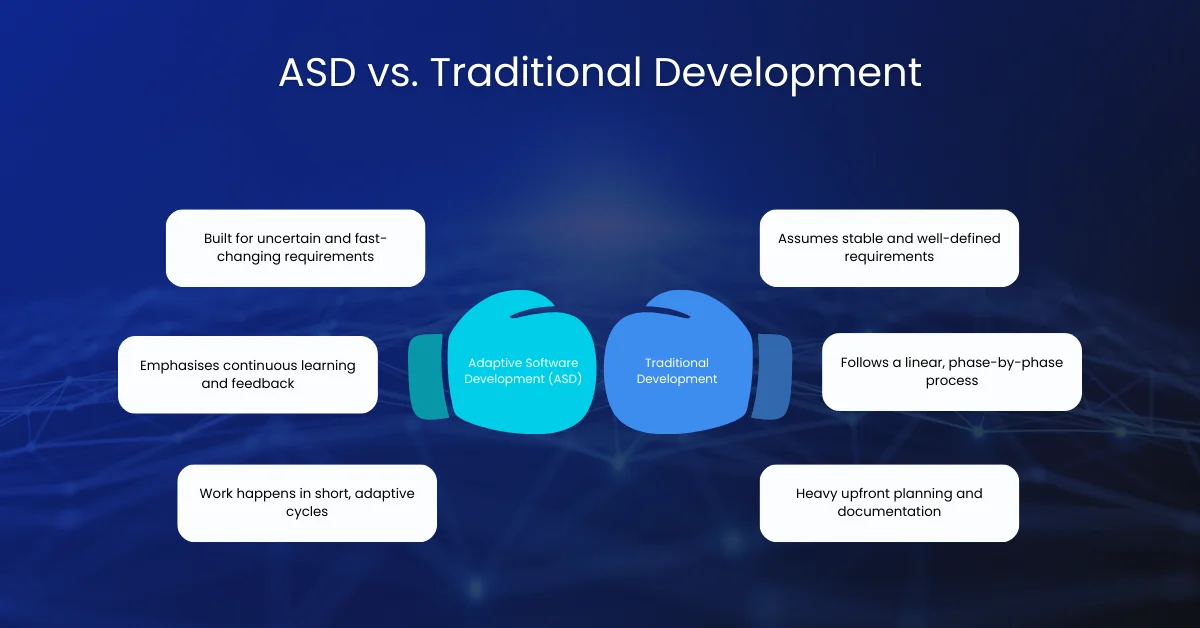
Understanding ASD’s origins explains why it remains so effective for 2026 challenges.
Timeline: From RAD to ASD to Agile
| Era | Methodology | Key Innovation | Limitation |
|---|---|---|---|
| 1980s | Rapid Application Development (RAD) | Quick prototyping & user feedback | Lacked structural rigor |
| Late 1980s | Spiral Development (Boehm) | Iterative cycles with risk analysis | Complex for simple projects |
| Mid-1990s | Adaptive Software Development | Formalized learning phases (Speculation, Collaboration, Learning) | Limited adoption |
| 1999 | ASD Book Published | Jim Highsmith releases seminal work | Still niche approach |
| Feb 2001 | Agile Manifesto | 17 pioneers (including Highsmith) define agile values | ASD becomes mainstream |
| 2001–Present | Agile Movement | Scrum, Kanban, XP, and ASD gain widespread adoption | Different frameworks compete |
| 2026 | AI-Enhanced Agile | ML predicts risks; automation handles repetitive tasks | Requires tech investment |
The Key Moment: Jim Highsmith and the Agile Manifesto (2001)
In February 2001 at Snowbird, Utah, 17 software pioneers including Jim Highsmith signed the Agile Manifesto, declaring shared values for adaptive software development. This watershed moment brought together representatives from eight different methodologies and legitimized approaches like ASD that had been considered unconventional.
The 7 Core Principles of Adaptive Software Development
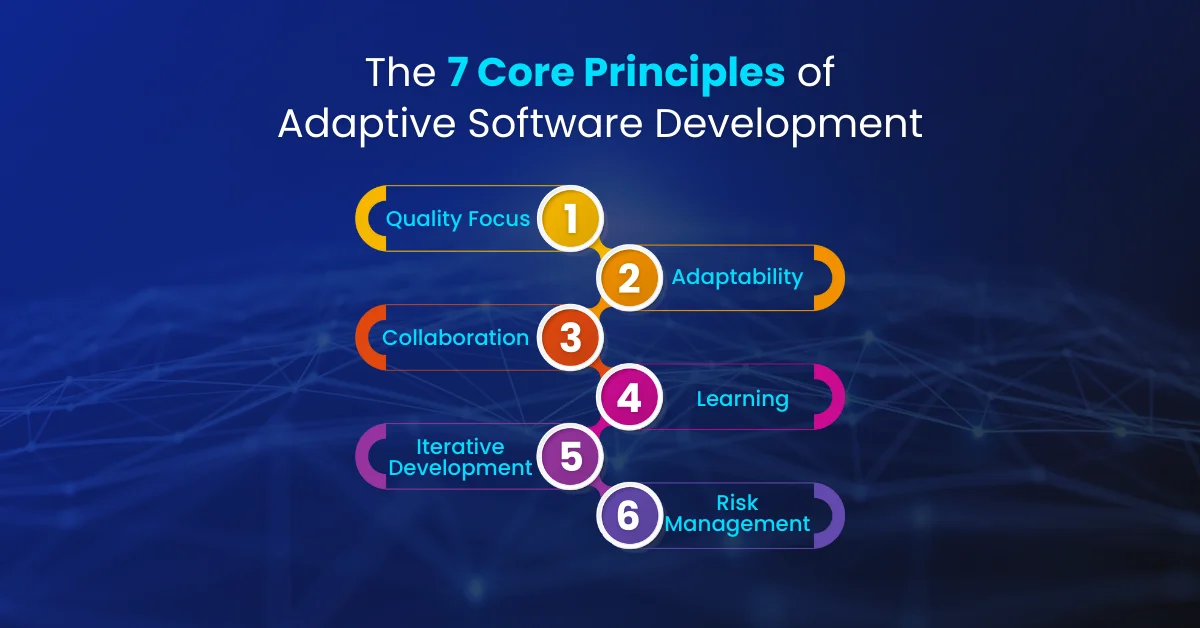
ASD’s strength lies in how these principles work together to enable teams to navigate complexity.
1. Adaptability and Adaptive Planning
Don’t try to predict the future perfectly. Instead, establish lightweight, mission-focused planning that acknowledges uncertainty and remains flexible.
- Define the high-level vision, not every detail upfront
- Update plans in each iteration based on new learning
- View changes as opportunities, not failures
- Maintain a living roadmap that evolves with understanding
2. Iterative Development Cycles
Break work into short, timeboxed iterations (typically 2-4 weeks) that deliver working software, not just documents.
- Each iteration produces a deployable increment
- Regular demos surface feedback early
- Quick feedback loops enable rapid course correction
- Contrast sharply with waterfall’s 6-12 month planning cycles
3. Continuous Collaboration and Teamwork
Software is created by people working together. ASD emphasizes open communication, shared responsibility, and cross-functional teams.
- Developers, testers, business analysts, and stakeholders work closely
- Daily stand-ups and pairing sessions maintain alignment
- Shared ownership replaces silos
- Customer involvement is not optional it’s essential
4. Continuous Learning and Improvement
Each iteration is a learning opportunity. Teams capture insights and apply them immediately.
- Retrospectives ask: “What went well? What didn’t? What will we change?”
- Experiments test assumptions; data informs decisions
- Knowledge is documented and shared across the organization
- The team becomes increasingly effective over time
5. Proactive Risk Management
Surface risks early through frequent testing, early prototyping, and continuous stakeholder feedback.
- Detect problems when they’re inexpensive to fix
- Conduct security, performance, and usability testing throughout development
- Address architectural risks before they become catastrophic
- Avoid discovering major issues at release time
6. Customer Satisfaction as the North Star
Every decision is evaluated against one criterion: Does this help us deliver software that satisfies customer needs?
- Continuous customer feedback guides priorities
- Early delivery of value builds confidence and engagement
- Working software is the primary measure of progress
- Reduce the risk of building the wrong thing
7. Self-Organizing Teams with Ownership
ASD empowers teams to make decisions about how they work, rather than imposing rigid processes from above.
- Teams decide how to structure daily work and problem-solving
- Individuals take ownership of commitments
- Distributed decision-making is faster and more informed
- Trust and autonomy drive motivation and quality
The ASD Lifecycle: Speculation, Collaboration, and Learning
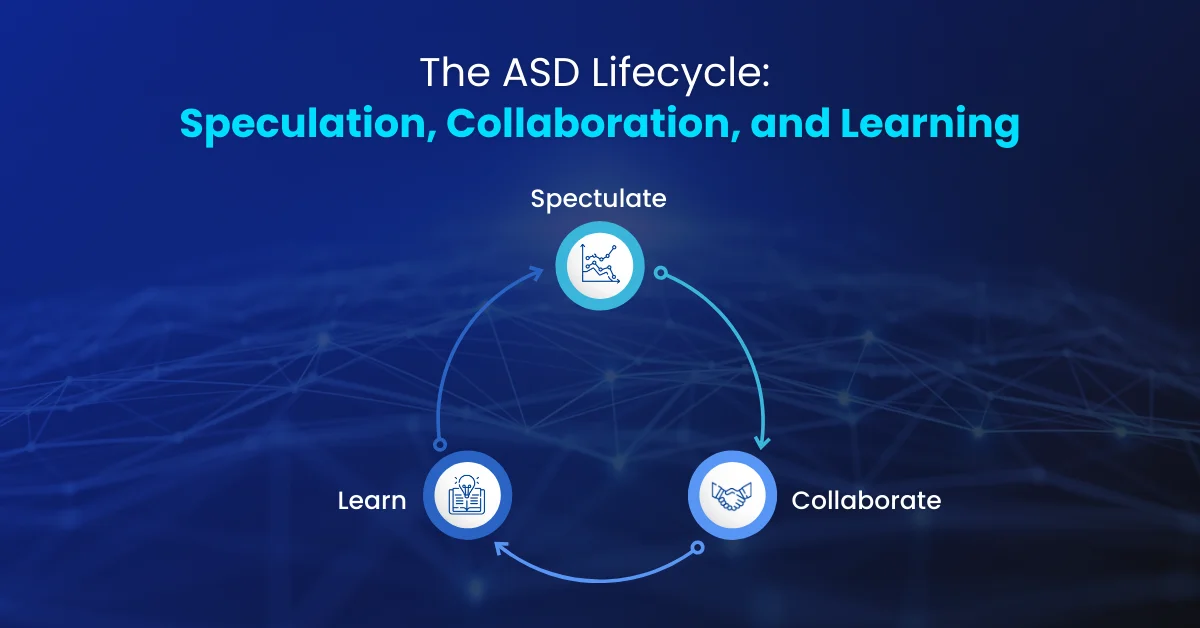
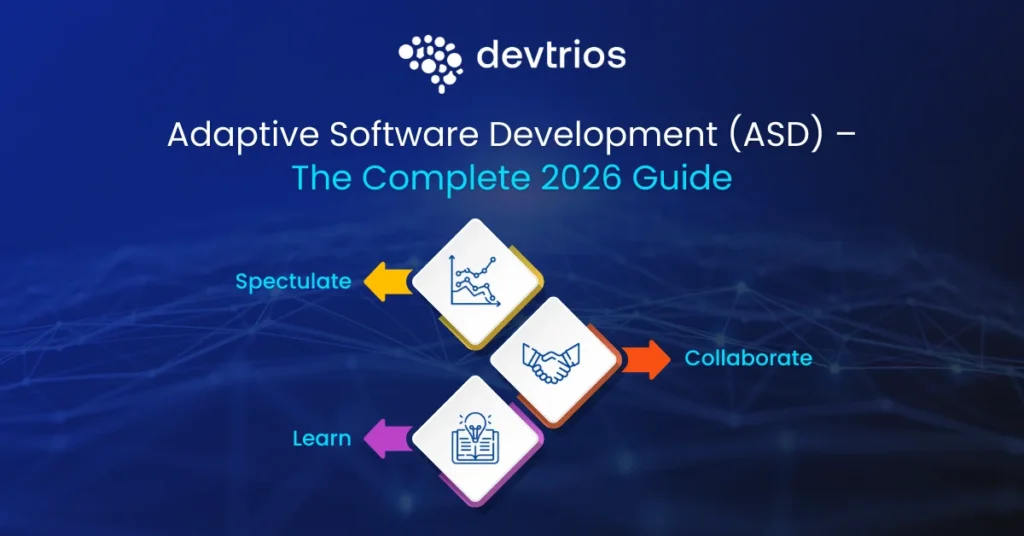
Rather than sequential phases, ASD cycles continuously through three interconnected phases. Each 2-4 week iteration progresses through all three, then repeats.
Phase 1: Speculation – Planning with Humility
Speculation is ASD’s approach to planning acknowledging that not all details can be known upfront.
Teams in Speculation:
- Define the mission and objectives – Why does this project exist? What problem does it solve? What success looks like?
- Identify initial risks – Where might we be wrong? What assumptions are we making?
- Establish high-level architecture – What’s the technical direction? How will major components interact?
- Create lightweight release planning – What features might we tackle? (Subject to change)
- Allocate resources – Who has what skills? How will teams be structured?
- Set iteration goals – What should we accomplish in the next 2-3 weeks?
Phase 2: Collaboration – Building with Communication
Collaboration is where teams actively develop software, emphasizing constant communication and feedback.
Teams in Collaboration:
- Daily stand-ups – Brief 15-minute check-ins on progress, blockers, and emerging issues
- Pair programming or code reviews – Developers share knowledge; issues are caught early
- Regular stakeholder demos – Show working software weekly or bi-weekly; gather feedback
- Open communication – Create psychological safety where concerns surface immediately
- Collaborative problem-solving – The team decides how to tackle obstacles, not management
- Continuous delivery focus – Each day moves toward delivering features customers value
Key Principle: Trust and transparency enable the team to move fast without creating chaos.
Phase 3: Learning – Improving Through Feedback
Learning is ASD’s mechanism for continuous improvement, embedding reflection deeply into the process.
Teams in Learning:
- Conduct focused retrospectives – What worked? What didn’t? What will we change?
- Review technical quality – Is the codebase maintainable? Where’s technical debt accumulating?
- Analyze user feedback – Are we solving the right problems? Which features resonate?
- Run experiments and tests – Try approaches; measure results; keep what works
- Capture lessons learned – Document insights for the team and broader organization
- Adjust next iteration’s plan – Explicitly incorporate learning into upcoming work
Key Principle: Learning is deliberate and systematic, not random improvement.
ASD vs. Scrum vs. Waterfall vs. Kanban: The Complete Comparison
Choosing the right methodology depends on your project’s characteristics. Here’s how ASD stacks up.
Adaptive Software Development vs. Scrum, Waterfall, and Kanban Comparison
When to Choose Each Methodology
Choose ASD if:
- High complexity and evolving requirements
- You can establish strong customer collaboration
- Risk mitigation and early problem detection matter
- Your team thrives with autonomy and learning focus
- Innovation and novel solutions are required
Choose Scrum if:
- Requirements are reasonably well-understood
- You need structured roles and predictable cycles
- Teams prefer formalized ceremonies and clear accountability
- Fast-paced delivery with fixed sprint durations works for you
Choose Waterfall if:
- Requirements are stable and well-defined upfront
- Heavy documentation is needed (compliance, safety-critical)
- Sequential phases with minimal dependencies fit your work
- Budget and timeline are fixed and non-negotiable
Choose Kanban if:
- Work arrives unpredictably (support, maintenance)
- You want to optimize flow and throughput
- Work items have variable complexity
- Visual management appeals to your team
Step-by-Step Implementation Guide: Getting ASD Right in 2026
Implementing ASD requires more than adopting practices it demands a genuine cultural shift. Here’s how to do it successfully.
Step 1: Assess Organizational Readiness (Week 1-2)
Before diving in, honestly answer these questions:
- Can we get customer buy-in? ASD requires ongoing stakeholder involvement and feedback.
- Do we have technical infrastructure? CI/CD pipelines, automated testing, version control must be in place.
- Are teams open to autonomy? Self-organizing teams need trust and space to experiment.
- Can we commit to training? ASD is a mindset shift, not just process change.
- Do we have suitable projects? Select projects with genuinely uncertain or evolving requirements.
Red flags: Distributed teams with poor communication, inflexible stakeholders, legacy monolithic architecture, or resistance to continuous deployment.
Step 2: Select the Right Pilot Project (Week 3-4)
Don’t transform your entire organization overnight.
Ideal pilot project has:
Moderate scope (realistic but not trivial)
Team of 5-9 people (experienced but manageable)
Genuinely uncertain requirements (where ASD adds value)
Willing, available customer or product owner
Leadership support for a new approach
Clear success metrics to evaluate results
Avoid: Massive initiatives, teams with no agile experience, or projects with completely fixed requirements.
Step 3: Invest in Training and Coaching (Month 2)
ASD is fundamentally different. Your team needs education and support.
Essential training covers:
- ASD methodology – Concepts, phases, practices, principles
- Collaborative team skills – Communication, conflict resolution, shared decision-making
- Technical practices – CI/CD, automated testing, refactoring, code review
- Customer collaboration – Effective feedback sessions, demo facilitation, stakeholder management
Pro tip: Hire an external ASD coach for the first 2-3 iterations. Experienced coaches accelerate learning and help teams navigate inevitable challenges.
Step 4: Establish Technical Infrastructure (Month 2-3)
ASD’s flexibility depends on robust technical foundations.
Critical infrastructure:
- Version control: GitHub, GitLab, or Bitbucket for collaborative code management
- CI/CD pipelines: Automated build, test, and deployment (Jenkins, GitHub Actions, GitLab CI)
- Automated testing: Unit, integration, and end-to-end tests running automatically
- Collaboration tools: Slack, Microsoft Teams for distributed communication
- Project management: Jira, Azure DevOps, or Monday.com for iteration tracking
Without this foundation, rapid, safe iteration is impossible.
Step 5: Configure Project Management Tool (Month 3)
Select a tool that supports iterative cycles with built-in feedback mechanisms.
Quick comparison:
| Tool | Best For | Strength | Consider If |
|---|---|---|---|
| Jira | Agile-focused teams | Extensive integrations, Scrum/Kanban boards | Already using Atlassian ecosystem |
| Azure DevOps | End-to-end DevOps | Native CI/CD, Office 365 integration | Invested in Microsoft infrastructure |
| Monday.com | Flexible workflows | No-code customization, visual boards | Want user-friendly, customizable interface |
| Trello | Simple kanban | Lightweight, easy to learn | Starting simple or small teams |
Step 6: Establish Iteration Cadence (Month 4)
Create repeatable rhythms that teams can depend on.
Sample 2-week iteration cycle:
| When | Meeting | Duration | Purpose |
|---|---|---|---|
| Monday 9 AM | Speculation Planning | 2-4 hours | Review last iteration, plan next cycle, identify risks |
| Daily 10 AM | Stand-up | 15 minutes | Sync on progress, blockers, emerging issues |
| Wednesday 2 PM | Mid-iteration Demo | 1 hour | Show working features, gather stakeholder feedback |
| Friday 3 PM | Learning Retrospective | 1-2 hours | What worked? What didn't? What changes for next iteration? |
Flexibility: These are guideposts, not rigid requirements. Adjust based on team needs.
Take Your Software Development to the Next Level
Adaptive Software Development (ASD) helps you tackle complex projects, respond to change, and deliver high-quality software faster. Connect with our experts to implement ASD principles, optimize workflows, integrate AI-enhanced agile practices, and empower your teams for 2026 and beyond.
Contact Our ASD ExpertsStep 7: Cultivate the Adaptive Mindset (Ongoing)
Technical practices matter less than mindset shifts.
Cultivate these beliefs:
- Embrace uncertainty as an opportunity, not a threat
- Value learning as a primary outcome, not a byproduct
- Build trust through transparency and open communication
- Focus on business value delivery, not plan adherence
- Experiment openly and learn from failures quickly
Advantages of Adaptive Software Development: Measurable Benefits
ASD’s adoption reflects real, quantifiable benefits it delivers.
1. Handles Complexity and Uncertainty
ASD thrives precisely where traditional methodologies struggle: complex projects with evolving requirements.
Real-world example: Spotify successfully scaled personalized music delivery to millions of users through autonomous squads that continuously refined recommendation algorithms based on user behavior.
2. Early Risk Detection and Prevention
Frequent testing, demos, and feedback loops surface risks early when they’re inexpensive to fix.
Financial impact: Fixing defects discovered late costs 10-100x more than fixing them early. Early detection directly reduces project costs.
3. Faster Time-to-Market
Incremental delivery means working software reaches users sooner.
Case example: Payvantage reduced application processing time from 15 minutes to just 5 minutes (67% improvement) while cutting abandonment rates by 40% through iterative optimization.
4. Higher Customer Satisfaction
Continuous involvement ensures software actually matches what customers need, not what was assumed.
Success story: Slack built its market-leading position through relentless user feedback iteration, incorporating features like emoji reactions and thread organization based on how users actually worked.
5. Reduced Rework and Cost Overruns
Detecting misaligned requirements and technical issues early minimizes expensive late-stage rework.
Statistical evidence: Studies show ASD reduces rework by 20-40% compared to traditional methodologies.
6. Continuous Improvement Embedded
Each iteration builds team capability and institutional knowledge.
Long-term effect: Teams become increasingly productive over time as they improve both the product and their development processes.
7. Market Responsiveness and Flexibility
Adapt quickly to competitive threats, market shifts, and new technologies.
Example: Netflix successfully transitioned from DVD rental to streaming to original content production by continuously adapting strategies based on market feedback and data a transformation rigid planning couldn’t support.
Challenges and How to Overcome Them: Practical Solutions
While ASD’s benefits are substantial, implementing it successfully requires addressing real challenges.
Challenge 1: Managing Uncertainty
The Problem: Working in uncertain environments is psychologically challenging, especially for teams trained in traditional, predictable development.
Solutions:
- Break goals into smaller, achievable pieces; plan 2-3 iterations ahead, then reassess
- Establish transparent communication; keep stakeholders informed about uncertainties
- Focus on learning, not perfection; accept that some decisions will be wrong
- Use data and metrics to ground decisions in evidence, not guesses
Challenge 2: Requires High Customer/Stakeholder Involvement
The Problem: ASD requires ongoing availability and engagement. Absent stakeholders cripple the approach.
Solutions:
- Dedicate a product owner or business representative to the team
- Schedule regular, structured feedback sessions (weekly demos or bi-weekly reviews)
- Set clear expectations upfront; explain why continuous involvement is essential
- Make participation convenient (30-minute demos, not 2-hour meetings)
Challenge 3: Difficult Long-Term Planning and Budgeting
The Problem: Organizations accustomed to fixed budgets and timelines struggle with ASD’s adaptive nature.
Solutions:
- Establish flexible budget models tied to effort, not fixed per-feature costs
- Communicate in terms of business value delivered, not features completed
- Use team velocity data (from 2-3 iterations) to forecast within ranges
- Create budget buffers for adaptation and learning
Challenge 4: Accumulation of Technical Debt
The Problem: In the rush to deliver features, teams sometimes cut technical corners, slowing future development.
Solutions:
- Allocate 20-30% of iteration capacity to code quality, testing, and technical improvements
- Create a “debt matrix” ranking which technical issues matter most
- Invest in automated testing; safe refactoring depends on robust test coverage
- Schedule regular refactoring as planned work, not afterthought
Challenge 5: Stakeholder Alignment Issues
The Problem: Stakeholders may struggle with ASD’s iterative, unpredictable nature.
Solutions:
- Educate stakeholders early with case studies and clear principles
- Demonstrate value with quick wins; early results build confidence
- Frame communication around business outcomes, not features
- Show how ASD reduces risk of building the wrong thing
Challenge 6: Scaling Across Multiple Teams
The Problem: What works for a 6-person team may not scale to 50 people across multiple teams.
Solutions:
- Adopt scaled frameworks like SAFe (Scaled Agile Framework) or LeSS (Large-Scale Scrum)
- Create decentralized decision-making; empower teams locally
- Invest in leadership development; leaders must support adaptive teams without micromanaging
- Establish clear integration points between teams
Tools and Resources for ASD Teams: 2026 Essentials
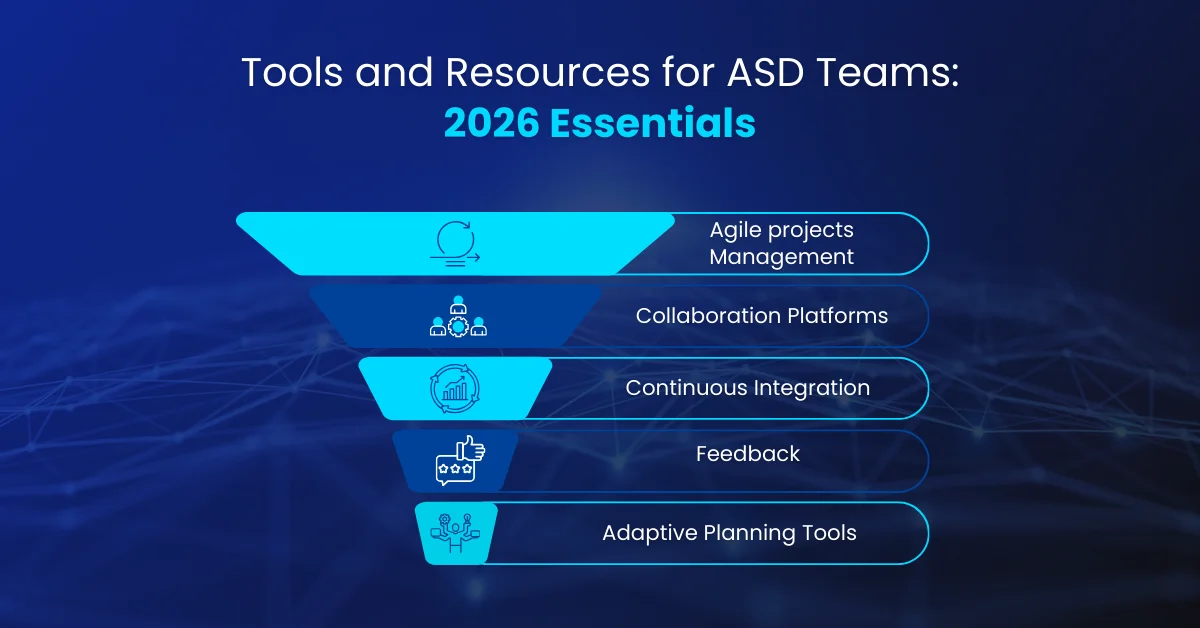
Jira
- Industry standard for agile teams
- Excellent Scrum and Kanban board support
- Customizable workflows
- Thousands of integrations
- Comprehensive platform: planning, version control, CI/CD, testing
- Excellent for Azure cloud users
- Strong DevOps integration
- Modern, user-friendly interface
- Exceptional customization (no-code)
- Supports hybrid methodologies
Version Control and Code Collaboration
GitHub: Leading platform, excellent for modern development practices
GitLab: Comprehensive DevOps platform with integrated CI/CD
Bitbucket: Seamless Jira integration for Atlassian users
Continuous Integration and Deployment
GitHub Actions: Native CI/CD for GitHub repositories
GitLab CI/CD: Built into GitLab; excellent for complex pipelines
Jenkins: Open-source automation server; highly flexible
Collaboration and Communication
Slack: Dominant platform; integrates with all dev tools
Microsoft Teams: Tight Office 365 integration; strong for Microsoft organizations
Automated Testing and Quality
SonarQube: Code quality analysis and technical debt measurement
GitHub Code Review: Built-in pull request review workflows
Bitbucket Code Insights: Code quality and security scanning
Real-World Case Studies: ASD in Action
The strongest evidence for ASD comes from organizations that implemented it successfully.
Case Study 1: Spotify – Autonomous Squads Driving Global Scale
Challenge: Deliver personalized music experiences for millions of users while rapidly adapting to new artists, trends, and user preferences.
Solution: Organized into autonomous “squads” (small, self-managing teams) focused on specific features. Each squad operated independently while maintaining alignment through shared principles.
ASD Elements: Lightweight mission-focused planning, continuous iteration based on user behavior data, autonomous decision-making, rapid experimentation.
Results:
- “Discover Weekly”: Personalized playlist, major user engagement driver
- “Release Radar”: New releases from followed artists, created habit-forming feature
- Rapid expansion to 220+ countries with localized experiences
Lesson: Self-organizing teams with clear missions can scale effectively while maintaining innovation speed.
Case Study 2: Netflix – Data-Driven Continuous Adaptation
Challenge: Transform from DVD rental to streaming to original content production while competing globally.
Solution: Grounded development in data analytics. Rather than committing to large content decisions upfront, they experimented, measured user engagement, and adapted investments based on real behavior.
ASD Elements: Speculative planning, collaborative development, continuous learning from viewing data, rapid iteration on UI/UX, data-driven risk management.
Results:
- Recommendation engine became increasingly sophisticated through continuous learning
- Hit original series (Stranger Things, The Crown) became subscription drivers
- Successfully pivoted business model multiple times
Lesson: Data-driven iteration enables adaptation at scale.
Case Study 3: Airbnb – Global Scaling with Market Adaptation
Challenge: Expand from a U.S.-focused platform to 220+ countries with vastly different markets, regulations, and user preferences.
Solution: Used ASD principles to balance global scale with market-specific adaptation. Teams adapted to local requirements while maintaining platform consistency through shared architecture.
ASD Elements: Mission-focused planning around core value propositions, collaborative teams across engineering and product, continuous learning from hosts and guests in different markets.
Results:
- Successfully localized for 220+ countries
- Maintained strong user experience across diverse markets
- Rapidly adapted (e.g., enhanced cleaning protocols during pandemic)
Lesson: Adaptive processes enable consistency with flexibility.
Case Study 4: Slack – User-Driven Feature Evolution
Challenge: Enter a crowded communication market and continuously evolve based on how users actually work.
Solution: Prioritized user feedback gathering and rapid iteration. Features that seemed theoretically useful but didn’t resonate were deprioritized; unexpected user behaviors revealed new opportunities.
ASD Elements: Continuous user feedback loops, rapid iteration, experimentation with integrations and workflows, learning-driven prioritization.
Results:
- Emoji reactions, threaded conversations, integrations evolved through user-driven iteration
- These details, often overlooked in planning, became central to appeal
- Built market-leading product through relentless user focus
Lesson: User feedback drives better features than theoretical planning.
Case Study 5: Payvantage – Measurable Business Impact
Challenge: Reduce application processing time and abandonment in loan application platform.
Solution: Systematically iterated on workflow, gathering feedback and analyzing drop-off points.
ASD Elements: Continuous user feedback, iterative improvements, data-driven prioritization, learning-focused refinement.
Results:
- Processing time: 15 minutes → 5 minutes (67% improvement)
- Abandonment rate: Reduced by 40%
- Tangible business impact through iterative optimization
Lesson: ASD delivers measurable business value through systematic iteration.
2026 Trends and Innovations in Adaptive Software Development
As software development evolves, ASD is being enhanced by emerging technologies and practices.
AI and Machine Learning Integration
AI is reshaping ASD in 2026:
- Predictive risk management: ML (Machine Learning) models analyze project data to predict risks before they emerge
- Intelligent code completion: GitHub Copilot and similar tools autocomplete code, reducing routine work
- Automated testing: ML identifies edge cases and generates test cases humans might miss
- Smart insights: AI analyzes team metrics and recommends process improvements
Impact: Teams focus on creative problem-solving while AI handles routine tasks.
DevOps and Continuous Delivery Evolution
DevOps practices are increasingly integrated with ASD:
- Continuous deployment: Automated pipelines release features multiple times per day
- Infrastructure as code: Treat infrastructure configurations like application code
- Real-time monitoring: AI-powered systems detect issues before users notice them
- Rapid rollback: Quickly revert experiments that don’t work
Impact: Faster feedback loops enable more rapid experimentation and learning.
Advanced Analytics and Real-Time Feedback
Organizations now have real-time dashboards showing software performance, user engagement, and emerging problems.
- Feature adoption metrics inform immediate prioritization
- Performance monitoring surfaces issues instantly
- User behavior analytics guide rapid iteration
- Predictive analytics forecast future problems
Impact: Learning cycles accelerate; data informs decisions faster.
Expansion Beyond Software Development
ASD principles are being applied to hardware, business processes, and organizational change management.
- Hardware development and embedded systems
- Product design and innovation
- Business process improvement
- Organizational transformation
Impact: Adaptive thinking becomes foundational to organizational strategy.
Conclusion
Adaptive Software Development represents a fundamental shift from viewing software development as a planning problem to viewing it as a learning problem. Rather than trying to predict the future perfectly, ASD builds processes around managing uncertainty, learning continuously, and adapting based on what you discover.
For organizations tackling complex software projects, ASD offers a proven path to:
Faster delivery of working software
Higher quality through early problem detection
Greater customer satisfaction through continuous involvement
Lower costs by reducing rework and late-stage failures
More engaged teams through autonomy and continuous learning
Next Steps
If you’re exploring whether adaptive development approaches might work for your organization, consider these practical first steps:
Start with a pilot project – Select one project with uncertain requirements to test the approach
Invest in team training – Education and coaching accelerate adoption and success; experienced teams like Devtrios can provide guidance and support throughout the process
Establish technical foundations – CI/CD, testing automation, and collaboration tools are non-negotiable
Cultivate the mindset – Technical practices matter less than embracing adaptability and learning
The organizations profiled in this guide – Spotify, Netflix, Airbnb, Slack – all demonstrate that adaptive development works at scale and delivers measurable business value. Partnering with experienced teams such as Devtrios can help you navigate the challenges of ASD implementation and accelerate adoption.
Get Professional Support for Your ASD Implementation
Successful ASD implementation requires more than understanding the theory. Experienced development teams and specialized support accelerate adoption and help you navigate the inevitable challenges that emerge during transformation.
Whether you’re assessing organizational readiness, selecting your pilot project, coaching your team, or designing technical infrastructure, partnering with experienced professionals can significantly reduce risk and accelerate time-to-value.
Learn how experienced development teams approach ASD implementation and help organizations successfully adopt adaptive methodologies for complex software projects.
Ready to accelerate your ASD journey? Partner with Devtrios today and transform your software development process.
Ready to Transform Your Software Development with ASD?
If your projects face evolving requirements or complex technical challenges, Adaptive Software Development (ASD) can help your team deliver faster, innovate continuously, and respond to change. Our experts guide you in implementing ASD principles, iterative cycles, AI-enhanced workflows, and self-organizing teams for measurable results in 2026.
Contact Our ASD Experts →Frequently Asked Questions (FAQs)
Adaptive Software Development is a type of Agile methodology specifically designed for complex projects with uncertain or evolving requirements. While "Agile" is a broad umbrella encompassing many approaches (Scrum, Kanban, XP), ASD emphasizes three continuous phases: speculation (adaptive planning), collaboration (teamwork), and learning (continuous improvement).
- Speculation: Mission-focused planning that defines core objectives and identifies risks while acknowledging uncertainty.
- Collaboration: The team actively develops software with continuous communication, demos, and stakeholder feedback.
- Learning: Systematic improvement through retrospectives, experimentation, and feedback analysis.
These phases repeat every 2-4 weeks, not sequentially.
Aspect | ASD | Scrum |
Focus | Learning and adaptation | Predictable delivery cadence |
Planning | Mission-focused, highly adaptive | Sprint-based, structured |
Roles | Fluid, collaborative | Prescribed (Product Owner, Scrum Master, Team) |
Best For | High complexity, innovation, uncertainty | Well-understood requirements, fast delivery |
ASD is more adaptive; Scrum is more structured.
Best for:
- Complex projects with technical uncertainty
- Innovative projects where the solution isn't fully known upfront
- Projects with evolving requirements based on market dynamics
- Projects requiring strong customer collaboration
- High-risk projects where early problem detection is critical
Handles complexity and uncertainty
Early risk detection and prevention
Faster time-to-market through incremental delivery
Higher customer satisfaction through continuous involvement
Reduced rework and cost overruns
Continuous learning and team improvement
Flexibility to respond to market changes
Managing uncertainty is psychologically challenging
Requires significant, ongoing customer availability
Difficult to accommodate fixed budgets and timelines upfront
Potential technical debt accumulation without active management
Scaling across multiple teams requires additional frameworks
May not suit highly regulated or stable-requirement projects
- Project management: Jira, Azure DevOps, or Monday.com
- Version control: GitHub, GitLab, or Bitbucket
- CI/CD: GitHub Actions, GitLab CI, or Jenkins
- Communication: Slack or Microsoft Teams
- Testing: Framework appropriate to your tech stack
- Assess organizational readiness for continuous customer collaboration
- Select a pilot project with uncertain requirements
- Invest in team training and external coaching
- Establish technical infrastructure (CI/CD, testing, automation)
- Configure project management tools appropriately
- Start small; build experience before scaling
- Focus on cultivating the adaptive mindset, not just implementing practices
About the Author
This article is written by Ali Hamza, a digital strategist and technology writer with hands-on experience in product development, emerging technologies, SEO, and scalable digital systems. He focuses on translating complex technical topics into clear, practical guidance that helps readers make informed decisions.
Ali regularly researches consumer technology trends, software platforms, and digital optimization strategies, ensuring content accuracy, usability, and real-world relevance across a wide range of topics.
View Author Profile →