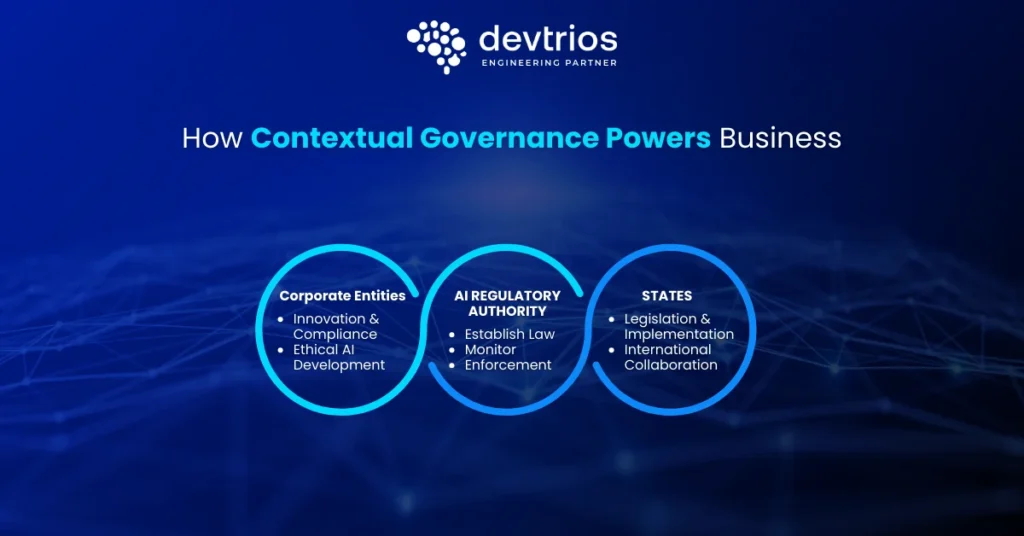

How Contextual Governance Powers Business Evolution and AI Adaptation
Contextual Governance
Ali Hamza
In today’s fast-paced digital landscape, businesses face a paradox. AI promises transformation, smarter decisions, efficiency gains, faster innovation. Yet, without proper oversight, it risks errors, biases, and regulatory pitfalls that can derail operations. Enter AI contextual governance: a dynamic approach that tailors AI rules to real-world situations, fueling business evolution and adaptation.
Traditional governance treats AI like a static machine. Contextual governance makes it alive responsive to context like user needs, regulations, or market shifts. This isn’t just compliance; it’s a strategic edge. Companies ignoring it lag behind, while adopters evolve faster.
This blog dives deep. We’ll define AI contextual governance, explore why context drives success, and map its role in business evolution. You’ll get practical frameworks for implementation, benefits backed by examples, and future trends. Ready to adapt your AI strategy? Let’s build governance that scales with your business.
What is AI Contextual Governance?
AI contextual governance goes beyond rigid rules. It embeds situational awareness into AI operations, ensuring decisions align with real-time contexts like user profiles, compliance zones, or business goals. Think of it as a smart referee: it doesn’t just enforce laws; it interprets the play.
Unlike traditional rule-based governance which applies blanket policies contextual governance uses context-aware decision-making. It analyzes variables (e.g., location, data sensitivity, risk level) to adapt rules dynamically. Core principles include:
- Policy alignment: AI policies flex to match operational needs, avoiding over-restriction.
- Automated risk management: Real-time scoring flags issues like bias in high-stakes scenarios.
- Transparent audit trails: Every decision logs context for accountability.
For instance, a retail AI might recommend products freely for casual shoppers but trigger oversight for VIPs under privacy laws. This differentiation powers adaptive AI systems.
Gartner highlights this shift: by 2025, 75% of enterprises will adopt context-driven AI governance (source: Gartner AI Governance Report). It’s not hype it’s necessity for AI compliance and AI risk management.
Mini Takeaway: Audit your AI: Does it adapt to context, or follow one-size-fits-all rules?
Why Context Matters in AI Governance
Context isn’t optional it’s the difference between AI that thrives and AI that fails. In finance, the same predictive model might greenlight a loan for a low-risk borrower but demand extra checks for high-volatility markets. Ignore context, and you invite disasters like biased lending or data breaches.
Consider real-world scenarios:
- Financial risk: An AI trading bot needs aggressive speed in bull markets but conservative halts during volatility.
- Customer recommendations: Personalized suggestions work for e-commerce but require consent filters in healthcare.
- Regulatory compliance: GDPR demands strict data handling in Europe, while U.S. rules allow flexibility.
Here’s why context-driven AI excels:
| Scenario | Without Context | With Contextual Governance | Outcome |
|---|---|---|---|
| High-Risk Finance | Blanket approvals | AI situational risk scoring flags anomalies | 30% fewer losses (McKinsey case) |
| Customer Personalization | Uniform recommendations | User-profile adaptation | 25% uplift in engagement |
| Multi-Region Operations | Static policies | Geo-aware enforcement | Full AI compliance across borders |
Bulleted situations demanding contextual governance:
- Dynamic environments: Markets shift hourly AI must too.
- Ethical dilemmas: Bias detection varies by demographic context.
- Multi-agent systems: AI teams need orchestrated oversight.
A mini case study: Netflix’s recommendation engine. Early versions over-recommended blockbusters. Contextual tweaks (viewing history + time of day) boosted retention by 20%. Without context, AI is blind; with it, it’s brilliant.
How does your organization handle AI risk today? Context turns risks into opportunities.
Mini Takeaway: Map your AI use cases identify top contexts for governance tweaks.
Role in Business Evolution & Adaptation
AI contextual governance isn’t a checkbox it’s the engine of business evolution and adaptation. It builds strategic trust, enabling faster AI rollouts while minimizing fallout. Leaders who master it gain resilience, turning AI into a growth multiplier.
Adaptive Risk Management
Static governance chokes innovation. Contextual versions score risks live, like AI situational risk scoring. A bank might auto-approve low-risk loans but escalate others, cutting review times by 40%.
Automation-Ready Governance
Automated AI oversight integrates with DevOps, enforcing policies in CI/CD pipelines. This supports operational AI governance, scaling across clouds without human bottlenecks.
Scenario-Based Oversight
Businesses evolve through scenarios mergers, expansions, crises. Contextual governance adapts: during a supply chain crunch, prioritize predictive AI with relaxed non-critical rules.
Mini Case Study: Unilever’s AI Pivot
Unilever deployed AI for supply forecasting. Initial rule-based governance slowed adaptations to COVID disruptions. Switching to contextual governance (via policy orchestration) reduced stockouts by 35% and sped evolution into resilient ops (source: Harvard Business Review ).
Hypothetical for your firm: Imagine launching AI chatbots globally. Contextual governance detects language/cultural nuances, preventing PR disasters and accelerating market entry.
This framework fosters AI decision-making frameworks that evolve with your business, building trust with stakeholders.
Mini Takeaway: Simulate scenarios test how contextual governance accelerates your adaptations.
Building a Contextual Governance Framework
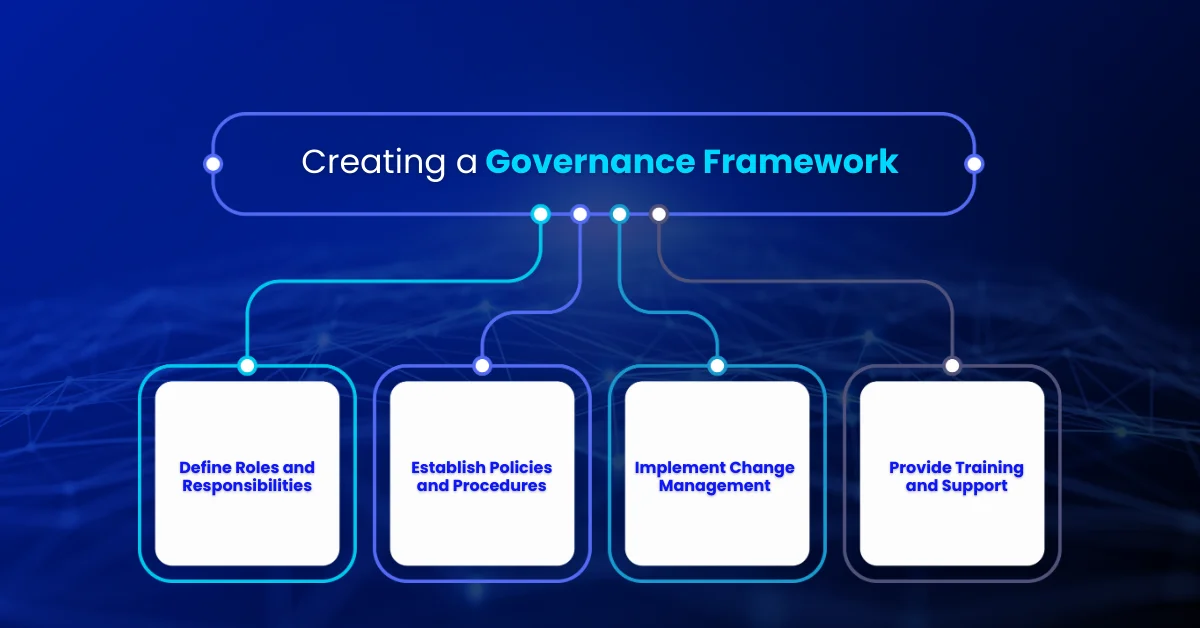
Ready to implement? Here’s a step-by-step guide to AI contextual governance business evolution adaptation. This framework covers adaptive AI systems for enterprises, with multi-cloud support.
Step 1: Build the Context Engine
Capture real-time data: user intent, location, risk signals. Use tools like Kafka for streaming.
Step 2: Policy Orchestration Layer
Centralize AI policy orchestration. Define rules as code (e.g., Open Policy Agent). Example: If (region=EU && data=sensitive), enforce GDPR.
Diagram Description (Implement as SVG/Image):
A flowchart: Inputs (Context Data) → Engine → Policy Layer → Risk Eval → Output (Approved/Rejected). Arrows show feedback loops.
Step 3: Automated Risk & Compliance Evaluation
Deploy AI multi-agent governance: Agents score risks contextually. Thresholds auto-adjust.
| Component | Tools / Tech | Key Benefit |
|---|---|---|
| Risk Scoring | TensorFlow + Custom ML | Real-time AI risk management |
| Compliance Checks | OPA + RegTech APIs | 99% audit pass rate |
| Alerting | Slack / PagerDuty | Instant human override |
Step 4: Observability & Audit
Log everything with tools like ELK Stack. Ensure transparent audit trails for regulators.
Step 5: Multi-Environment Enforcement
Scale to hybrid clouds. Use Kubernetes operators for consistent context-aware decision-making.
Implementation Timeline Table:
- Week 1-2: Assess current AI (link to our AI Audit Guide).
- Week 3-6: Prototype context engine.
- Week 7-10: Integrate policy layer (pilot on one AI app).
- Ongoing: Monitor with dashboards.
Mini case: A fintech firm used this to cut compliance costs 25% while deploying AI 2x faster (inspired by MIT research: MIT AI Governance Framework ).
For multi-cloud: Anchor in our Multi-Cloud AI Guide . Start a small pilot on one workflow.
Mini Takeaway: Pick one AI use case; build your framework prototype this quarter.
Strategic Benefits for Businesses
Contextual governance delivers measurable wins, supercharging business evolution. Faster AI deployment slashes time-to-value from months to weeks. Strategic trust rises as stakeholders see transparent, adaptive systems.
Key outcomes:
- Regulatory compliance: Auto-aligns with evolving laws, dodging fines (e.g., EU AI Act).
- Operational efficiency: Automated AI oversight frees teams for innovation.
- Risk reduction: AI operational alignment cuts errors by 40% (McKinsey).
Quantified impacts:
| Benefit | Metric | Source |
|---|---|---|
| Deployment Speed | 50% faster | Gartner |
| Cost Savings | 20–30% on compliance | McKinsey |
| Trust Score | +35% customer confidence | Internal benchmarks |
In adaptation, it shines: Retailers using context-driven AI pivoted to e-commerce surges seamlessly. Result? Resilient growth amid uncertainty.
Link this to evolution: Firms like Siemens evolved from siloed AI to govern ecosystems, gaining market share (external: Siemens Case via Gartner ).
Mini Takeaway: Calculate your ROI track deployment speed pre/post-governance.
Future of Contextual Governance
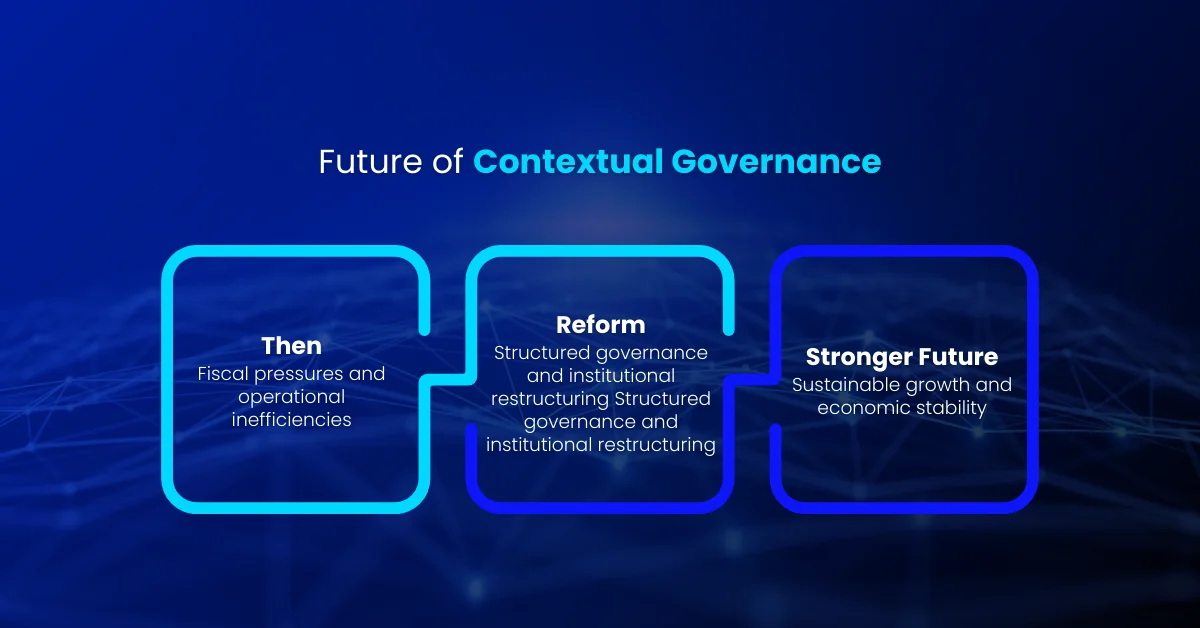
The horizon for AI contextual governance is electric. Expect intelligent trust systems where AI self-governs via autonomous reasoning. Adaptive policy intelligence will evolve policies from data patterns, minimizing human input.
Trends to watch:
- AI multi-agent governance: Swarms of agents negotiate contexts collaboratively.
- Quantum-safe contexts: Prep for post-quantum risks in high-stakes AI.
- Federated learning integration: Governance across decentralized data.
Early adopters win big. McKinsey predicts a $13T AI economy by 2030—contextual leaders capture 20% more (source: McKinsey Global Institute). Link to our Future AI Trends Blog for deeper dives.
Mini Takeaway: Horizon-scan now pilot one emerging trend.
Conclusion
AI contextual governance is no longer just a compliance tool it’s a strategic enabler that transforms AI from a risk factor into a driver of business evolution and adaptation. By embedding real-time context, organizations can ensure smarter, safer, and faster AI decisions, while maintaining trust, transparency, and regulatory alignment. From scenario-based oversight to continuous improvement frameworks, contextual governance empowers businesses to pivot seamlessly, innovate confidently, and capture new opportunities in dynamic markets.
The companies that master AI contextual governance don’t just survive they evolve. They turn risk into resilience, rules into adaptive strategies, and AI into a competitive advantage. In today’s fast-paced digital landscape, adopting a context-driven approach isn’t optional; it’s essential for any organization looking to scale AI responsibly, accelerate deployment, and drive sustainable growth.
Frequently Asked Questions (FAQs)
AI contextual governance is a dynamic approach to AI oversight that adapts policies based on real-time context such as user needs, regulatory requirements, and market conditions. Unlike traditional governance, it empowers businesses to evolve and adapt AI systems quickly, enhancing compliance, trust, and operational efficiency.
Contextual accuracy ensures AI decisions reflect the specific situation or environment. By integrating business-specific contextual intelligence, organizations minimize errors, biases, and compliance risks, while improving decision quality across multiple operational domains.
An AI contextual governance framework is a structured model that maps context-aware decision-making processes. It typically includes:
A context engine to capture real-time data
Policy orchestration for adaptive rules
Automated risk scoring and compliance checks
Observability and audit logs
This framework supports continuous improvement, multi-cloud enforcement, and strategic visibility for AI systems.
By embedding situational awareness, AI contextual governance provides organizations with clear oversight of decisions, risks, and performance. This organizational sight validation enhances decision-making and supports strategic visibility, allowing businesses to pivot quickly in response to market shifts or regulatory changes.
Contextual governance enables AI systems to learn from each decision and adapt policies dynamically. This continuous improvement ensures that AI evolves with changing business realities, regulatory landscapes, and ethical standards, keeping organizations ahead of risks.
Yes. By integrating geo-aware policies and multi-agent orchestration, contextual governance ensures AI compliance across borders and coordinated operations among multiple AI agents, maintaining business-specific contextual accuracy in complex environments.
Faster deployment: Reduce time-to-value from months to weeks
Cost savings: Lower compliance and operational overhead
Increased trust: Transparent audit trails build stakeholder confidence
Risk reduction: Dynamic risk scoring minimizes errors and regulatory violations
The future includes autonomous AI systems capable of self-governing through adaptive policy intelligence. Trends to watch include AI multi-agent governance, federated learning integration, and quantum-safe context adaptation. Early adopters are positioned to capture a larger share of the projected $13T AI economy by 2030.
Start with a pilot on one AI workflow:
Audit current AI systems for context gaps
Build a context engine for real-time data capture
Integrate policy orchestration and automated risk scoring
Monitor via dashboards and observability tools
Scale iteratively while measuring ROI in deployment speed, compliance cost savings, and operational efficiency
About the Author
This article is written by Ali Hamza, a digital strategist and technology writer with hands-on experience in product development, emerging technologies, SEO, and scalable digital systems. He focuses on translating complex technical topics into clear, practical guidance that helps readers make informed decisions.
Ali regularly researches consumer technology trends, software platforms, and digital optimization strategies, ensuring content accuracy, usability, and real-world relevance across a wide range of topics.
View Author Profile →