
App Development Cost in 2026: How Much Does It Really Cost to Build an App?
Uncover 2026’s real app development costs stage-by-stage estimates, global developer rates, calculators, hidden fees, and expert tips from leading agencies.


Uncover 2026’s real app development costs stage-by-stage estimates, global developer rates, calculators, hidden fees, and expert tips from leading agencies.

Discover the real cost of building a website in the UK. Full breakdown of website design, development, features, and pricing for businesses in 2026.

Top web technologies for web development in 2025 explained. Learn which frameworks, languages, and tools businesses and developers should use.

Discover how AI can transform the entire client journey from smarter ads to seamless onboarding and retention. Boost satisfaction & growth with Devtrios AI!

Discover why many agency owners quit and learn proven strategies to stay ahead, grow your business, and thrive in a competitive market.
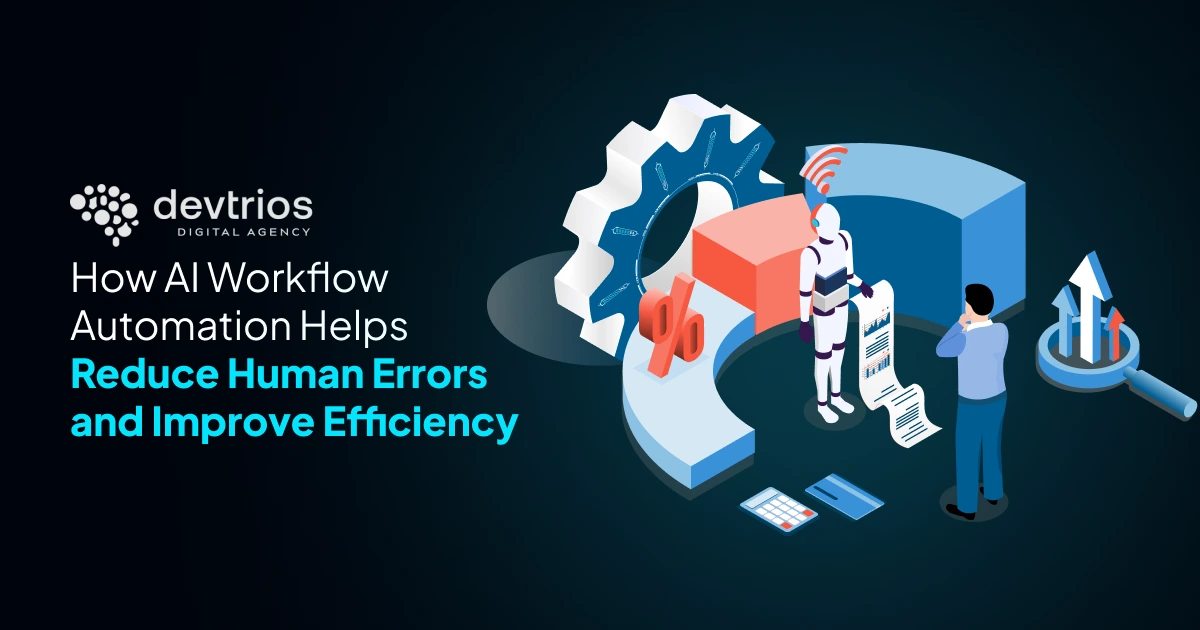
Category Hire a Automation Team Publication Date Author Follow us on Facebook X-twitter Linkedin Youtube Instagram Pinterest Tiktok Threads AI workflow automation is a powerful tool for reducing human errors and improving efficiency. It helps eliminate manual data entry mistakes, ensuring tasks are performed consistently and accurately. By automating routine decisions, businesses avoid delays and costly errors. AI also enhances communication flow, reducing misunderstandings. Additionally, AI keeps track of tasks, ensuring nothing is overlooked. With AI handling these processes, employees can focus on more important work, ultimately increasing productivity. An AI workflow automation agency can guide businesses in setting up these systems for smoother operations and fewer errors. Here are the ways AI workflow automation helps reduce human errors and improve efficiency: Eliminating Manual Data Entry Errors Manual data entry is one of the most common sources of human error. When employees are tasked with entering data, the chance for mistakes increases, whether it’s misplacing a decimal, entering incorrect information, or duplicating entries. These errors can lead to costly issues down the line, such as incorrect reporting or flawed decision-making. AI workflow automation reduces these risks by automatically pulling in, validating, and entering data from different sources. By relying on AI, businesses ensure that the data is accurate, reducing the potential for errors while saving time on manual data entry. AI can also check the consistency of data across multiple systems, preventing discrepancies before they become a problem. Don’t Burn Out Scale Smart Get support, refine your strategy, and stay ahead of the competition. Contact Us Ensuring Consistency in Tasks One of the main advantages of AI is its ability to perform tasks with consistent quality, regardless of how many times the task is done or how long the workday lasts. Unlike humans who might experience fatigue or distraction, AI works tirelessly and precisely. This consistency is especially crucial for tasks like processing orders, updating databases, or following up with clients. By ensuring that every task is completed exactly the same way each time, AI eliminates the variations and errors that human workers might introduce. Businesses can therefore expect more reliable results, smoother processes, and improved customer satisfaction. With AI, there’s no worry about missed steps or different outcomes, making your workflows predictable and dependable. Minimizing Delays with Speed and Accuracy In many business environments, speed is critical. AI workflow automation allows businesses to speed up processes significantly. For example, AI can quickly process data, handle customer requests, and complete complex tasks in a fraction of the time it would take a human. This reduction in processing time leads to faster decision-making, quicker responses to customers, and more efficient overall operations. But speed is only one part of the equation; accuracy is just as important. AI performs tasks with pinpoint accuracy, ensuring that everything from calculations to document processing is error-free. This means businesses don’t have to worry about costly delays caused by mistakes, allowing them to be more agile and responsive to customer needs. Automating Decision-Making Processes Traditionally, decisions within businesses are made based on experience, intuition, or manual processes, all of which can introduce errors and bias. AI, however, uses data-driven algorithms to make decisions that are based on patterns and insights from vast amounts of data. AI can quickly analyze current and historical data, identify trends, and make decisions accordingly. Whether it’s setting prices, adjusting inventory levels, or choosing the best marketing strategies, AI provides a consistent and logical approach to decision-making. By automating these processes, businesses not only save time but also ensure that their decisions are based on the most accurate and up-to-date information, reducing the risk of human error. Streamlining Communication Communication breakdowns are common in busy workplaces, leading to mistakes, confusion, and delays. Whether it’s missing an important message, misunderstanding instructions, or failing to update a colleague on a project’s status, communication errors can cause significant problems. AI workflow automation can streamline communication by automatically sending updates, reminders, and responses. For example, AI can be used to automatically schedule meetings, send reminders, or even respond to common customer service queries. AI chatbots can handle routine customer interactions, providing accurate responses instantly and freeing up employees to focus on more complex tasks. By ensuring clear and timely communication, AI minimizes the risk of misunderstandings and improves the flow of information. Reducing Risk of Overlooking Tasks In fast-paced business environments, it’s easy for important tasks to be overlooked. Human workers juggle multiple responsibilities, and despite their best efforts, something may slip through the cracks. AI workflow automation reduces this risk by providing automated task tracking and reminders. It can send notifications about upcoming deadlines, upcoming meetings, and incomplete tasks, ensuring that nothing is forgotten. AI can also prioritize tasks based on urgency or importance, helping teams stay focused on what matters most. With AI’s help, businesses can ensure that tasks are completed on time and nothing falls behind, which is especially valuable for maintaining smooth operations and meeting customer expectations. Conclusion In conclusion, AI workflow automation helps businesses reduce errors and improve efficiency in several ways. It handles repetitive tasks, automates decisions, and ensures tasks are completed on time and accurately. Devtrios, as an AI workflow automation agency, helps businesses implement these solutions to streamline their processes. With AI improving workflow, businesses can reduce mistakes and boost overall performance. Contact Us Full Name Email Phone No. Website Design & DevelopmentMobile App DevelopmentCustom Software / SaaSAI / AutomationSEO & Digital MarketingCloud / Hosting / DevOpsConsultation OnlyOther Project Type About Project I agree to the processing of my details as described in the Privacy Policy.
Learn why SEO is important for business growth in 2025. Discover the key benefits of SEO and how Devtrios helps brands grow organically.

Category CRM Integration Publication Date Author Follow us on Facebook X-twitter Linkedin Youtube Instagram Pinterest Tiktok Threads 5 CRM Integration Mistakes That Undermine Your ROI | Devtrios 5 CRM Integration Mistakes That Undermine Your ROI Implementing a CRM system promises better customer management and improved business results. However, despite the benefits CRM systems offer, many organizations experience poor returns due to avoidable integration mistakes. 70% CRM Failures 5 Common Mistakes 25% ROI Loss The CRM Integration Challenge These errors can cause inefficiencies, user frustration, and wasted resources that reduce your return on investment (ROI). This article highlights five frequent CRM integration mistakes and explains why they undermine ROI. Furthermore, it outlines practical steps to help you avoid these pitfalls. By addressing these challenges head-on, you position your business for a successful CRM integration that drives lasting growth. Lack of Clear Objectives High impact on success Poor Data Quality High impact on accuracy Insufficient Employee Involvement Critical for adoption Inadequate System Integration Medium impact but common No Focus on Future Needs High impact on scalability CRM Integration Impact on ROI This chart shows how different CRM integration mistakes impact your return on investment. Data quality issues and lack of clear objectives have the most significant negative effects. Employee Adoption Rates by Department This chart demonstrates how different departments adopt CRM systems. Sales teams typically show the highest adoption rates when properly trained and involved in the selection process. Table of Contents 1. Lack of Clear Objectives and Strategy 2. Poor Data Quality 3. Insufficient Employee Involvement 4. Inadequate Integration with Other Systems 5. No Focus on Future Needs Additional Resources Building ROI-Driven CRM Integrations CRM Integration Impact Comparison CRM Integration Mistake Impact on ROI Difficulty to Fix Priority Level Lack of Clear Objectives High Medium High Poor Data Quality Very High High Critical Insufficient Employee Involvement High Medium High Inadequate System Integration Medium High Medium No Focus on Future Needs High High High CRM Implementation Progress Goal Definition 80% Data Migration 65% Employee Training 45% System Integration 30% Data Quality Impact Clean data directly impacts CRM effectiveness and user adoption rates. Cost of CRM Mistakes CRM integration mistakes can significantly increase implementation costs. User Satisfaction Employee involvement directly correlates with CRM satisfaction rates. CRM Integration FAQs How long does a typical CRM integration take? Most CRM integrations take 3-6 months from planning to full implementation. The timeline depends on factors like data complexity, system customization, and employee training requirements. Complex integrations with multiple systems can take longer. What’s the most common reason for CRM integration failure? Poor data quality is the most common reason for CRM integration failure. Migrating incomplete, outdated, or duplicate information compromises the system’s effectiveness and leads to poor user adoption and decision-making. How can we ensure employee adoption of a new CRM? Involve employees early in the selection and customization process, provide role-specific training, and demonstrate how the CRM makes their jobs easier. Leadership support and ongoing feedback mechanisms also significantly improve adoption rates. 1. CRM Integration Mistakes: Lack of Clear Objectives and Strategy Without clear objectives, CRM implementations often fail to deliver expected results Why It Hurts ROI Starting a CRM integration without detailed goals often undermines the entire initiative. Many teams implement a CRM hoping technology alone improves performance; however, without a solid plan, results often fall short. As a result, efforts become scattered, and outcomes fail to meet expectations. When an organization fails to define specific objectives, measuring progress becomes difficult. For instance, adding features that don’t align with business needs leads to wasted resources. To avoid this, establish measurable outcomes before starting the project. In addition, involve leadership and end-users early to ensure the CRM aligns with core strategic priorities. Without measurable objectives, teams cannot track progress or prioritize features that directly impact your business. This leads to wasted time and funds on tools that don’t serve your core needs. Moreover, lack of direction can cause confusion among staff, lowering adoption. How to Avoid It To begin, define clear objectives such as increasing customer retention, shortening sales cycles, or improving support response times. Next, involve leadership along with sales, marketing, and support teams to align the CRM with business goals. Finally, set measurable KPIs and review them regularly to stay on track and make necessary adjustments. Example: A B2B manufacturing firm launched a CRM with no defined success metrics. Sales teams struggled with lead tracking, and management lacked visibility. After revising goals and involving end users, they boosted sales conversions by 12% within six months. For further details on setting effective CRM goals, visit CRM integration objectives. If you need help aligning your strategy with execution, explore Devtrios’ custom software development services to create tailored CRM solutions. 2. CRM Integration Mistakes: Poor Data Quality Data quality issues can severely impact CRM effectiveness and ROI Why It Hurts ROI Accurate data is the backbone of an effective CRM. Migrating incomplete, outdated, or duplicate information compromises the system’s power and leads to poor decisions. Furthermore, data quality issues compound quickly if left unchecked. Your CRM only performs well if it contains accurate and complete data. Migrating outdated, duplicate, or incomplete data remains one of the most common CRM integration mistakes. Without ongoing attention to data health, problems escalate quickly. For instance, duplicate customer records cause confusion, slow down workflows, and reduce overall efficiency. Moreover, inaccurate or outdated data erodes customer trust and leads to misleading reports that affect decision-making. How to Avoid It To ensure reliable system performance, prioritize a comprehensive data audit before migration to identify duplicates, inconsistencies, and outdated records. Use cleansing tools to remove errors and establish standardized data entry procedures. Encourage ongoing data maintenance and regular reviews. Additionally, promote cross-team accountability for data quality, which strengthens trust across the organization. Example: A retail chain migrated legacy CRM data without cleaning duplicates. Consequently, sales reps wasted time contacting the same customer multiple times, lowering efficiency. A subsequent cleanup process increased outreach quality and raised response rates by 18%. Review best practices

Category Digital Marketing Publication Date Author Follow us on Facebook X-twitter Linkedin Youtube Instagram Pinterest Tiktok Threads 3 Steps to Improve Your Website Conversion Rate | Devtrios Table of Contents Introduction: The Conversion Rate Challenge The Truth Behind Low Website Conversion Rates Why Your Website Conversion Rate is Low Step 1: Clarify Your Value Proposition Step 2: Optimize User Experience (UX) Step 3: Build Trust and Credibility Seamlessly Improve Conversions with Devtrios Conclusion: Convert Visitors Into Customers Effective conversion rate optimization requires a strategic approach Introduction: The Conversion Rate Challenge Improving your website conversion rate is crucial for turning visitors into paying customers, leads, or engaged subscribers. Although you may drive a lot of traffic to your site, poor conversion rates still mean missed opportunities and wasted marketing spend. Unfortunately, most websites struggle with optimizing this vital metric because they overlook key areas like clarity, user experience, and trust. Therefore, in this comprehensive guide, you’ll learn why your website conversion rate may be low and discover three practical steps to fix it effectively. With these strategies, combined with expert services like those offered by Devtrios, you can transform your website into a powerful engine for growth. Start Your Conversion Journey Today The Truth Behind Low Website Conversion Rate Regardless of how much traffic your site receives, a poor website conversion rate signals fundamental issues. Simply put, visitors may not be taking action because your messaging is confusing, your site is hard to use, or you haven’t built enough trust to encourage interaction. Fortunately, many websites suffer from the same problems, and most of these can be corrected. Monitoring your conversion metrics is essential for optimization To increase your website conversion rate, it’s essential to focus on three main pillars that work together seamlessly: clarity of message, optimized user experience, and credible trust signals. Moreover, businesses that master these elements consistently outperform competitors in conversion metrics. Why Your Website Conversion Rate is Low Many common pitfalls contribute to a low website conversion rate, such as: Unclear messaging that leaves visitors confused about your offer Weak or generic value propositions that fail to attract attention Poor user experience (UX) that frustrates or loses visitors due to slow loading or difficult navigation Lack of trust signals such as testimonials, reviews, or security badges Absence of clear calls to action causing visitors to hesitate Additionally, driving unqualified traffic that isn’t ready to convert If you want to improve your website conversion rate, addressing these fundamental issues is non-negotiable. Otherwise, your marketing efforts will continue to underperform and your visitors will bounce away. Struggling with Low Conversion Rates? Our experts can identify exactly what’s holding your website back and provide actionable solutions. Get Your Free Conversion Analysis Step 1: Clarify Your Value Proposition to Improve Website Conversion Rate The Problem If visitors can’t immediately understand who you are, what you offer, and why it matters to them, your website conversion rate will suffer significantly. Research highlights unclear messaging as the biggest factor killing conversions. Clear value propositions immediately communicate benefits to visitors The Solution Craft a simple, benefit-driven headline that captures attention instantly. Present a clear, unique value proposition that spells out the benefits your audience gains. Use “you”-focused language addressing your visitors’ pain points and needs. Break down information with visuals and bullet points for easier comprehension. Additionally, investing in professional UI/UX Design Services ensures your value proposition is communicated clearly and powerfully, which is essential to boosting your website conversion rate. A well-designed site guides visitors immediately, making their decision to stay or engage much easier. Step 2: Optimize User Experience (UX) for Higher Website Conversion Rate The Problem A poorly designed website with confusing menus, slow loading times, and mobile issues causes visitors to abandon your site. Consequently, this directly lowers your website conversion rate regardless of how good your product or service is. Good UX design creates seamless pathways to conversion The Solution Simplify navigation so visitors can easily find contact forms, product pages, or service details. To improve user experience, speed up your website by compressing images, minimizing code, and monitoring performance regularly. Ensure flawless mobile responsiveness since over 50% of users browse via mobile devices. Include clear and visually distinct calls to action on every page. Conduct A/B testing on headlines and CTAs to optimize for the best conversion rate. Furthermore, ongoing Custom Software Development and App Maintenance & Support keeps your user experience smooth, secure, and conversion-ready. This ensures that technical issues don’t silently undermine your efforts to improve conversion rates. Step 3: Build Trust and Credibility to Boost Website Conversion Rate The Problem Visitors hesitate to convert when your site doesn’t feel trustworthy or credible. This lack of trust harms your website conversion rate substantially. Numerous experts agree that trust signals are a critical factor for online success. Trust signals like testimonials and security badges increase conversion confidence The Solution Display genuine testimonials, reviews, and client logos to demonstrate proven success with your audience. Showcase detailed case studies with real results. Use trust badges, security certificates, and clear refund or guarantee policies to ease visitor fears. Maintain a modern, professional design that reflects reliability and expertise. Ultimately, these trust-building elements turn casual browsers into confident buyers and increase your website conversion rate. Ready to Transform Your Conversion Rate? Our team specializes in implementing these proven strategies to dramatically improve website performance. Schedule Your Free Consultation Seamlessly Improve Your Website Conversion Rate with Devtrios To ensure your website conversion rate improves sustainably and dramatically, you need experts who understand the nuances involved. Comprehensive digital solutions for maximum conversion optimization UI/UX Design Services Create seamless, user-friendly experiences proven to boost conversion rates with our expert design team. Learn More Custom Software Development Add unique features that better serve your customers while optimizing site performance for maximum conversions. Learn More SEO & Digital Marketing Attract the right visitors—those most likely to convert—with our strategic SEO and digital marketing services. Learn More Mobile App Development Extend your digital reach, engaging

Category MVP Roadmap Publication Date Author Follow us on Facebook X-twitter Linkedin Youtube Instagram Pinterest Tiktok Threads Launching a new product as a startup comes with immense pressure. Indeed, speed is crucial but delivering value fast without missteps is even more critical. That’s why a well-crafted MVP roadmap becomes your startup’s best strategy for rapid, efficient, and user-focused product development. In this in-depth guide from Devtrios, you’ll get a practical, actionable 6-step MVP roadmap that helps you quickly validate your ideas, optimize resources, and build products your users genuinely want while staying ahead in a competitive market. What is an MVP and Why Build One? First and foremost, an MVP, or Minimum Viable Product, represents the simplest version of your product designed to address a core user problem with minimal effort and investment. Using an MVP roadmap lets startups validate their concepts early, learn directly from real users, and avoid wasting time and money on unnecessary features. More importantly, creating a clear and focused MVP roadmap ensures your development efforts aim squarely at what drives growth and user adoption rather than chasing distractions. Six Steps to MVP Success 1. Define the Core Problem and Target Audience To begin with, every effective MVP starts by zeroing in on two critical questions: What pressing problem will your product solve? Who exactly faces this problem? Therefore, you must dive deep into market research with surveys, interviews, and competitive analysis to understand your target audience’s pain points and unmet needs. Tools like the Lean Canvas simplify your strategy by turning complex plans into living, adaptable documents aligned with your vision. If you don’t solve a real pain, even the most elegant product will fail. Startups that nail this step execute faster and smarter. Consequently, it is essential to take a deeper dive into defining your core problem and audience. By doing so, you will build a solid foundation that powers the rest of your MVP roadmap. Moreover, as you gain clearer insights, you can iteratively refine your understanding and ensure that every subsequent step is directly informed by this critical groundwork. Thus, not only do you reduce the likelihood of costly missteps, but you also accelerate your path toward achieving genuine product-market fit. 2. Map Out the User Journey Next, understanding your users’ interaction from awareness to continued use is critical. This customer journey mapping stage visually represents all touchpoints your MVP should support to create a seamless user experience. Specifically, focus on: Discoverability: How users find your product Decision-making: What encourages sign-up or purchase Onboarding: How users get real value quickly Retention: How to keep users engaged over time Furthermore, it is important to carefully mark where frustration or drop-off happens along the user journey. By systematically identifying these pain points, you can gain invaluable insights that allow you to design intuitive, value-driven flows. Additionally, this approach not only streamlines the user experience but also increases retention and satisfaction levels. As a result, your MVP roadmap becomes even more effective in guiding users smoothly from their first interaction to long-term engagement. Moreover, addressing these obstacles early on will help you optimize development resources and foster user loyalty right from the start. You can learn more about user journey mapping in MVP development to maximize engagement from day one. 3. Prioritize MVP Features Moreover, resist the urge to include every possible feature at the outset. The core of a successful MVP is ruthless focus. Use prioritization frameworks like MoSCoW or impact vs. effort analysis to include only what delivers the essential value. To do this effectively: List all potential features and user stories Score each for user value, technical feasibility, and problem relevance Defer “nice-to-haves” for later stages Additionally, check out expert guidance on MVP feature prioritization and strategic feature selection to sharpen your choices. 4. Design and Develop the MVP Now that you have a clear feature set, it’s time to focus on building smart and lean. Prioritize usability and functionality over perfection in design. Rapid wireframes and prototypes help your team align and validate user flows before heavy development investment. To proceed correctly, approach MVP design by: Creating simple wireframes outlining key workflows Mocking or skipping non-essential functionalities initially Involving users early for quick usability tests Maintaining close collaboration between designers, developers, and stakeholders for agility Also, use wireframing techniques to keep your development tightly focused on the user journey. Remember, your MVP isn’t about a beautiful UI. Instead, it’s about solving the right problem, fast, and validating that solution with users. 5. Launch and Gather Feedback Once the MVP is ready, launching it means entering the real market with a tested, focused version of your product. Therefore, choose a small, relevant test group or early adopters and collect invaluable insights through surveys, interviews, and usage analytics. The most effective feedback channels include: In-app surveys and prompts Direct user interviews Social media and community engagement Analytics tracking real behaviors By doing so, getting honest, detailed feedback turns assumptions into actionable data and accelerates learning. You can learn how to implement a robust post-launch MVP feedback loop. 6. Iterate Based on User Feedback Finally, the strength of an MVP lies in its iterative nature. You must analyze, prioritize, and implement improvements continuously to move your product toward real product-market fit. The key iteration practices include: Grouping feedback into themes and prioritizing enhancements Adjusting features, interface, and performance flexibly Retesting with users frequently to confirm impact Being ready to pivot if core assumptions change Therefore, continuous iteration is the heartbeat of a successful MVP roadmap that leverages real user needs to evolve naturally. Explore advanced MVP feedback and iteration strategies that keep your startup adaptive and relevant. Why Devtrios for Your MVP Roadmap Journey? At Devtrios, we don’t just code MVPs; instead, we become your strategic partner on the path from concept to launch. Our approach integrates a deep understanding of startup dynamics, design thinking, and rapid agile development to help your MVP reach the market faster and smarter. Specifically, we offer: Speed: