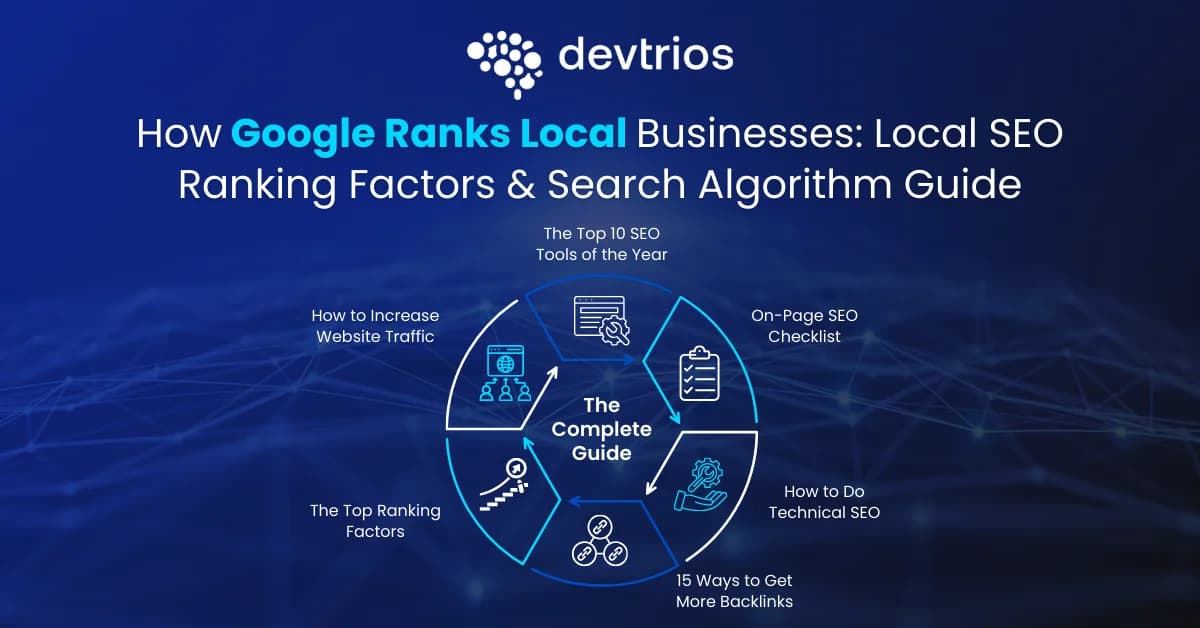
Local SEO ranking factors drive visibility in Google Maps, the Local Pack, and organic local results by aligning businesses with searcher needs. Google’s local search algorithm balances traditional signals with AI enhancements to deliver relevant, trustworthy outcomes. Businesses optimizing these factors effectively capture high-intent traffic from queries like “plumber near me.”
In Simple Terms
Google ranks local businesses by physical distance, query relevance, and established authority. AI refines these through natural language understanding, user behavior, and entity connectionsacross Google Business Profile and the web. This ensures results match local intent precisely.
How Google Decides Local Rankings
Google evaluates searches via three interconnected pillars.
- Proximity: Distance from searcher using location data and service areas.
- Relevance: Alignment of categories, content, and context with the query.
- Prominence: Trust from reviews, citations, links, and engagement.
Why this matters:These pillars create personalized Local Pack results, with AI adapting to conversational local intent.
Google's Local Search Algorithm
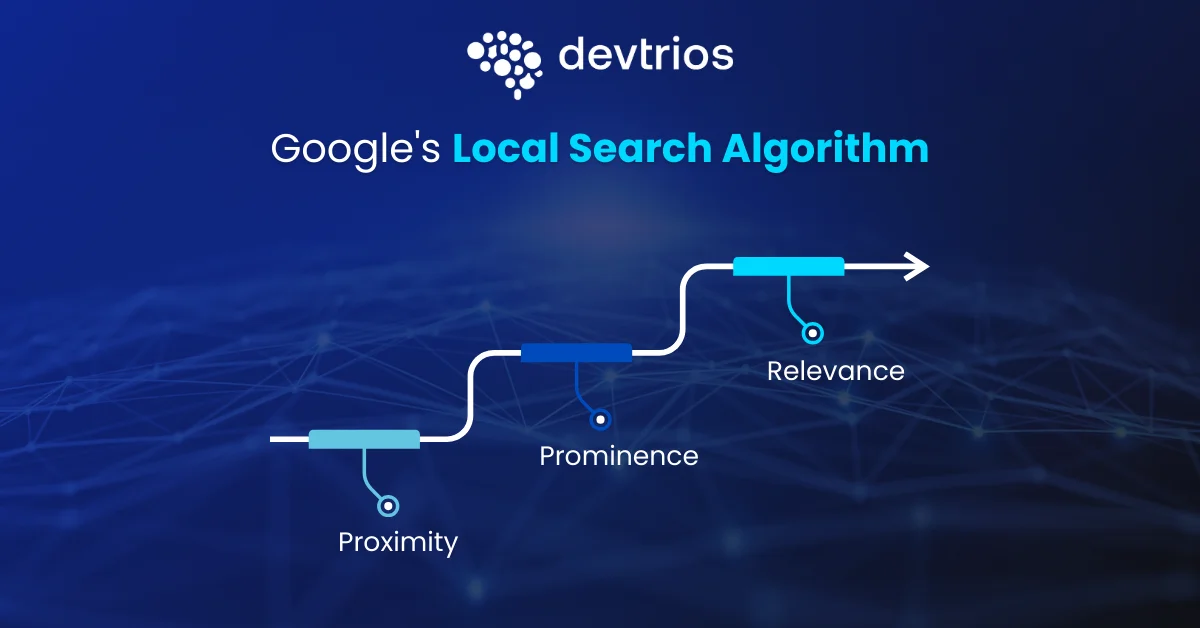
Google’s local search algorithm leverages natural language processing to detect local intent in Google Maps queries. It integrates data from Google Business Profile, website signals, and external citations to form entity knowledge graphs. Semantic search links related terms like “car repair” to “auto service,” boosting contextual matches.
Large language models analyze behavioral patterns and review sentiment for dynamic adjustments. This holistic approach prioritizes Google Business Profile completeness alongside real-world validation.
Why this matters:Grasping algorithm interactions guides sustainable optimizations over fleeting tactics.
Proximity: Establishing Reach
Proximity filters Local Pack candidates by searcher location, favoring nearby options without direct control. Service-area businesses expand via Google Business Profile radius settings, visible only to locals. Google Maps uses device signals for precision.
Strong relevance or prominence can override minor distance gaps in specialized searches.
Why this matters: Proximity gates initial visibility; neglecting it cedes ground to closer rivals.
Relevance: Aligning with Intent
Relevance stems from precise Google Business Profile categories—select one primary matching core services to avoid dilution. Dedicated website pages for “[Service] in [City]” embed LocalBusiness schema, clarifying entities for AI parsing. Semantic phrases like “emergency plumbing Lahore” enhance matches without repetition.
Avoid secondary category overload, as it confuses local intent signals.
Why this matters: Relevance ensures consideration; mismatches sideline even prominent businesses.
Prominence: Proving Authority
Prominence builds via reviews, local citations, and backlinks, with Google Business Profile responses signaling engagement. Review content mentioning services carries weight over ratings alone, as AI extracts sentiment. Local links from chambers or news sites reinforce geo-relevance.
Consistent NAP across directories solidifies entity identity.
Why this matters: Prominence distinguishes leaders in saturated Local Pack competitions.
On-Page Local SEO Optimization
On-page elements target organic local rankings with NAP in footers, schema for services and hours, and city-specific content. Service pages with unique insights outperform thin location lists, linking internally to Google Business Profile. Optimize titles as “[Service] in [City]” for Maps integration.
Monitor impressions in Google Search Console.
Why this matters: On-page bridges Local Pack and organic, capturing diverse local queries.
Google Business Profile Mastery
Google Business Profile anchors rankings with accurate categories, 20+ geotagged photos showing interiors, and weekly posts highlighting offers. Attributes like “family-owned” aid semantic filtering; Q&A preempts local intent questions. Verify multi-locations to manage proximity.
Primary category drives initial relevance choose strategically.
Why this matters: Incomplete profiles undermine all efforts, as Google Business Profile dominates Local Pack signals.
Reviews and Reputation Signals
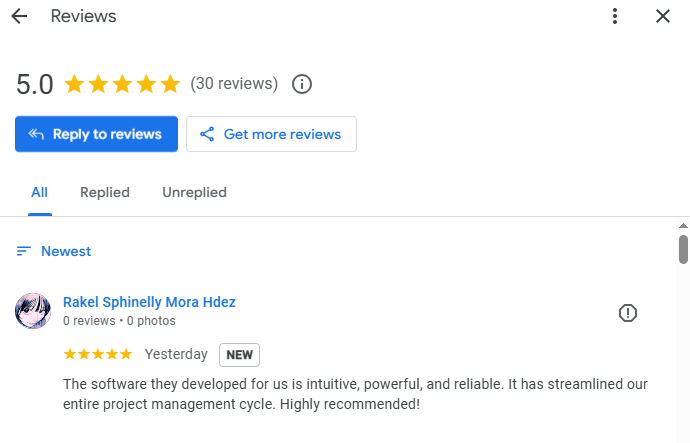
Reviews fuel prominence through volume, recency, and service-specific language, analyzed by AI for authenticity. Request via timed SMS post-service; respond to all, embedding keywords naturally. Unaddressed negatives erode trust faster than positives build it.
Cross-platform monitoring maintains consistency.
Why this matters:Reviews validate real experiences, swaying clicks and algorithmic favor.
Citations, Backlinks, and Behavioral Signals
Citations from Yelp and local directories lock NAP consistency, aiding entity resolution. Backlinks from co-cited local sites amplify prominence; behavioral metrics like directions requests confirm intent. Social shares add subtle brand signals.
Why this matters:These form an authority web, personalizing results via engagement.
AI and Semantic Search Factors
AI Overviews extract from structured sections, favoring E-E-A-T via observed audit patterns across industries. Optimize for voice with phrases like “find nearby dentist open now.” Entity repetition Google Business Profile, Local Pack, Google Maps strengthens topical authority.
Why this matters: AI elevates extractable, trustworthy content in evolving searches.
Local SEO Ranking Factors: Practical Optimization Framework
Apply factors systematically for measurable gains.
Website (On-Page)
- Audit NAP schema consistency; create 1-2 service-city pages per location.
- Embed Google Maps widgets linking to verified Google Business Profile.
Google Business Profile
- Upload fresh photos weekly; post events matching local intent.
- Primary category audit—swap if mismatched to top queries.
Reviews
- Automate requests 48 hours post-service; respond within 24 hours.
- Analyze sentiment for service gaps using free tools.
Authority (Links + Citations)
- Submit to 50+ core directories; fix inconsistencies via audits.
- Secure 5-10 local sponsorship links annually.
Engagement (Behavioral)
- Add prominent “Get Directions” CTAs; track calls in Google Business Profile.
- A/B test landing page speed for dwell time.
AI Readiness
- Format FAQs for snippets; add author expertise bios.
- Test conversational queries in AI tools for gaps.
This framework, drawn from real local SEO audits, scales across retail, services, and hospitality.
Ready to Rank Every Location in Local Search?
If you're managing multiple business locations, your growth depends on how well each branch ranks locally. Our multi-location SEO specialists help you eliminate keyword cannibalization, optimize Google Business Profiles, build consistent citations, and scale rankings across every city aligned with 2026 search algorithms and AI-driven search behavior.
Frequently asked questions
Proximity, relevance, and prominence lead, powered by Google Business Profile optimization, reviews, and citations.
It weighs pillars with AI parsing local intent from Google Maps, entities, and behaviors for relevant Local Pack results.
Reviews boost prominence via content and responses, signaling trust beyond ratings.
Citations ensure NAP consistency, vital for entity accuracy in Google Business Profile rankings.
AI enhances semantic relevance and personalization, rewarding structured content for overviews and voice searches.
Facebook LinkedIn Threads Pinterest

Written by
Ali Hamza
Marketing strategist
Ali Hamza is an SEO specialist and digital marketer with 7+ years of experience in SEO, content strategy, WordPress, and online growth marketing. He shares practical insights and industry-based strategies focused on improving search visibility, user experience, and long-term organic growth.