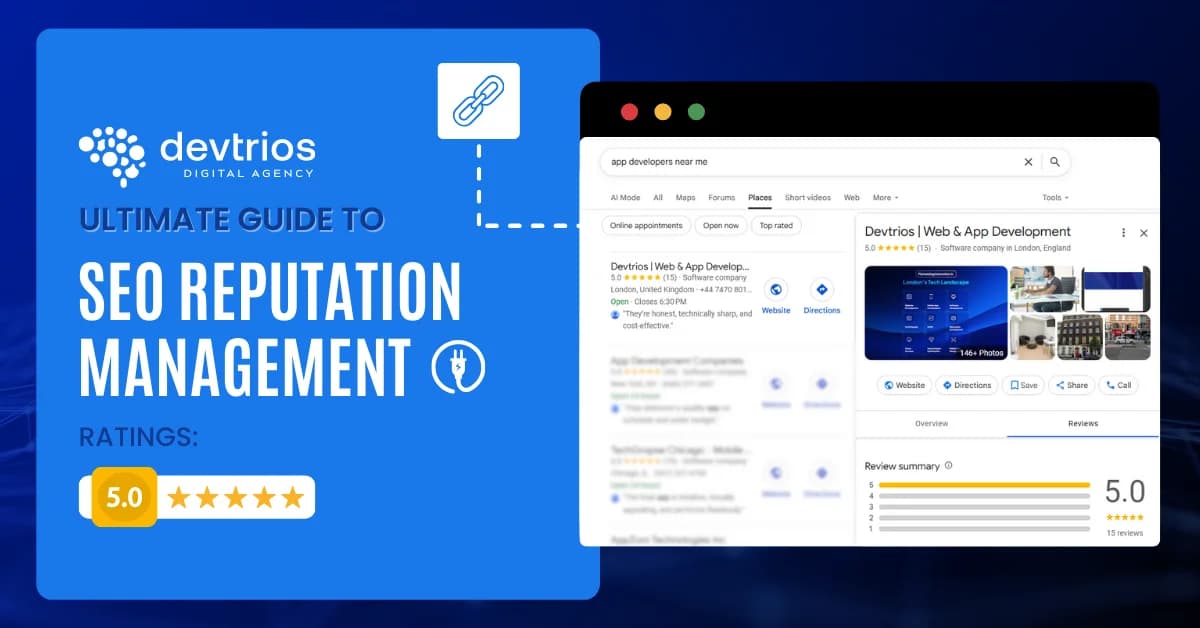
What happens when someone Googles your business name? That single moment determines whether they call you, click to a competitor, or walk away forever. BrightLocal’s 2026 Local Consumer Review Survey found that 94% of consumers avoid businesses with poor reviews and most form that opinion before they ever visit your website.
Your page-one search results are your digital storefront window. If that window is smudged with negative press, outdated directories, or damaging reviews, revenue walks out the door. This is where SEO reputation management, the strategic fusion of search engine optimization and online reputation management (ORM) becomes one of your most critical business tools.
In 2026, it goes further than Google. AI-powered platforms like ChatGPT, Google AI Overviews, Perplexity, and Gemini now shape how people discover and evaluate brands before they even click a link. This guide covers everything: from traditional SERP control to AI Overviews, Answer Engine Optimization (AEO), Generative Engine Optimization (GEO), semantic entities, schema markup, crisis management, and the tools that tie it all together.
1. What Is SEO Reputation Management?
SEO reputation management is the process of using search engine optimization tactics to influence and control how your brand is perceived in search results. The goal is to ensure that when someone types your business name or brand-related queries into Google, the first page is dominated by positive, accurate, and brand-controlled information.
This discipline sits at the intersection of three fields: Traditional SEO (optimizing web pages to rank in SERPs), Online Reputation Management or ORM (monitoring and shaping how your brand is perceived across all digital touchpoints), and Content Marketing (creating authoritative content that builds trust, fills knowledge gaps, and drives organic traffic).
Key Distinction: While ORM is broad covering social media, PR, forums, and review sites SEO reputation management zeroes in on what search engines surface. 91% of users never scroll past page one of Google.
Modern SEO reputation management also encompasses what happens on AI platforms. When a user asks ChatGPT or Gemini ‘Is [Your Brand] trustworthy?’, the answer those systems generate is shaped by your brand’s digital footprint: your content, mentions, reviews, and entity authority across the web.
2. How Search Engines Evaluate Your Online Reputation
Google’s ranking algorithms use hundreds of signals to determine which results to show many of them directly reflect brand reputation. Understanding these signals helps you build a strategy that works at the algorithm level, not just the surface level.
Core Reputation Signals Google Evaluates
- Reviews: Volume, recency, sentiment, and diversity of sources (Google, Trustpilot, G2, Yelp) all factor into local ranking and brand trust scoring.
- Brand Mentions (Linked and Unlinked): Google’s NLP systems use Named Entity Recognition (NER) to understand when your brand is mentioned across the web even without a hyperlink. These unlinked co-citations are powerful entity signals.
- E-E-A-T (Experience, Expertise, Authoritativeness, Trustworthiness): Google’s quality rater guidelines emphasize E-E-A-T, especially for YMYL topics. Author credentials, sourced claims, About pages, and editorial standards all contribute.
- Behavioral Signals: Click-through rate (CTR), dwell time, and pogo-sticking tell Google whether users find your content satisfying.
- Schema Markup and Structured Data: Organization, Review, FAQPage, and Article schema signal to Google how to interpret your content increasing eligibility for rich results, Knowledge Panels, and AI Overviews.
- Content Freshness: Google’s Query Deserves Freshness (QDF) algorithm rewards recently updated, relevant content. Stale pages signal a neglected brand.
- NAP Consistency: Consistent Name, Address, and Phone number across directories builds local trust and citation authority.
The Knowledge Graph and Entity Recognition
Google organizes the web into entities, people, places, brands, and concepts and maps relationships between them in a structure called the Knowledge Graph. If your brand is recognized as an entity in the Knowledge Graph, you may appear in Knowledge Panels and have stronger AI reputation signals. To build entity recognition: ensure your brand name is consistent everywhere, publish structured data using Organization schema, and earn mentions in credible publications that Google already trusts.
Protect & Improve Your Online Reputation
What appears on page one of Google directly impacts customer trust and revenue. Our SEO reputation management specialists help suppress negative search results, strengthen brand authority, and ensure your business is represented accurately across search engines using ethical, long-term SEO strategies.
3. SEO Reputation Management in the Age of AI: AEO, GEO & SGE
Traditional SEO was about ranking in the blue links. In 2026, that is no longer enough. The search landscape has been fundamentally restructured by Google’s AI Overviews, Answer Engine Optimization (AEO), and Generative Engine Optimization (GEO).
Key Statistic: Ahrefs analyzed 300,000 keywords and found that when an AI Overview appeared in the SERP, the top-ranking page saw an average 34.5% lower CTR than comparable queries without an AI Overview. Your brand must appear inside these summaries, not just below them.
Google AI Overviews — What You Must Know
Google’s AI Overviews generate synthesized answers at the top of the SERP, pulling from multiple sources. For reputation management, this creates both a risk and an opportunity. The risk: if negative reviews or damaging articles are cited by AI Overviews, they gain enormous visibility even if they rank on page 2. The opportunity: if your owned content, structured FAQs, and authoritative pages are cited, your brand benefits from prominent positioning at zero-click positions.
To appear in AI Overviews:use FAQ schema, write concise 40–60 word answers to common questions, include statistics, cite credible sources, and maintain strong traditional SEO rankings (76% of AI Overview citations pull from top-10 pages, per Ahrefs).
Answer Engine Optimization (AEO)
AEO is the practice of structuring content so AI-powered answer engines Google AI Overviews, Siri, Alexa, and voice search can extract and surface your content as the direct answer. Key AEO principles for reputation management:
- Write in conversational, question-first format using natural language that mirrors how users ask questions
- Use FAQPage schema markup to make your Q&A machine-readable
- Structure each content section to answer one specific question this improves ‘chunking’ where AI models extract meaning from self-contained blocks
- Target featured snippets and People Also Ask boxes with 40–60 word direct answers
- Include the current year in title tags and meta descriptions LLMs favor recent content
Generative Engine Optimization (GEO)
GEO is the broader strategy of making your brand visible inside AI-generated answers across platforms like ChatGPT, Perplexity, and Gemini. Where SEO is about ranking, GEO is about being cited. GEO tactics for reputation management:
- Publish first-party research, original data, and case studies AI systems prioritize citable, unique facts
- Earn brand mentions (linked and unlinked) across authoritative publications AI models weigh brand recognition, not just backlinks
- Build entity authority: ensure your brand, key personnel, and services are clearly defined with consistent terminology
- Use server-side rendering many AI crawlers still struggle with heavy JavaScript
- Maintain a cross-platform presence: website, GBP, LinkedIn, Trustpilot AI systems source answers from wherever you exist
Research by Amsive shows that LLM traffic converts at 3.76% vs 1.19% for traditional organic search a 216% improvement. GEO is not just a reputation play; it drives revenue.
4. Semantic SEO, NLP & Entity Optimization for Reputation
Modern search engines do not just match keywords they understand meaning. Google’s NLP systems, including BERT and MUM, read content the way a human expert would, evaluating context, semantics, and topical depth.
Key Entities to Target in Reputation Content
Google’s Knowledge Graph recognizes specific entities related to reputation management. Including these in your content signals topical relevance to both search algorithms and AI models: Brand SERP, Knowledge Panel, Google Business Profile (GBP), E-E-A-T, Review Schema and Aggregate Rating, NAP Consistency, SERP Suppression and Reverse SEO, Parasite SEO, and Topical Authority.
User Intent and the Reputation Search Journey
Understanding user intent is critical because different searchers have different needs and the content that satisfies them is different. Navigational queries like ‘[Brand Name] official site’ require an optimized homepage and claimed GBP. Informational queries like ‘[Brand] reviews’ or ‘is [Brand] legit?’ are served by FAQ pages and case studies. Investigative queries like ‘[Brand] complaints’ need suppression content and positive press. Transactional queries like ‘best [service] near me’ are answered by local SEO and GBP optimization. AI and voice queries like ‘Is [Brand] a good company?’ require AEO-formatted FAQs and Organization schema.
5. The 8-Step SEO Reputation Management Strategy
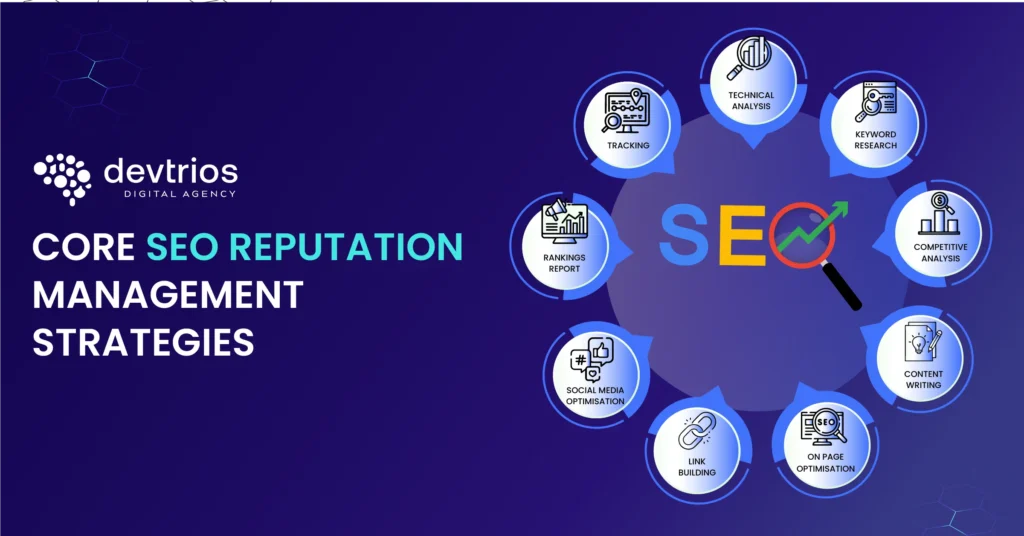
Step 1: Brand SERP Audit and Reputation Baseline
Search your brand name, brand + reviews, brand + complaints, brand + service, and brand + city in an incognito browser. Audit the top 20 results, categorizing each as positive, negative, neutral, or unknown. Identify which results you own versus what others control. Test your brand on ChatGPT, Perplexity, and Google AI Overviews to understand what AI models say about you.
Step 2: Sentiment Analysis and Entity Gap Assessment
Evaluate the tone and accuracy of all discovered content using Brand24, Mention, or Google Alerts. Assess which entities (brand name, key products, founders) are associated positively or negatively. If your brand does not have a Knowledge Panel, create a Wikidata entry, publish consistent structured data, and earn authoritative backlinks to trigger one.
Step 3: Keyword and Topical Content Planning
Map out a content cluster covering every query a potential customer might search related to your brand: branded keywords like ‘[Brand] reviews’ and ‘[Brand] pricing’, informational keywords explaining how your service works, suppression keywords targeting the exact queries bringing up negative results, and People Also Ask questions about your brand.
Step 4: Own Your Brand SERP
The goal is to control as many of the top 10 results for your brand name as possible. Optimize and rank these platforms: your official website, LinkedIn company page, Google Business Profile, Facebook page, Twitter/X profile, YouTube channel, industry directories (Clutch, G2, Crunchbase), Wikipedia or Wikidata if eligible, guest posts on high-authority publications, and press releases via PR Newswire or BusinessWire.
Step 5: Review Generation and Response Strategy
Reviews are one of the most powerful reputation signals for both traditional SEO and AI reputation evaluation. BrightLocal’s 2026 survey found that 47% of consumers consider a review outdated unless written within the past week or month. Implement a post-purchase review request system via email and SMS. Respond to every review positive and negative within 24–48 hours. Never offer incentives for positive reviews. Use natural review keywords in responses, which can influence local ranking.
90% of consumers read reviews before visiting a business, and Google rewards businesses that actively manage reviews with improved local visibility.
Step 6: Content Authority Layering and Parasite SEO
Content authority layering means publishing expert content on multiple platforms, creating an interconnected web of positive, authoritative pages that outrank negative results. Tier 1 owned content includes long-form blog posts, case studies, YouTube videos, and AEO-formatted FAQs. Tier 2 earned content includes guest posts on industry publications (DA 50+), press releases, and podcast appearances. Tier 3 parasite SEO involves publishing on high-authority platforms like Medium, LinkedIn Articles, and Quora to leverage their domain authority a well-crafted LinkedIn article about your brand can rank on page one, giving you another SERP slot you control.
Step 7: Schema Markup and Technical Optimization
Schema markup is the technical bridge between your content and how search engines interpret it. For reputation management, implement these schema types: Organization Schema (defines your brand as a Knowledge Graph entity), LocalBusiness Schema (for local reputation and map pack visibility), AggregateRating Schema (enables star ratings in SERPs), FAQPage Schema (AI Overview and featured snippet eligibility), Article Schema (author credentials and E-E-A-T signals), and BreadcrumbList Schema (sitelink appearance in branded SERPs).
Pro Tip:Validate all schema using Google’s Rich Results Test tool. Errors in structured data can prevent your pages from appearing in rich results and AI Overviews.
Step 8: Ongoing Monitoring and Adaptation
Set up a monitoring infrastructure that alerts you to new threats and measures progress: Google Alerts for brand name mentions, Google Search Console for branded keyword tracking, Brand24 or Mention for real-time social and news monitoring, BrightLocal for local review performance, Semrush or Ahrefs for competitor and SERP movements, and manual monthly AI testing across ChatGPT, Perplexity, and Gemini.
Need Professional SEO Reputation Management?
Devtrios SEO services are designed to enhance your online reputation and increase visibility through ethical, data-driven strategies that build trust and drive long-term success.
6. Google Business Profile: Your Most Important Local Reputation Asset
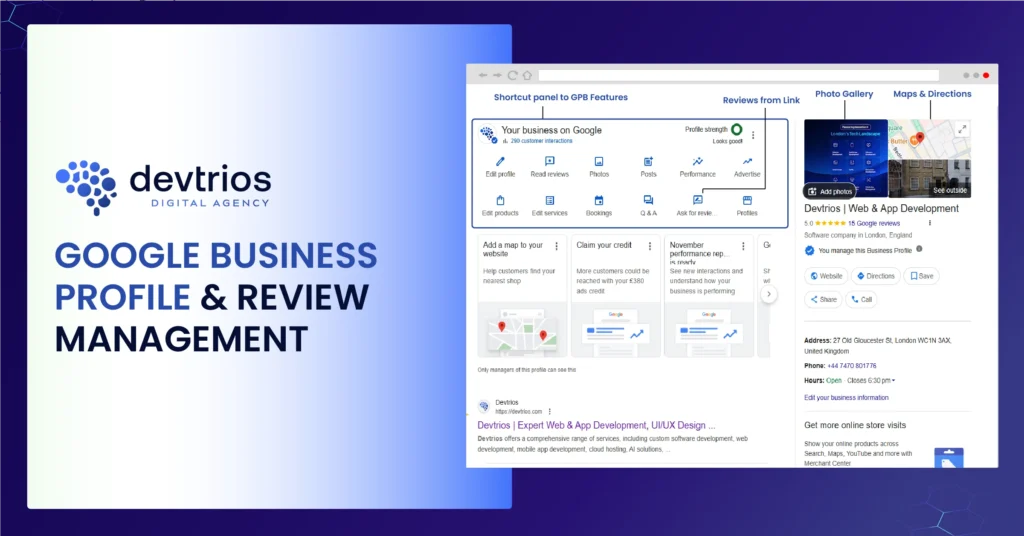
For local and service-based businesses, your Google Business Profile (GBP) directly controls what appears in the local map pack, Google Maps, and the branded Knowledge Panel. Complete every field business name, category, address, phone, website, description, attributes, and opening hours. Upload high-quality photos regularly profiles with photos receive 42% more direction requests and 35% more website clicks. Use the Q&A section proactively. Publish Google Posts weekly to maintain freshness signals. Respond to all reviews within 24–48 hours Google has confirmed that responding to reviews improves local visibility. Aim for a rating above 4.0 and a review velocity of at least 2–4 new reviews per month.
7. Backlink Authority and SERP Suppression Tactics
Backlinks remain the single most powerful ranking signal in Google’s algorithm. In reputation management, they serve a specific purpose: boosting the authority of your positive, owned pages so they outrank negative results.
The Mathematics of SERP Suppression
If your brand has one negative result on page one, you need to optimize at least nine other results to push it off. To push it to page three, you may need to optimize up to 20 positive results. This is why early, proactive reputation management is far more efficient than crisis response.
Backlink Strategies for Reputation SEO
- Digital PR and Earned Media: Pitch stories to journalists and publications in your industry. A single backlink from a DA 80+ news outlet is worth more than 100 links from directories.
- HARO (Help a Reporter Out): Respond to journalist queries as an expert source to earn editorial backlinks from high-authority publications.
- Social Profile Backlinks: Ensure all social profiles link back to your website these profiles themselves can rank on page one for your brand name.
- Internal Linking: Your most important brand pages (About Us, Case Studies, Reviews) should receive strong internal links from high-traffic blog posts and service pages.
8. Crisis Reputation Management and Rapid Response
The First 48 Hours
- Do not ignore or delete negative social media comments this amplifies the crisis
- Issue an honest, empathetic acknowledgment within 24 hours silence is interpreted as guilt
- Contact the platform or publication to correct factual inaccuracies provide documentation
- Begin publishing new, positive content immediately to dilute the negative signal’s freshness advantage
Medium-Term Suppression Campaign
- Launch a targeted content campaign creating in-depth, authoritative pages targeting the exact queries driving traffic to the negative result
- Accelerate your review generation strategy to create a wave of fresh positive sentiment
- Build backlinks aggressively to your positive pages authority is the fastest path to suppression
What SEO Cannot Do
SEO cannot directly remove a page from Google’s index. Only the publisher or a valid legal order (under GDPR’s Right to Be Forgotten in the EU) can achieve that. What SEO does is suppress: it pushes negative content so far down the SERP that the vast majority of users never encounter it. This is known as Reverse SEO.
7. Backlink Authority and SERP Suppression Tactics
Backlinks remain the single most powerful ranking signal in Google’s algorithm. In reputation management, they serve a specific purpose: boosting the authority of your positive, owned pages so they outrank negative results.
The Mathematics of SERP Suppression
If your brand has one negative result on page one, you need to optimize at least nine other results to push it off. To push it to page three, you may need to optimize up to 20 positive results. This is why early, proactive reputation management is far more efficient than crisis response.
Backlink Strategies for Reputation SEO
- Digital PR and Earned Media: Pitch stories to journalists and publications in your industry. A single backlink from a DA 80+ news outlet is worth more than 100 links from directories.
- HARO (Help a Reporter Out): Respond to journalist queries as an expert source to earn editorial backlinks from high-authority publications.
- Social Profile Backlinks: Ensure all social profiles link back to your website these profiles themselves can rank on page one for your brand name.
- Internal Linking: Your most important brand pages (About Us, Case Studies, Reviews) should receive strong internal links from high-traffic blog posts and service pages.
8. Crisis Reputation Management and Rapid Response
The First 48 Hours
- Do not ignore or delete negative social media comments this amplifies the crisis
- Issue an honest, empathetic acknowledgment within 24 hours silence is interpreted as guilt
- Contact the platform or publication to correct factual inaccuracies provide documentation
- Begin publishing new, positive content immediately to dilute the negative signal’s freshness advantage
Medium-Term Suppression Campaign
- Launch a targeted content campaign creating in-depth, authoritative pages targeting the exact queries driving traffic to the negative result
- Accelerate your review generation strategy to create a wave of fresh positive sentiment
- Build backlinks aggressively to your positive pages authority is the fastest path to suppression
What SEO Cannot Do
SEO cannot directly remove a page from Google’s index. Only the publisher or a valid legal order (under GDPR’s Right to Be Forgotten in the EU) can achieve that. What SEO does is suppress: it pushes negative content so far down the SERP that the vast majority of users never encounter it. This is known as Reverse SEO.
9. Common Reputation Problems and Their SEO Solutions
- Negative review ranking on page 1: Create better content, earn authoritative backlinks to owned pages, and build a review generation campaign to dilute the negative signal.
- Outdated negative press article: Publish fresh, better-optimized content targeting the same queries, and request an update or correction from the publisher.
- No branded results on page 1: Build social profiles, claim GBP, submit to authoritative directories, and create foundational blog content.
- Competitor ranking for your brand name: File a trademark complaint, strengthen your own pages, and use PPC to secure branded search terms.
- Negative AI Overview about your brand: Create AEO-optimized FAQs, earn positive AI citations through digital PR, and suppress the negative source with better content.
- Low star rating on GBP: Launch a review generation campaign, respond to all reviews, and resolve the root customer complaints driving negative feedback.
- Fake negative reviews: Report to the platform with evidence, flag for policy violation, and respond publicly with context to minimize the impact.
10. Tools for SEO Reputation Management
Monitoring
- Google Alerts (free) — basic brand mention monitoring across news and web
- Brand24 — real-time monitoring across social, forums, news, and review sites with sentiment scoring
- Mention — real-time brand monitoring with agency-focused reporting
Review Management
- BrightLocal — review tracking, citation auditing, and local rank tracking
- Podium — review collection via SMS; ideal for local service businesses
- Yext — manage listings and reviews across hundreds of directories from one dashboard
SERP and Competitor Analysis
- Semrush — keyword tracking, SERP analysis, competitor backlink monitoring
- Ahrefs — deep backlink analysis and SERP position tracking
- Google Search Console — free branded keyword performance data
Schema and Technical SEO
- Google Rich Results Test — validate all structured data before deployment
- Schema.org markup generator — create Organization, LocalBusiness, FAQPage schema
AI Reputation Monitoring
- Monthly manual queries of ChatGPT, Perplexity, Gemini, and Bing Copilot with your brand name
- Profound.co — tracks AI citation frequency and brand mentions in LLMs
- Semrush AI SEO Toolkit — measures AI Overviews visibility and snippet win rates
11. Realistic Timelines
- 0–30 Days: Audit complete, quick wins claimed, schema deployed, GBP optimized
- 30–60 Days: New content indexed, early ranking movements, review campaigns running
- 3–6 Months: Positive assets climbing in rankings, negative results moving to page 2
- 6–12 Months: Brand SERP largely controlled, AI citation presence building, stable positive reputation
- Ongoing: Reputation maintained and defended against new threats
Reputation management is a marathon. Initial improvements appear within 30–60 days, but complete Brand SERP ownership typically takes 6–12 months of consistent effort.
12. SEO Reputation Management Implementation Checklist
Foundation — Do First
- Conduct full Brand SERP audit for top 20 results on all brand queries
- Set up Google Alerts for brand name, key products, and main competitors
- Claim and fully optimize Google Business Profile
- Claim all major social media profiles even inactive ones
- Implement Organization and LocalBusiness schema on website
- Audit NAP consistency across all online directories and fix inconsistencies
Content and SEO
- Publish a comprehensive About Us page with E-E-A-T signals and founder credentials
- Create a Reviews or Testimonials page with AggregateRating schema
- Build an FAQ page targeting People Also Ask questions about your brand
- Create a topical content cluster covering all reputation-related queries
Reviews and Off-Page
- Launch review generation campaign via email or SMS follow-up
- Respond to 100% of existing reviews within the next 30 days
- Identify and pursue 10+ digital PR opportunities for earned media coverage
- Build profiles on Clutch, G2, Trustpilot, or industry-relevant review platforms
AI and Future-Proofing
- Add FAQPage schema to all Q&A content for AI Overview eligibility
- Rewrite key sections to be answer-first and 40–60 words for AEO compliance
- Test your brand on ChatGPT, Perplexity, and Gemini document what AI says
- Publish original data, research, or case studies for GEO citation potential
Conclusion: Your Brand's Reputation Is Your Most Valuable Asset
In 2026, your Google search results, your AI citations, and your review profile are collectively your brand’s most powerful marketing asset or its biggest liability. Customers form opinions about your business in seconds based on what they see when they search your name.
A proactive SEO reputation management strategy combines traditional SERP control with modern AI optimization: building entity authority in the Knowledge Graph, appearing in AI Overviews and answer engines, maintaining a steady stream of genuine positive reviews, and suppressing negative content before it ever threatens your page-one presence.
The businesses that win the next decade understand the search landscape has expanded beyond blue links and that reputation is now built at the intersection of SEO, AEO, GEO, semantic content, and authentic customer relationships.
Start with your Brand SERP audit today. Your future customers are searching right now.
Need Professional SEO Support?
Our SEO specialists help businesses improve rankings, manage online reputation, and build long-term organic visibility using ethical, data-driven strategies.
Frequently asked questions
SEO reputation management is the practice of using search engine optimization strategies to influence the search results for a brand's name. The goal is to ensure that positive, brand-controlled web pages dominate the first page of Google, thereby building trust and credibility.
ORM (Online Reputation Management) is the broad practice of managing brand perception across all digital channels, social media, review sites, forums, PR, and search. SEO reputation management is a subset of ORM that specifically focuses on search engine results pages (SERPs) and, increasingly, AI-generated answers.
SEO cannot directly remove a page from Google's index. Only the page's publisher or a valid legal order can achieve removal. What SEO does is suppress: by building more authoritative, positive pages that outrank the negative content, SEO pushes unwanted results from page one to page two or beyond where fewer than 1% of users ever look.
AI search platforms like Google AI Overviews, ChatGPT, and Perplexity now shape brand perception before users click a link. If negative content is cited in AI-generated answers, it gains massive visibility. Brands must optimize for AI citation (GEO) and direct answers (AEO) in addition to traditional SERP rankings.
Initial improvements can appear within 30–60 days as new content gets indexed. Significant SERP control for a brand with active reputation issues typically takes 3–6 months. Complete brand SERP ownership and stable AI reputation presence may take 6–12 months of consistent effort.
Brand SERP ownership is the goal of controlling as many of the top 10 search results for your exact brand name as possible. By optimizing your website, social profiles, directory listings, and third-party content, you can realistically control 8–10 of the top results leaving no room for negative content on page one.
The most critical schema types are: Organization (defines your brand as a Knowledge Graph entity), LocalBusiness (for local reputation and map pack visibility), AggregateRating/Review (enables star ratings in SERPs), and FAQPage (makes Q&A content eligible for featured snippets and AI Overviews).
Absolutely. BrightLocal data shows that 76% of consumers read online reviews for local businesses before making a decision. For small businesses, a strong first-page reputation is often the deciding factor between a customer choosing you or a competitor. More positive reviews and better search results mean more revenue directly.

Written by
Ali Hamza
Marketing strategist
Ali Hamza is an SEO specialist and digital marketer with 7+ years of experience in SEO, content strategy, WordPress, and online growth marketing. He shares practical insights and industry-based strategies focused on improving search visibility, user experience, and long-term organic growth.