
Choosing the right JavaScriptframework is one of the most critical decisions a development team can make. In 2026, this choice directly impacts everything from application performance and scalability to developer productivity and hiring. The landscape of front-end development is constantly shifting, with new tools and paradigms emerging that promise to build faster, more efficient web experiences. Amidst this evolution, the Svelte vs React 2026 debate has become central for developers planning their next project.
React, the established titan backed by Meta, has dominated the field for years with its vast ecosystem and component-based architecture. On the other side is Svelte, a newer, innovative framework that challenges the status quo by shifting work from the browser to the compiler. This fundamental difference sets the stage for a compelling comparison of performance, bundle size, and developer experience. As front-end development trends 2026 push for even greater efficiency and leaner applications, understanding the unique strengths of both frameworks is essential. This guide will provide a deep dive into Svelte and React, helping you determine the best JS framework for your goals in 2026 and beyond.
What is React? The Pillar of Modern Web Development

React, often referred to as ReactJS, is an open-source JavaScript library developed and maintained by Meta (formerly Facebook). Since its release, it has become a cornerstone of front-end development, powering the user interfaces of countless web applications, from massive platforms like Netflix and Spotify to emerging startups. Its longevity and widespread adoption make it a top contender for the best JS framework in 2026.
At its core, React simplifies the process of building complex, interactive UIs by breaking them down into small, reusable pieces called components. This component-based architecture is a key reason for its popularity. It allows developers to manage and scale large applications more effectively. Instead of updating the entire webpage when data changes, React uses a Virtual DOM to efficiently update only the specific components that need to change, leading to faster rendering and a smoother user experience.
Core Features and Benefits of React in 2026
React’s continued dominance is no accident. Its robust feature set has evolved to meet modern development needs, keeping it highly relevant.
- Component-Based Architecture: This modular approach lets you build encapsulated components that manage their own state. This makes code more reusable, easier to debug, and simpler to maintain, especially in large, collaborative projects.
- JSX (JavaScript XML): JSX is a syntax extension that allows you to write HTML-like code directly within your JavaScript. While it may seem unusual at first, it provides a powerful way to describe what your UI should look like, combining logic and markup in a single, cohesive file.
- The Virtual DOM: React creates a in-memory copy of the actual browser DOM. When a component’s state changes, React updates the virtual DOM first, calculates the most efficient way to apply these changes, and then updates the real DOM. This process, known as reconciliation, minimizes performance bottlenecks.
- Unidirectional Data Flow: Data in React applications typically flows in one direction (from parent to child components). This makes application state more predictable and easier to trace, which is crucial for debugging complex applications.
The Power of React Hooks
Introduced in React 16.8, React Hooks revolutionized how developers write components. Before Hooks, managing state and side effects in functional components was not possible, forcing the use of more verbose class components. Hooks allow you to use state and other React features without writing a class.
The most common Hooks are:
- useState: Lets you add state to functional components.
- useEffect: Lets you perform side effects in your components, such as fetching data or subscribing to an API.
- useContext: Allows you to work with React’s Context API to avoid “prop drilling” (passing props down through many levels of components).
React Code Example: State Management with Hooks
Here is a simple example of a counter component that uses the useState Hook to manage its state. This demonstrates the conciseness and declarative nature of modern React development.
import React, { useState } from 'react';
function Counter() {
 // Declare a new state variable, which we'll call "count"
 const [count, setCount] = useState(0);
 return (
<p>You clicked {count} times</p>);
}
export default Counter;
In this snippet, useState(0) initializes our state count to 0. The setCount function is used to update this state. When the button is clicked, setCount is called, React re-renders the Counter component, and the updated count value is displayed.
A Rich and Mature Ecosystem
One of React’s most significant advantages is its massive and mature ecosystem. Whatever problem you face, there is likely a tool, library, or tutorial to help you solve it.
- State Management: For complex applications, managing state across many components can become challenging. Libraries like Redux and Zustand provide powerful and predictable state management solutions that integrate seamlessly with React.
- Frameworks: Next.js has become the go-to production framework for React. It offers features like server-side rendering (SSR), static site generation (SSG), and file-based routing out of the box, significantly improving performance and SEO.
- Mobile Development: With React Native, you can leverage your React skills to build native mobile applications for iOS and Android. This “learn once, write anywhere” approach is a huge benefit for teams looking to develop across web and mobile platforms.
By 2026, the React ecosystem is more robust than ever, offering battle-tested solutions for routing, styling, animation, and data fetching. This extensive support network reduces development time and ensures you are building on a reliable foundation.
What is Svelte? The Compiler-First Challenger

Svelte enters the discussion not just as another JavaScript framework, but as a fundamental reimagining of how to build user interfaces. Unlike traditional frameworks like React that do most of their work in the user’s browser (at runtime), Svelte is a compile-time framework. This means it converts your components into highly efficient, imperative JavaScript code at build time. The result is a paradigm shift that often leads to faster applications and smaller bundle sizes, positioning Svelte as a strong contender for the best JS framework 2026.
This compiler-first approach means your application ships without the overhead of a framework’s runtime library. Instead of a Virtual DOM, Svelte surgically updates the real DOM when your application’s state changes. This surgical precision is possible because Svelte knows exactly what could change in your app at compile time, eliminating the need for complex diffing algorithms in the browser.
Core Features and Benefits of Svelte in 2026
Svelte’s unique philosophy gives rise to a compelling set of features that directly address common developer pain points.
- No Virtual DOM: By eschewing the Virtual DOM, Svelte generates code that updates the browser’s DOM directly. This approach reduces memory overhead and can lead to faster initial renders and updates, especially in complex applications.
- Truly Reactive: Reactivity is built into the language itself. There’s no need for special functions or hooks to trigger updates. When you assign a new value to a variable, Svelte automatically generates the necessary JavaScript to update the DOM.
- Smaller Bundle Sizes: Since the framework itself doesn’t need to be shipped to the browser, Svelte applications start incredibly lean. The final bundle only contains the minimal code required to run your app, which is a massive advantage for performance, particularly on low-powered devices or slow networks.
- Less Boilerplate Code: Svelte’s syntax is designed for brevity and clarity. You can often achieve the same functionality as in React with significantly less code, which improves readability and makes development faster.
The Magic of Reactive Declarations
One of Svelte’s most powerful concepts is the reactive declaration, denoted by $:. This syntax tells Svelte to re-run a piece of code whenever the values it depends on change. It’s an elegant way to handle computed properties and reactions to state changes without extra boilerplate.
For example, if you have a count variable, you can easily create a doubled variable that automatically updates whenever count changes:
$: doubled = count * 2;
This simplicity is central to the Svelte developer experience.
Svelte Code Example: Simple Reactivity
Here’s a Svelte component for a counter, which achieves the same goal as the earlier React example. Notice the minimal code required no imports, no special hook functions, just standard JavaScript assignments.
<p>You clicked {count} times</p> In this code, Svelte’s compiler understands that when the count variable changes, the paragraph tag <p> must be updated. The on:click directive is Svelte’s concise way of handling DOM events. The code is clean, readable, and very close to plain HTML and JavaScript.
The Svelte Ecosystem: SvelteKit and Stores
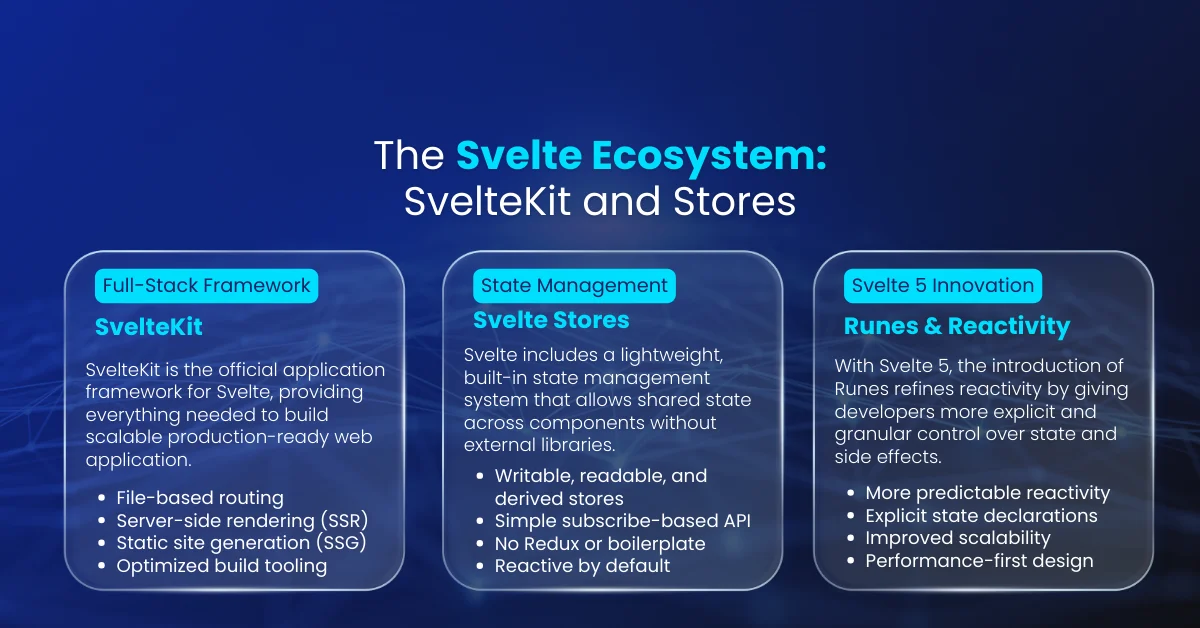
While Svelte itself is a component framework, its ecosystem has matured significantly, largely thanks to SvelteKit.
- SvelteKit: As Next.js is to React, SvelteKit is to Svelte. It is the official, full-stack application framework that provides a complete solution for building production-ready web apps. SvelteKit includes a powerful file-based router, server-side rendering (SSR), static site generation (SSG), and optimized build tooling, making it the standard for any serious Svelte project in 2026.
- Stores: For managing state that needs to be shared across different components, Svelte provides a built-in system called Stores. A store is simply an object with a subscribe method that allows components to be notified of value changes. Svelte offers writable, readable, and derived stores, providing a flexible and lightweight solution for global state management without requiring third-party libraries like Redux.
With Svelte 5 and its introduction of “Runes,” the framework has further refined its reactivity model, giving developers even more granular control while maintaining its core principles of simplicity and performance. This continued innovation makes Svelte an exciting and powerful choice for modern web development.
Key Differences: A Head-to-Head Comparison
While both Svelte and React are powerful tools for building modern user interfaces, they operate on fundamentally different principles. The primary distinction lies in their core architecture: React is a JavaScript library that utilizes a Virtual DOM and runs in the browser, while Svelte is a compiler that shifts that work to the build step, resulting in highly optimized vanilla JavaScript.
This architectural divergence creates significant differences across several key areas. Understanding these distinctions is crucial for making an informed decision in the React vs Svelte comparison. Below is a detailed breakdown of how they stack up against each other in 2026.
Svelte vs. React: At a Glance
| Feature | React | Svelte |
|---|---|---|
| Core Paradigm | Library with a runtime | Compiler-first framework |
| DOM Updates | Uses a Virtual DOM for diffing and batching updates. | Updates the real DOM directly at compile time. |
| Bundle Size | Larger, as it includes the React runtime library. | Smaller, because no framework runtime is shipped. |
| Performance | Highly optimized, but may introduce runtime overhead. | Excellent runtime performance with minimal overhead. |
| Learning Curve | Steeper due to JSX, hooks, and state management concepts. | Easier, with syntax close to plain HTML, CSS, and JavaScript. |
| Syntax | Uses JSX (JavaScript XML) to combine logic and markup. | Uses standard HTML with special directives and script blocks. |
| Developer Experience | Powerful ecosystem but can be verbose and complex. | Cleaner code, less boilerplate, and faster development. |
| Ecosystem | Vast and mature with extensive community support. | Rapidly growing but smaller than React’s ecosystem. |
| Reactivity | Managed explicitly via useState and other hooks. | Built-in reactivity; updates happen on variable assignment. |
Performance and Bundle Size Comparison
Performance is a critical factor in web development, directly impacting user experience and SEO. In the performance comparison of Svelte vs React, Svelte often has a distinct advantage. Because Svelte compiles your code into small, framework-free JavaScript, the initial load times are typically faster and the overall bundle size is significantly smaller. This bundle size comparison is especially important for mobile users or those on slower internet connections. React, on the other hand, must include its runtime library in the final bundle, leading to a larger initial footprint. While React’s Virtual DOM is highly optimized for complex updates, Svelte’s direct DOM manipulation can be faster for many common scenarios.
Developer Experience (DX) and Learning Curve
Developer experience is about how intuitive and productive a framework feels to use. Here, the choice is more subjective.
- React: Developers coming to React must learn JSX, the concept of hooks, and often a state management library like Redux. This can present a steeper learning curve for beginners. However, its vast community and extensive documentation mean that help is almost always available. The sheer volume of existing tools and libraries makes solving complex problems easier.
- Svelte: Svelte is often praised for its gentle learning curve. Its syntax is an extension of HTML, CSS, and JavaScript, making it feel more familiar to developers. The framework’s design philosophy emphasizes writing less code. Features like built-in scoped styling and effortless reactivity reduce boilerplate, leading to a clean and highly readable codebase that many find enjoyable to work with.
Ecosystem and Community
React’s long-standing dominance has given it an unparalleled ecosystem. From UI component libraries and state management solutions to testing utilities and full-stack frameworks like Next.js, there is a mature, battle-tested tool for nearly every need. This massive support network is a significant advantage for enterprise-level applications and teams that need to move quickly.
Svelte’s ecosystem is younger and smaller but growing at an impressive pace. SvelteKit has emerged as a first-class application framework that rivals Next.js in features and developer experience. While you may not find as many third-party libraries as you would for React, the core tools are robust, and the community is vibrant and innovative.
Performance & Bundle Size Analysis: The Deciding Factor?

When it comes to building for the modern web, performance is not just a feature it is a fundamental requirement. Users expect fast-loading, responsive applications, and search engines reward them with better rankings. This is where the performance comparison between Svelte and React becomes a critical point of analysis for developers and businesses in 2026. The architectural differences between the two directly influence two key metrics: final bundle size and runtime efficiency.
The Bundle Size Comparison: Lean vs. Comprehensive
Bundle size refers to the total size of the JavaScript files a user must download to run your web application. A smaller bundle means a faster initial page load, which is crucial for retaining users, especially on mobile devices or slower networks.
Svelte’s Advantage: The No-Runtime Approach
Svelte’s most significant performance advantage stems from its nature as a compiler. It processes your code during the build step and generates lean, optimized vanilla JavaScript. Crucially, it does not ship a framework runtime library to the browser. The only code sent to the user is the code necessary to run your application.
This results in remarkably small bundle sizes, especially for smaller to medium-sized applications. For a simple “Hello World” app, Svelte’s output can be just a few kilobytes. This makes it an exceptional choice for performance-critical projects like e-commerce landing pages, embedded components, or applications targeting emerging markets with limited internet speeds.
React’s Reality: The Runtime Overhead
React, by contrast, is a library that operates at runtime. To function, every React application must include the React and ReactDOM libraries in its final bundle. While modern build tools and techniques like tree-shaking help minimize this, the baseline overhead is unavoidable. In 2026, this runtime typically adds a significant number of kilobytes to even the simplest application.
For large-scale applications with hundreds of components, the relative size of the React runtime becomes less of a concern. However, for smaller projects, this initial weight can be a noticeable disadvantage in a direct bundle size comparison.
Runtime Efficiency: Virtual DOM vs. Surgical Updates

Runtime performance determines how smoothly your application runs after the initial load, especially when handling user interactions, data updates, and animations.
React and the Virtual DOM
React is famous for its use of the Virtual DOM (VDOM). When state changes, React creates an updated VDOM tree and compares it with the previous version a process called “diffing.” It then calculates the most efficient way to batch these changes and applies them to the actual browser DOM.
This approach is highly effective for applications with complex and frequent state updates. By batching DOM manipulations, the VDOM avoids performance bottlenecks that can arise from making many small, individual updates directly. However, the diffing process itself consumes memory and processing power, creating a level of overhead that is always present in the browser.
Svelte’s Surgical Precision
Svelte bypasses the need for a Virtual DOM entirely. Because it’s a compiler, it knows at build time exactly how your application’s state relates to the DOM. When state changes, Svelte generates precise, imperative code that updates only the affected parts of the DOM directly. There is no diffing process to run in the browser.
This “surgical” approach to DOM updates can be incredibly fast and memory-efficient. It eliminates the abstract layer of the VDOM, leading to excellent runtime efficiency with minimal overhead. For applications with complex visualizations or real-time data feeds, this can translate into a smoother, more responsive user experience.
Real-World Scenarios: Where Performance Matters Most
The differences in performance and bundle size are not just academic they have practical consequences.
- Mobile Web and Low-Powered Devices: For users on smartphones, tablets, or less powerful hardware, every kilobyte and every millisecond matters. Svelte’s smaller bundles and lower memory usage make it a superior choice for delivering fast experiences on these devices.
- Large-Scale Enterprise Applications: In massive applications with thousands of components, React’s mature ecosystem and the VDOM’s efficient batching capabilities can be a major asset. The predictable state management patterns and battle-tested libraries available for React often outweigh the initial bundle size cost.
- Interactive Visualizations and Games: Projects that require fluid animations or constant updates, such as data dashboards or browser-based games, can benefit significantly from Svelte’s runtime efficiency. The lack of VDOM overhead means updates are often faster, resulting in higher frame rates and a less “janky” feel.
- Jamstack and Static Sites: For content-driven websites built on the Jamstack architecture, initial load time is paramount for SEO and user experience. SvelteKit’s ability to generate highly optimized, framework-free static pages makes it a powerful contender in this space, often outperforming similar setups using Next.js and React.
Developer Experience & Learning Curve: Simplicity vs. Power

Beyond raw performance, the day-to-day experience of writing, debugging, and maintaining code is a massive factor in choosing a framework. This developer experience (DX) and the associated learning curve can determine a team’s productivity and overall job satisfaction. In this area, Svelte and React present two very different philosophies, catering to different priorities and developer preferences.
Still Deciding Between Svelte or React?
Choosing the wrong framework can slow performance, increase costs, and limit scalability. Our front-end experts help you select, architect, and build with the right framework based on your business goals, performance needs, and long-term roadmap.
Get Expert Front-End Consultation →
The Learning Curve: Svelte vs React for Beginners
For developers new to front-end frameworks, the initial learning journey can be a significant hurdle. How quickly can a developer become productive?
Svelte: A Gentle On-Ramp
Svelte is widely celebrated for its gentle learning curve. Its design philosophy centers on embracing web standards, which means the syntax feels incredibly familiar to anyone with a basic understanding of HTML, CSS, and JavaScript. There are no new paradigms like JSX to master. A Svelte component is essentially an HTML file supercharged with a <script> tag for logic and a <style> tag for styles that are scoped by default.
This straightforward approach makes Svelte an excellent choice for beginners. The mental model is simpler: you declare variables, you change them, and the UI updates. This directness removes a layer of abstraction, allowing new developers to build tangible things faster and with more confidence.
React: A Steeper, More Abstract Climb
React presents a steeper learning curve. A new developer must grasp several concepts that are unique to the React ecosystem:
- JSX: A syntax extension that mixes HTML-like markup directly into JavaScript. While powerful, it’s an abstraction that requires getting used to.
- State and Lifecycle: Understanding how to manage component state with hooks like useState and handle side effects with useEffect is fundamental and can be confusing at first.
- Component Composition: Thinking in terms of reusable components and passing data via props is a core tenet of React that takes time to master.
While more challenging initially, learning React provides a strong foundation in component-based architecture, a pattern used across many modern frameworks.
Syntax and Boilerplate: Concise vs. Verbose
The amount of code required to achieve a task directly impacts readability and development speed.
Svelte's Brevity and Readability
Svelte shines in its ability to do more with less code. Because reactivity is built-in and styles are scoped out of the box, Svelte components are remarkably clean and free of boilerplate. For instance, updating state is as simple as a variable assignment (count += 1), whereas React requires a setter function (setCount(count + 1)). This conciseness not only speeds up development but also makes the codebase easier to read and maintain over time.
React's Explicit Nature
React’s code is often more verbose. Its explicitness can be seen as a benefit, as it makes data flow and state updates very clear. However, it also means writing more boilerplate for common tasks. Everything from importing React itself to using hooks and managing state requires more lines of code compared to Svelte. This can sometimes make simple components feel overly engineered.
Tooling and TypeScript Support
A rich set of developer tools can dramatically improve productivity and code quality.
- TypeScript Integration: Both frameworks offer first-class TypeScript support, which is a standard requirement for most large-scale applications in 2026. In React, using TypeScript with JSX (.tsx files) is a mature and well-documented process. Svelte has also made huge strides, with robust TypeScript support integrated directly into SvelteKit and the Svelte language tools. Both provide excellent type-checking and autocompletion within popular code editors.
- Developer Tools: React’s developer tools are arguably the industry standard. The React DevTools browser extension provides an unparalleled ability to inspect the component hierarchy, view props and state, and profile performance. Svelte’s ecosystem is younger but has a strong set of official tools, including a dedicated Svelte extension for VS Code that offers excellent syntax highlighting and IntelliSense.
Ultimately, the choice comes down to preference. React offers a massive, battle-hardened ecosystem and a powerful, explicit paradigm. Svelte provides a streamlined, intuitive experience that prioritizes simplicity and developer happiness by staying closer to the web platform itself.
Use Cases & When to Choose Each Framework
Choosing between Svelte and React isn’t about finding the “best” framework in a vacuum; it’s about selecting the right tool for the job. In 2026, both frameworks are mature, powerful, and capable of building almost anything. However, their unique architectures make them better suited for specific scenarios.
To help you decide, we’ve broken down common development scenarios into a clear use-case table, followed by a deeper dive into why one might edge out the other.
Quick Decision Matrix: Svelte vs. React 2026
| Use Case / Scenario | Recommended Framework | Why? |
|---|---|---|
| Small to Medium Web Apps | Svelte | Lower boilerplate and simpler syntax enable rapid development and smaller bundle sizes. |
| Large Enterprise Applications | React | Massive ecosystem, strict architectural patterns, and a large talent pool support long-term scalability. |
| High-Performance Dashboards | Svelte | No Virtual DOM overhead results in faster UI updates for real-time data visualization. |
| Mobile App Development | React | React Native is the industry standard for cross-platform mobile apps and allows shared business logic. |
| SEO-Heavy Content Sites | Both (Next.js / SvelteKit) | Both frameworks offer strong Server-Side Rendering (SSR), improving crawlability and search rankings. |
| Rapid Prototyping / MVPs | Svelte | Faster iteration cycles due to minimal setup and an intuitive learning curve. |
| Low-Bandwidth / Emerging Markets | Svelte | Smaller bundle sizes ensure quicker load times on slower networks and low-end devices. |
| Complex State Management | React | A mature ecosystem (Redux, Recoil, XState) handles complex and large-scale state requirements. |
When to Choose Svelte
Svelte is often the best JS framework in 2026 for developers who prioritize performance, simplicity, and speed of delivery.
- Performance-Critical Applications: If you are building an app where every millisecond of load time counts—such as an e-commerce platform targeting mobile users or an embedded widget—Svelte is the superior choice. Its compile-time approach strips away unused code, delivering the leanest possible bundle to the browser.
- Rapid Prototyping and MVPs: Startups often need to move fast. Svelte’s syntax is concise and readable, requiring significantly fewer lines of code than React to achieve the same result. This reduced boilerplate allows teams to build Minimum Viable Products (MVPs) quickly and iterate on feedback without getting bogged down in complex architectural decisions.
- Data Visualization and Interactive Graphics: Svelte is a favorite among data journalists and developers building rich, interactive dashboards. Because it updates the DOM directly without a diffing algorithm, it handles high-frequency state changes—like real-time stock charts or animated graphs—with incredible smoothness.
- Teams New to Frameworks: Svelte vs React for beginners is a common debate, but Svelte usually wins on approachability. If your team is transitioning from vanilla HTML/JS/CSS or older libraries like jQuery, Svelte’s learning curve is much gentler. It feels like “enhanced HTML” rather than a completely new programming paradigm.
When to Choose React
React remains the heavyweight champion for stability, scale, and cross-platform flexibility.
- Large-Scale Enterprise Systems: For massive applications maintained by hundreds of developers over many years, React is the safer bet. Its strict component model, unidirectional data flow, and vast ecosystem of testing tools enforce discipline. Major companies rely on React because it is predictable and easier to hire for.
- Cross-Platform Development (Web + Mobile): If your goal is to launch a product on the web, iOS, and Android simultaneously, React is the clear winner. React Native allows you to share a significant portion of your codebase between platforms. While Svelte Native exists, it does not yet match the maturity or community support of React Native.
- Complex Ecosystem Requirements: sometimes you need a specific, niche library that already exists in the React ecosystem. Whether it’s a complex rich-text editor, a specific payment integration, or an advanced drag-and-drop system, chances are there is already a React package for it. This can save weeks of development time compared to building a custom solution in Svelte.
- Career Growth and Hiring: From a business perspective, it is easier to find experienced React developers than Svelte experts. From a developer perspective, mastering React opens up more job opportunities in the current market.
Ultimately, the choice depends on your project’s specific constraints. If you need raw performance and speed, go with Svelte. If you need scale, ecosystem depth, and mobile reach, React is still the king.
Can You Use Both Together?
Given their distinct strengths, a logical question arises: can you get the best of both worlds by using Svelte and React together in the same project? The technical answer is yes, but the practical answer is more complex. While Svelte and React integration is possible, it comes with significant trade-offs that teams must carefully consider.
This approach is most commonly seen in large, legacy applications where a complete rewrite is not feasible. In such cases, teams might introduce a new framework for a specific feature or section of the app. This is often referred to as a micro-frontends architecture.
How Svelte and React Integration Works
Integrating components from one framework into another typically relies on Web Components. Both Svelte and React have the capability to either wrap existing components as custom elements or compile components directly into them.
- Using Svelte Components in a React App: You can configure the Svelte compiler to output a custom element (<custom-element>). This component can then be imported and used within a React application just like any other HTML tag. This is a popular strategy for adding highly performant, isolated pieces of UI (like a chart or an interactive widget) to a larger React codebase.
- Using React Components in a Svelte App: This is less common but also achievable. You would need a wrapper or adapter that can mount a React component tree onto a specific DOM node within your Svelte application.
Potential Benefits and Use Cases
Despite the challenges, there are scenarios where mixing frameworks makes sense:
- Gradual Migration: If you have a large React application and want to migrate to Svelte, you can do so piece by piece. New features can be built as Svelte components and integrated into the existing React app, slowly phasing out the old code without a “big bang” rewrite.
- Performance-Critical Islands: For a mostly React-based application that has a performance-critical section (e.g., a complex data grid or a real-time analytics dashboard), rebuilding just that “island” of functionality in Svelte can provide a significant performance boost without disrupting the rest of the application.
- Leveraging Specific Libraries: A team might need a specific, powerful component that is only available as a React library. Instead of rebuilding it from scratch in Svelte, they might choose to wrap the React component and use it within their Svelte application.
The Risks and Complications
Before embarking on a multi-framework journey, it is crucial to understand the downsides.
- Increased Bundle Size: The most immediate drawback is that you will be shipping two framework runtimes to your users (React’s runtime and the compiled Svelte code, which, while small, is still an addition). This negates one of Svelte’s primary advantages and can harm initial load performance.
- Higher Complexity and Maintenance Overhead: Your development team now needs to be proficient in two different ecosystems. This complicates the build process, debugging, and state management. Sharing state between Svelte and React components is not straightforward and often requires custom event listeners or a global state store, adding another layer of complexity.
- Inconsistent Developer Experience (DX): Switching between JSX in React and Svelte’s template syntax can be jarring for developers. It creates a disjointed codebase that is harder to read, navigate, and onboard new team members into.
For most new projects, choosing one framework and sticking with it is the most prudent path. The benefits of a unified architecture, a single build process, and a consistent developer experience typically outweigh the niche advantages of mixing Svelte and React. Framework compatibility should be pursued as a solution for migration or specific optimization, not as a standard architectural pattern.
Future of Svelte and React: Trends, Adoption, and What’s Next
The web development landscape is in a perpetual state of motion, and the frameworks that define it are constantly evolving. As we look toward the future, the trajectories of Svelte and React are being shaped by emerging front-end development trends 2026, including performance optimization, modular architecture, and the growing influence of AI in coding. Understanding where these two powerhouses are headed is key to making a future-proof technology choice.
The Future of React: Stability, Integration, and AI

React’s future is one of stability, continued dominance in the enterprise sector, and deeper integration with modern web standards and tooling. Backed by Meta and a colossal community, React is not a framework that will fade away. Instead, its evolution will be more gradual and deliberate.
- Deeper AI Integration: The React team and its community are actively exploring how AI can enhance the developer experience. We can expect to see more intelligent tooling, AI-powered code generation (like v0.dev), and debugging assistants that understand the React component model. The goal is to automate boilerplate and allow developers to focus on complex logic.
- Performance and Concurrency: With features like Server Components and advancements in its concurrent rendering capabilities, the future of React is focused on solving performance issues at scale. The framework will continue to find innovative ways to handle data fetching and rendering for massive, dynamic applications without sacrificing user experience.
- Continued Dominance in Enterprise: React’s vast talent pool and extensive, battle-tested ecosystem make it a safe and reliable choice for large organizations. Its future involves strengthening its position by offering clear migration paths, long-term support, and predictable updates, ensuring that large-scale applications built today will be maintainable for years to come.
React’s adoption will likely remain strong, especially in corporate environments and for complex, cross-platform projects. Its evolution will be less about revolutionary changes and more about refining its powerful architecture to be more performant and developer-friendly in an AI-driven world.
The Future of Svelte: Growth, Innovation, and Mainstream Adoption
The future of Svelte is characterized by rapid growth, disruptive innovation, and a push toward mainstream adoption. As developers increasingly prioritize performance and a streamlined experience, Svelte’s core principles are more relevant than ever.
- Compiler-Led Innovation: Svelte’s compiler-first approach gives it a unique advantage. Future versions can adopt new JavaScript features or web platform APIs at the compiler level, passing the benefits to developers without requiring them to change their code significantly. This agility will allow Svelte to stay on the cutting edge of web performance. The introduction of Runes in Svelte 5 is a prime example of this, offering more granular reactivity control.
- Growing Adoption and Ecosystem: While its ecosystem is smaller than React’s, it is expanding at an explosive rate. As more companies report success stories with Svelte, its adoption is set to accelerate. This growth will fuel the development of more third-party libraries, tools, and resources, closing the gap with React. SvelteKit has already established itself as a top-tier meta-framework, making Svelte a viable choice for full-stack applications.
- The Go-To for Performance: As the web pushes towards greater interactivity and accessibility on a wider range of devices, Svelte’s small bundle sizes and runtime efficiency will become even more critical. It is well-positioned to become the default choice for projects where performance is the primary non-functional requirement.
Svelte’s trajectory is one of a challenger becoming a mainstream contender. Its focus on developer happiness and raw performance resonates with a growing segment of the community, and its influence on front-end development trends 2026 will only continue to increase.
Conclusion & Recommendation: Making the Right Choice in 2026
The debate of Svelte vs React 2026 isn’t about declaring a single winner; it’s about acknowledging that the “best JS framework 2026” depends entirely on your specific needs. Throughout this guide, we’ve explored how these two powerful tools approach web development from radically different angles. React continues to reign as the industry standard, offering an unmatched ecosystem and stability for large-scale enterprise applications. Svelte, conversely, has solidified its position as the performance king, delivering leaner bundles and a streamlined developer experience that is hard to ignore.
As we look at the landscape of front-end development, the choice boils down to a trade-off between maturity and innovation.
Actionable Advice: Which Framework Should You Choose?
Choosing the right framework is a strategic decision that impacts your product’s performance and your team’s happiness. Here is our final recommendation based on common project scenarios:
- Choose Svelte if:
- Performance is Paramount: You are building for mobile users, emerging markets, or hardware-constrained environments where every kilobyte of bundle size matters.
- You Want Speed and Simplicity: You are a startup building an MVP, or your team prefers a syntax that feels like enhanced HTML rather than complex JavaScript.
- You Need Real-Time Interactivity: Your project involves complex data visualizations or high-frequency updates where Svelte’s surgical DOM updates will outshine the Virtual DOM.
- Choose React if:
- Scale and Longevity are Critical: You are building a massive enterprise platform that needs to be maintained for a decade by hundreds of developers.
- You Need a Robust Ecosystem: You rely on specific third-party libraries, complex UI component suites, or extensive testing tools that are readily available in the React world.
- Cross-Platform is a Requirement: You plan to share logic between your web and mobile applications using React Native.
Final Thoughts
In 2026, you cannot make a “wrong” choice with either of these frameworks. Both Svelte and React are capable of building incredible, fast, and SEO-friendly web applications. If you have the resources, we highly recommend building a small proof-of-concept in both. Experiencing the difference between React’s explicit hooks and Svelte’s compiled reactivity firsthand is often the best way to decide which philosophy aligns with your team’s vision.
Ultimately, the best framework is the one that allows your team to ship value to your users most effectively. Whether you choose the stability of the React giant or the agility of the Svelte challenger, the future of web development is bright, fast, and exciting.
Confused Between Svelte and React?
Choosing the wrong JavaScript framework can impact performance, scalability, and long-term costs. Get expert guidance to select the right framework based on your product goals, team structure, and future growth plans.
Frequently asked questions
For developers just starting their journey, Svelte is generally considered better for beginners. Its syntax is an extension of standard HTML, CSS, and JavaScript, which makes the learning curve much gentler. There's less boilerplate code and fewer new concepts to learn compared to React, which requires understanding JSX, hooks, and a more abstract component model. This allows beginners to become productive more quickly and build confidence.
In many performance comparisons, Svelte is faster than React, particularly in initial load times and runtime efficiency. This is because Svelte is a compiler that generates highly optimized vanilla JavaScript at build time, resulting in smaller bundle sizes and no framework overhead in the browser. React uses a Virtual DOM, which is very efficient for complex updates, but the process of diffing and reconciliation adds a layer of abstraction and overhead that Svelte avoids.
Yes, it is technically possible to use Svelte and React in the same project, typically within a micro-frontends architecture. You can compile a Svelte component into a custom web component and use it within a React application. However, this approach is complex and comes with significant downsides, including increased bundle size (shipping two frameworks), maintenance challenges, and a disjointed developer experience. It is generally recommended only for specific use cases like gradual migration, not for new projects.
The main difference is their fundamental architecture. React is a JavaScript library that runs in the browser, using a Virtual DOM to manage UI updates. Svelte, on the other hand, is a compiler that processes your code at build time, generating surgical, imperative code that updates the DOM directly. This key distinction leads to other differences: Svelte generally produces smaller bundles and offers better runtime performance, while React has a much larger and more mature ecosystem.
Both frameworks are excellent for SEO in 2026 when used with their respective meta-frameworks. React, when paired with Next.js, and Svelte, when paired with SvelteKit, both provide first-class support for Server-Side Rendering (SSR) and Static Site Generation (SSG). These techniques render pages on the server before sending them to the client, ensuring that search engine crawlers can easily index the content. The choice depends less on the framework itself and more on implementing these rendering strategies correctly.

Written by
Ali Hamza
Marketing strategist
Ali Hamza is an SEO specialist and digital marketer with 7+ years of experience in SEO, content strategy, WordPress, and online growth marketing. He shares practical insights and industry-based strategies focused on improving search visibility, user experience, and long-term organic growth.