San Francisco remains the undisputed epicenter of global technology innovation in 2026, a position cemented not by legacy but by continuous reinvention. The city’s startups and established companies collectively raised $111.7 billion through the third quarter of 2025 exceeding the previous record of $92.9 billion set across the entire year of 2021 representing a 20% surge in capital deployment. This concentration of venture funding, technological talent, and entrepreneurial ambition explains why San Francisco accounts for approximately 45% of all U.S. venture capital investment and hosts 268 unicorn companies valued at over $1 billion each. The ecosystem supports 6,263 startups per 100,000 residents, the highest startup density on Earth. For businesses seeking technology partners, understanding San Francisco’s dominant companies and the trends they drive provides essential context for making informed decisions about digital transformation, product development, and long-term competitive positioning.
Why San Francisco Is Still the World's Leading Tech Hub in 2026
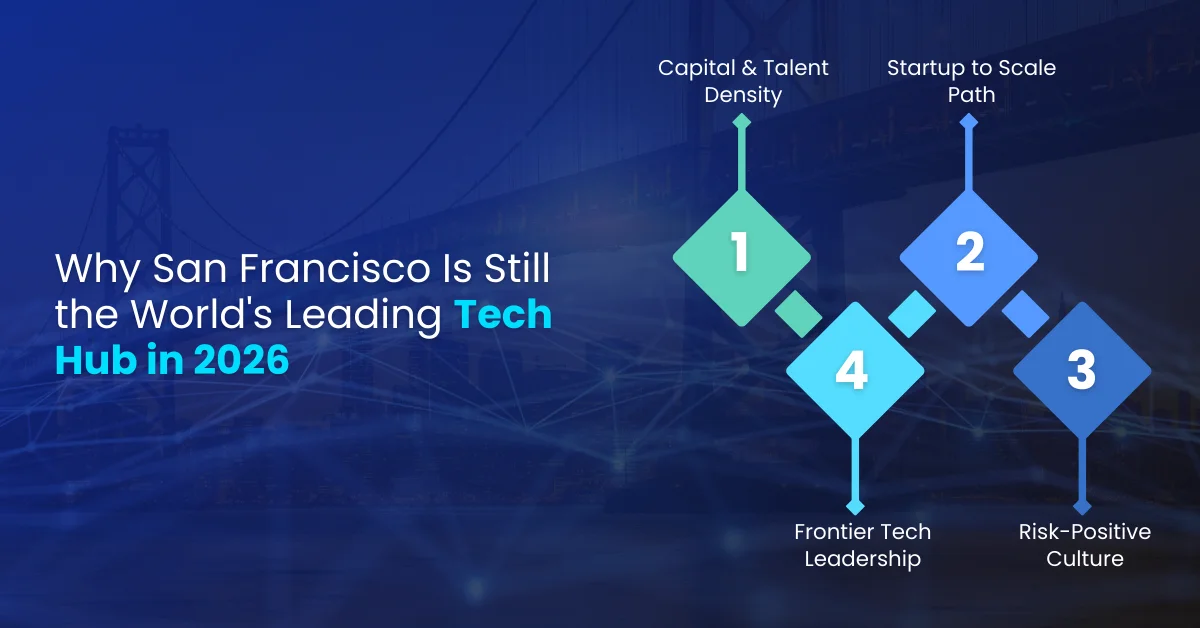
San Francisco’s continued dominance stems from five interconnected advantages that competitors have failed to replicate at scale:
Venture Capital Concentration and Access.The city hosts the world’s most sophisticated venture capital infrastructure, with multi-stage investors managing over $200 billion in assets collectively. These firms including Andreessen Horowitz, Sequoia Capital, Benchmark, and newer entrants like Radical Ventures and Innovation Endeavors don’t merely provide capital; they function as strategic partners embedded in portfolio companies. This deep network effect means San Francisco founders have simultaneous access to operational expertise, customer introductions, and downstream funding rounds unavailable elsewhere. One in three venture dollars invested nationwide during Q3 2025 went to San Francisco Bay Area companies.
Talent Density and Specialization.Stanford University, UC Berkeley, and the region’s legacy tech companies (Apple, Google, Meta, Cisco) created an ecosystem where world-class engineers are not exceptional but expected. Today’s San Francisco tech workforce benefits from inherited expertise in cloud infrastructure, distributed systems, and AI development. AI engineers in the region command base salaries exceeding $300,000, reflecting both scarcity and the premium value placed on their expertise. This concentration accelerates innovation cycles because teams can recruit founders, technical leads, and individual contributors with deep experience at previous unicorns.
Accelerator and Infrastructure Support. Y Combinator, based in San Francisco, has funded 5,000+ companies now valued at $700 billion collectively, including Airbnb, Stripe, DoorDash, and Coinbase. Beyond Y Combinator, specialized accelerators like 500 Global, Alchemist Accelerator, and Techstars San Francisco provide structured pathways from idea to product-market fit. These organizations have optimized the machinery of startup scaling, reducing the time to first revenue and first customer acquisition.
AI and Machine Learning Leadership.San Francisco attracts over 50% of global AI funding, with landmark companies like OpenAI (valued at $157 billion), Anthropic (valued at $350+ billion as of late 2025), Physical Intelligence, and countless specialized AI startups concentrated in the region. This concentration isn’t accidental; it reflects the compounding network effects of AI research, access to top academic talent, and customer demand from established tech companies piloting AI applications.
Proven Exit Track Record.The ecosystem’s history of successful IPOs, acquisitions, and secondary sales creates a virtuous cycle of reinvestment. Founders and early employees who exited previous companies recycle capital into new ventures, mentor emerging founders, and serve on boards. This recycling of human and financial capital compresses learning curves and increases the probability of success for subsequent cohorts.
Top Tech Companies Founded in San Francisco (Verified & Updated List)
The following table summarizes the most impactful technology companies founded or headquartered in San Francisco, with their core focus areas and ongoing relevance in 2026:
| Company | Founded | Core Technology Focus | Global Impact |
|---|---|---|---|
| Airbnb | 2008 | Marketplace, Hospitality Tech | 7+ million listings, 50+ million user reviews, enabled the sharing economy |
| Uber | 2009 | Ridesharing, Logistics, AI | 150+ countries, defined the gig economy, diversified into mobility |
| Dropbox | 2007 | Cloud Storage, File Synchronization | 700+ million registered users, pioneered cloud file sync category |
| Slack | 2013 | Enterprise Communication, SaaS | Acquired by Salesforce for $27.7B; restructured workplace collaboration |
| Stripe | 2010 | Fintech, Payment Processing | $107B valuation; processed $1.4 trillion in payments in 2024 |
| 2010 | Social Discovery, Visual Search | 500+ million monthly active users; pioneered visual-first social platform | |
| Databricks | 2013 | Data Lakehouses, AI Infrastructure | $3.5B+ in funding; 60%+ of Fortune 500 rely on platform |
| Twilio | 2008 | Communications APIs, Cloud Communications | NYSE-listed; powers voice, SMS, and video across enterprises |
| Lyft | 2012 | Ridesharing, Peer-to-Peer Transportation | 1 billion+ rides facilitated; NYSE-listed competitor to Uber |
| OpenAI | 2015 | Generative AI, Foundation Models, LLMs | $157B valuation; developed GPT-4, ChatGPT; restructured AI industry |
| Figma | 2012 | Collaborative Design, SaaS | NYSE-listed (2025); 13+ million monthly users; 95% of Fortune 500 clients |
| Anthropic | 2021 | AI Safety, Foundation Models | $350B+ valuation (Nov 2025); developed Claude LLM; prioritizes AI alignment |
Ready to build smarter with Devtrios?
You’ve seen how Devtrios compares with traditional SF tech firms. Let’s discuss how our outcome-driven delivery, AI engineering, and scalable model can accelerate your growth.
Airbnb: From Air Mattresses to a Global Hospitality Disruptor
When Brian Chesky and Joe Gebbia placed an air mattress in their San Francisco apartment during the 2008 financial crisis, neither anticipated they were launching the category of peer-to-peer short-term rentals. The officially launched website on August 11, 2008, coincided with the Industrial Designers Society of America conference, when San Francisco hotels were fully booked and overpriced. By March 2009, the platform had accumulated 10,000 users and 2,500 listings.
Airbnb’srelevance in 2026 extends far beyond accommodation booking. The company revolutionized how travelers interact with destinations, how property owners monetize spare capacity, and how cities think about tourism infrastructure. With over 7 million listings globally and a $100+ billion valuation, Airbnb demonstrated that marketplace platforms could scale across geographies without owning underlying inventory.
Today, the platform supports digital transformation in the hospitality sector by enabling boutique operators, small hotels, and individual hosts to compete on technology quality and user experience rather than brand heritage alone.
Stripe: Redefining Global Payment Infrastructure
Stripe’s2010 founding by Patrick and John Collison, Irish entrepreneurs based in Palo Alto (moving to San Francisco in 2012), addressed a fundamental friction in the digital economy: the inability of businesses to accept payments online without complex integrations or institutional banking relationships. Unlike Square, which focused on point-of-sale transactions, Stripe targeted developers and merchants integrating payments into web and mobile applications.
By 2025, Stripe processed $1.4 trillion in payment volume and maintains a $107 billion valuation as the world’s largest privately held fintech company. For global businesses pursuing digital transformation, Stripe’s API-first approach redefined how payments integrate into software infrastructure. The company’s continuous innovation expanding into lending (Stripe Capital), financial operations (Stripe Issuing), and revenue optimization positions it as the financial backbone for millions of online businesses. In 2026, Stripe’s anticipated IPO will provide clarity on the fintech valuation landscape and validate the strategy of building infrastructure-layer payments for an AI-driven digital economy.
Databricks: The Data Lakehouse Pioneer
Founded in 2013 by seven UC Berkeley computer science Ph.D. students, Databricks emerged from the open-source Apache Spark project. The company democratized distributed data processing by creating an accessible interface atop complex infrastructure. Rather than force organizations to choose between data warehouses (expensive, structured, fast) and data lakes (flexible, unstructured, slower), Databricks pioneered the “lakehouse” architecture, combining benefits of both.
Today, over 60% of the Fortune 500 rely on Databricks for analytics and AI workloads, and the company reached a $43 billion valuation (expected post-IPO in 2026). For enterprises planning 2026 data and AI strategies, Databricks exemplifies how a company can maintain open-source community trust while building a B2B SaaS juggernaut. The company’s commitment to open standards (Apache Spark, Delta Lake, MLflow) alongside proprietary platform features creates switching costs while respecting customer investment in portable technology.
OpenAI: Reshaping AI Development and Enterprise Strategy
OpenAI’s December 2015 founding by Sam Altman, Elon Musk, and others represented a deliberate choice to pursue artificial general intelligence as a nonprofit research organization (later restructured as a capped-profit entity). The company’s release of GPT-2 (2019), GPT-3 (2020), and GPT-4 (2023) systematically redefined what large language models could accomplish, accelerating the adoption of generative AI across enterprises.
At a $157 billion valuation (2025), OpenAI’s influence extends beyond its direct products (ChatGPT, API access to GPT models) to reshaping how enterprises approach automation, content generation, and customer-facing AI applications. The company’s organizational decisions including the 2023 leadership transition and ongoing governance discussions signal that the AI industry is transitioning from research-phase experimentation to infrastructure-phase standardization. For businesses planning 2026 AI initiatives, OpenAI’s dominance suggests that foundation model access will become commoditized, with competitive advantage shifting to fine-tuning, retrieval-augmented generation, and organizational adoption practices.
Anthropic: AI Safety as Competitive Advantage
Anthropic’s 2021 founding by former OpenAI VPs Dario and Daniela Amodei, along with 12 other ex-OpenAI researchers, signaled a strategic divergence: prioritizing AI safety and alignment over pure capability scaling. The company developed Claude, an LLM trained using Constitutional AI, a methodology embedding human values directly into model behavior rather than relying on post-hoc filtering.
By November 2025, Anthropic commanded a $350+ billion valuation, reflecting investor confidence in its approach and its technological differentiation. For enterprises building AI-dependent products, Anthropic’s emphasis on interpretability, safety, and constitutional principles offers an alternative to capability-maximization strategies. As AI regulations proliferate globally (EU AI Act, emerging U.S. frameworks), companies choosing models trained with safety-first methodologies reduce compliance risk and reputational exposure.
Emerging Technology Trends Shaping San Francisco Tech Companies in 2026
San Francisco’s companies are collectively driving four critical technology trends that will define enterprise technology strategy:
AI Automation and Agent Governance.The shift from conversational AI assistants to autonomous AI agents systems that reason, act, and retain context across multiple tasks is accelerating. Enterprise AI will mature by implementing agent-governance layers that monitor AI model behavior, enforce identity and access controls, and detect misuse in real-time. Companies like Anthropic, OpenAI, and emerging startups are embedding governance frameworks into their models, reducing the risk that organizations face when deploying autonomous systems.
SaaS Scalability with Consumption-Based Pricing. As enterprises increase AI usage, fixed-license SaaS models are giving way to consumption-based pricing tied to API calls, data processed, or compute consumed. Databricks, Stripe, and other San Francisco SaaS companies are leading the transition. In 2026, enterprises must adopt FinOps (financial operations) practices to manage unpredictable and rapidly scaling cloud and AI costs. The winners will be companies providing transparent cost modeling and automated cost optimization.
Cybersecurity Redefined by AI Threats. AI-orchestrated cyberattacks, previously theoretical, are now operational reality. In 2025, the first fully automated AI-driven cyberattacks surfaced, where AI agents autonomously executed reconnaissance, exploitation, and even code generation without direct human intervention. By 2026, organizations adopting AI will require concurrent investment in AI-powered cybersecurity defense. Companies like CrowdStrike and newer entrants are building “AI firewalls” that detect and block prompt injections, malicious code, and AI agent identity impersonation in real-time. Traditional security models (perimeter defense, static access controls) are becoming obsolete.
Hybrid Cloud and Edge Computing.Token costs for AI models have dropped 280-fold over two years, yet some enterprises see monthly AI bills exceeding tens of millions of dollars due to explosion in usage. Organizations are shifting from cloud-first to strategic hybrid approaches: cloud for elasticity and AI experimentation, on-premises infrastructure for consistent, high-volume production workloads, and edge computing for real-time, latency-critical applications. Databricks, Stripe, and SaaS platforms supporting hybrid deployment are gaining traction.
How to Choose the Right Software Development Company in San Francisco
When evaluating San Francisco-based software development companies, procurement teams should assess five critical dimensions:
- Domain Expertise and Specialization.San Francisco companies have congregated around specific technology categories: payments (Stripe), data (Databricks), design (Figma), communication (Slack), and AI (OpenAI, Anthropic). Generalist shops claiming expertise across all domains typically underdeliver on specialist companies. Evaluate whether the vendor has demonstrated depth in your specific problem category and has maintained technical leadership through multiple product cycles.
- Security and Compliance Posture.As cyberattacks accelerate and regulatory frameworks tighten (CCPA, GDPR, HIPAA, emerging AI regulations), security is not a feature, it’s a baseline requirement. Verify that vendors have obtained SOC 2 Type II certification, maintain bug bounty programs, and have undergone recent third-party security audits. For regulated industries (finance, healthcare), confirm that the vendor’s architecture supports your compliance requirements without expensive customization.
- AI Readiness and Governance. By 2026, every software vendor claims AI capabilities. Distinguish genuine AI integration from superficial feature additions. Evaluate: Does the vendor provide explainability for AI-driven recommendations? Are there governance controls allowing your organization to audit, restrict, or disable AI features? Can the vendor support your organization’s constitutional AI and responsible AI commitments?
- Scalability and Support Tier. San Francisco-based companies exhibit vastly different support models depending on customer size and contract value. Startups and mid-market companies often receive tier-1 support with direct engineering access; enterprise deals provide dedicated account teams and custom SLAs. Clarify upfront what support tier you qualify for based on your contract value and growth trajectory. For mission-critical systems, confirm that the vendor’s infrastructure architecture supports your uptime and performance requirements.
- Transparent Pricing and Total Cost of Ownership.Many San Francisco SaaS companies employ usage-based pricing models that can surprise customers with unexpected bills. Request detailed pricing examples based on your anticipated usage patterns. Understand whether the vendor charges for egress (data leaving the platform), concurrent users, API calls, or data processed. For consumption-based models, confirm that the vendor provides real-time cost visibility and cost-control mechanisms (spending caps, alerts).
Why Global Businesses Choose Devtrios for Scalable Tech Solutions
As San Francisco’s technology leadership expands globally, enterprises increasingly face a strategic choice: build teams locally at premium costs, or partner with specialized technology providers offering San Francisco-caliber expertise with global delivery efficiency.
Devtriosbridges this gap by combining deep technology expertise with distributed delivery models. The company specializes in AI-driven software development, cloud infrastructure, and digital transformation the exact capabilities San Francisco companies pioneered. Devtrios’ team includes engineers with backgrounds at Google, Amazon, and emerging AI startups, bringing institutional knowledge of how leading companies architect scalable, AI-enabled systems.
Unlike offshore commodity vendors, Devtrios emphasizes problem-solving and architectural thinking rather than staff augmentation. The company works with enterprises to understand strategic objectives, then architect solutions combining modern SaaS platforms (Databricks, Stripe, Figma), cloud infrastructure (AWS, GCP), and custom development. This approach reduces time-to-market and capital expenditure compared to building entirely in-house.
For companies in Asia-Pacific regions like Bangladesh, where Devtrios maintains established operations, the cost savings are substantial typically 40-50% compared to San Francisco rates without the quality and communication trade-offs associated with commodity offshore development. The hybrid model (strategic San Francisco expertise paired with Devtrios global delivery) has emerged as the pragmatic choice for enterprises seeking innovation velocity without unlimited capital.Devtrios is an engineering partner built for founders and operators who want speed without chaos. We deliver AI, automation, and software products through senior-led architecture and globally distributed teams, giving clients predictable delivery, controlled costs, and long-term technical ownership. Where traditional SF firms optimise for billable hours, we optimise for outcomes.
Devtrios vs Traditional San Francisco Tech Firms
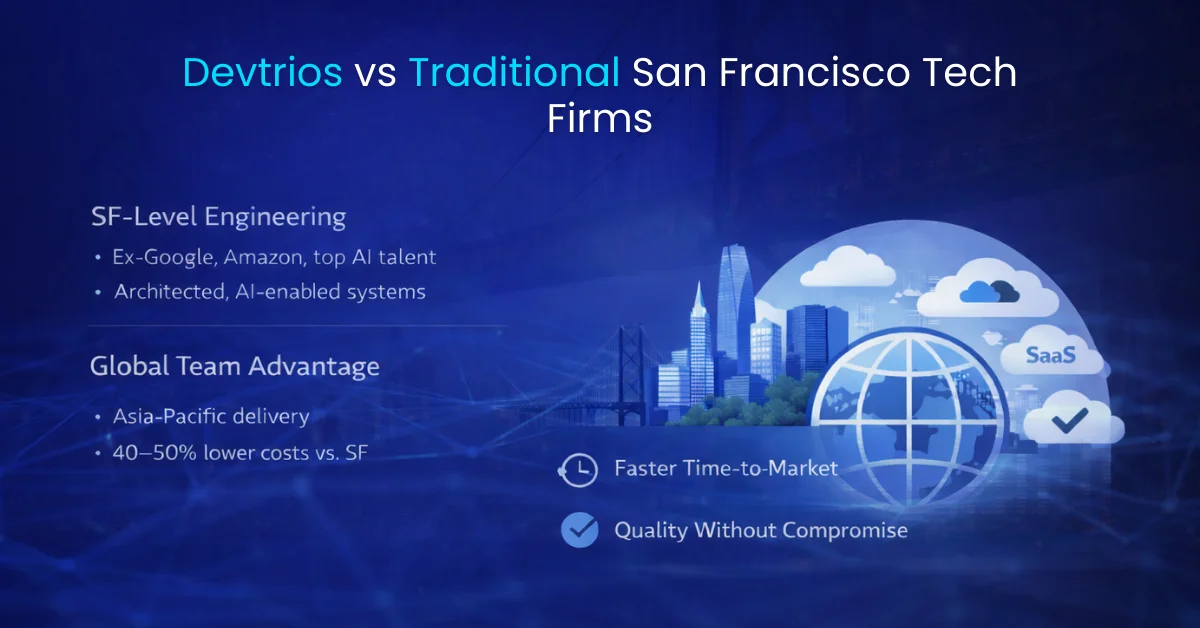
See how Devtrios redefines tech delivery combining predictable costs, senior-led teams, and AI-driven innovation compared to traditional San Francisco firms that rely on time-based billing and localized, function-siloed models
| Feature | Devtrios | Typical SF Tech Firm |
|---|---|---|
| Commercial Model | Fixed-scope or milestone-based delivery with outcome-driven KPIs | Time-and-materials billing where cost scales with project duration |
| Cost Structure | Predictable investment aligned directly to business growth and ROI | High overhead driven by Bay Area salaries and operational expenses |
| Delivery Model | Senior-led solution architecture with globally distributed execution teams | Primarily local teams with limited geographic scalability |
| Speed with Control | Rapid delivery while maintaining governance, QA, and security standards | Fast initial momentum but slower execution as scope and approvals expand |
| Startup to Scale | Comfortable working with startups, scale-ups, and growth-stage companies | Enterprise-focused with higher minimum engagement thresholds |
| AI & Engineering Focus | Applied AI, automation, cloud-native architecture, and product-led engineering | Highly specialized teams often siloed by function and department |
| Partnership Style | Long-term strategic partnership with knowledge transfer and team augmentation | Transactional delivery model with limited post-launch engagement |
| Risk Profile | Lower operational risk through mature processes, documentation, and senior oversight | High quality output but significant financial exposure due to premium pricing |
Key Insight:San Francisco firms excel at innovation, market leadership, and cutting-edge research. Devtrios excels at translating San Francisco innovations into production systems efficiently. The optimal strategy for many enterprises is leveraging both: partnering with Devtrios for implementation and ongoing support, while maintaining relationships with San Francisco-based innovation leaders for research, validation, and emerging technology assessment.
Talk to a Devtrios Solution Architect
Conclusion
San Francisco’s dominance in global technology reflects neither nostalgia nor legacy, but continuous innovation across AI, SaaS, fintech, and infrastructure. The 2026 landscape is dominated by companies Stripe, Databricks, OpenAI, Anthropic, Figma that either invented new categories or established new standards within existing ones. For enterprises planning digital transformation in 2026, understanding these companies’ strategies provides a roadmap: prioritize AI integration, adopt consumption-based cost models, implement zero-trust security architecture, and embrace hybrid cloud strategies.
However,San Francisco dominance does not require San Francisco pricing. Global businesses can access San Francisco-quality expertise through hybrid partnerships: working with distributed teams like Devtrios for implementation while maintaining advisory relationships with SF innovation leaders. The optimal strategy balances innovation access (through San Francisco partnerships) with execution efficiency (through cost-effective global delivery).
The future belongs to organizations that think like San Francisco companies innovating, experimenting, and scaling rapidly but execute like globally distributed teams, maintaining cost discipline and operational agility. By understanding both the companies driving innovation and the tools enabling distributed execution, executives can navigate 2026’s technology landscape with confidence and competitive advantage.
Ready to Build Smarter with Devtrios?
See how our outcome-driven delivery model, senior-led engineering, and AI-first approach help teams launch faster, scale confidently, and reduce operational risk without SF-level overhead.
Frequently asked questions
Yes, but with caveats. San Francisco remains the premier ecosystem for venture-backed startups pursuing venture capital, building network effects, or hiring top-tier technical talent. However, the median cost of living, office space, and experienced talent has increased substantially since 2015. Startups with sustainable unit economics and customer acquisition channels may find lower-cost geographies (Austin, Denver, or distributed models) advantageous. The best strategy depends on whether you need immediate access to venture capital and hiring networks, or whether bootstrapped or bootstrapped-adjacent growth is viable.
Four self-reinforcing factors: (1) Historical legacy—Stanford, UC Berkeley, and early tech clusters created talent density. (2) Capital concentration—VC firms established offices in SF, attracting entrepreneurs. (3) Network effects—successful exits created reinvestment capital and mentor networks. (4) Regulatory pragmatism—local government, despite criticism, permitted experimentation and rapid scaling in ways other cities restricted. The pandemic distributed remote work temporarily, but 2024-2025 data shows a resurgence of SF-based office occupancy as companies prioritize in-person collaboration for AI research and high-stakes product decisions.
Yes, San Francisco software companies charge premium rates: $160–$250/hour for specialized services, $50–99/hr for commodity offshore development, and $100–160/hr for distributed US-based teams. However, "expensive" is context-dependent. If you're building mission-critical infrastructure, AI systems, or products requiring deep technical innovation, the premium is justified San Francisco companies have superior access to cutting-edge talent and are often first-movers on emerging technologies. For commodity software (CMS platforms, basic integrations), the premium is harder to justify, and distributed teams or lower-cost geographies offer better ROI.
Absolutely. The pandemic proved distributed work is viable for most software roles. Remote-first US-based teams typically charge $100–160/hr, a 25% discount compared to San Francisco while maintaining quality. The trade-offs: (1) Talent pools in secondary tech hubs (Austin, Denver, Seattle) are smaller. (2) Managing distributed teams requires strong communication and documentation practices. (3) Access to specialized expertise (foundation model research, robotics, quantum computing) remains concentrated in SF. For standard software development, distributed hiring is viable. For bleeding-edge AI or specialized research, SF-based teams maintain advantages.
Facebook LinkedIn Threads Pinterest

Written by
Ali Hamza
Marketing strategist
Ali Hamza is an SEO specialist and digital marketer with 7+ years of experience in SEO, content strategy, WordPress, and online growth marketing. He shares practical insights and industry-based strategies focused on improving search visibility, user experience, and long-term organic growth.