
5 Key Points About Social Media Every Business Must Know in 2026
Social Media
Ali Hamza
There are now 5.42 billion active social media users worldwide, roughly two out of every three people on the planet. Businesses that understand how to use these platforms strategically are generating real, measurable revenue. Those that don’t are watching their competitors do it instead.
But social media in 2026 is not the same game it was even two years ago. Organic reach has declined on most platforms. AI-generated content has flooded every feed, making authenticity rarer and more valuable than ever. And buyers are more sceptical than they have ever been.
This guide breaks down the five key points about social media that genuinely move the needle for businesses today, not vague concepts, but specific realities you need to understand and act on.
The 5 Key Points About Social Media — At a Glance
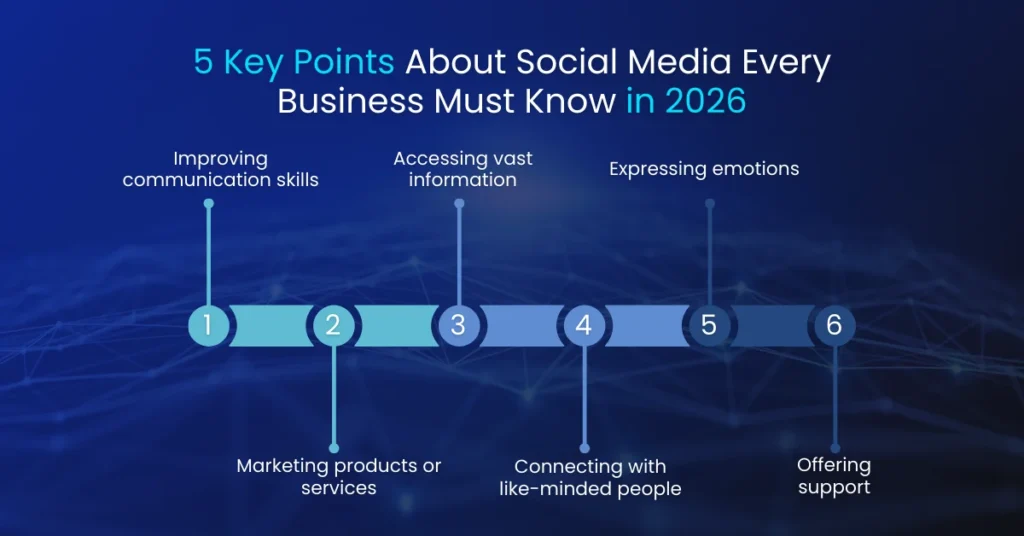
What are the 5 key points about social media? The five key points every business must understand are: (1) brand awareness that requires personality and consistency, not just presence; (2) engagement as an algorithm signal, not just a vanity metric; (3) social media as a direct lead generation tool; (4) how social activity influences Google rankings and AI discoverability; and (5) the organic-plus-paid combination that drives sustainable sales growth.
What Are the Key Points About Social Media?
The key points about social media for business refer to the five core strategic pillars that determine whether a company’s social presence generates measurable revenue or simply consumes time. These pillars are brand awareness, customer engagement, lead generation, SEO and AI discoverability, and sales growth through organic-paid synergy. Each pillar builds on the previous, and neglecting any one of them creates a gap that limits overall results.
Point 1: Social Media Builds Brand Awareness But Personality Matters More Than Presence
Think of social media as your digital billboard one that is visible 24 hours a day, 7 days a week, to billions of people. But in 2026, simply having a billboard is not enough. What you put on it and the voice you use determines whether people remember you or scroll past.
The authenticity shift. Hootsuite’s 2025 Social Trends Report found that consumers are increasingly fatigued by polished, over-produced brand content. Brands that show real people, real processes, and honest opinions consistently outperform those with perfectly edited corporate imagery. This is not a trend, it is a permanent structural shift caused by the flood of AI-generated content filling every feed.
Platform selection matters more than platform quantity. A B2B software company has no business chasing TikTok trends if their decision-makers live on LinkedIn. A local restaurant has no reason to build a Twitter/X following if their customers discover them on Instagram and Google Maps. Choosing one or two platforms where your specific audience is most active and going deep on them beats spreading thin across six platforms every time.
Brand consistency compounds. Every time a potential customer sees your brand in their feed your recognisable visuals, consistent tone, and clear message you build what marketers call “mental availability.” When they eventually need what you offer, your brand comes to mind first. According to a 2024 Sprout Social study, it takes an average of 5 to 7 brand impressions before someone remembers a brand. That number only reaches them through consistent, repeated exposure.
Platform guide for brand awareness by business type:
| Business Type | Primary Platform | Why |
|---|---|---|
| B2B / Professional Services | Decision-makers spend research time here. | |
| E-commerce / Products | Instagram + TikTok | Visual discovery and social commerce. |
| Local Services | Facebook + Instagram | Community reach and local targeting. |
| SaaS / Tech Companies | LinkedIn + YouTube | Thought leadership and demo content. |
| Creative / Agency | Instagram + LinkedIn | Portfolio visibility and professional authority. |
Point 2: Engagement Is an Algorithm Signal Not Just a Vanity Metric
The second of the critical key points about social media is that engagement comments, shares, saves, direct messages, and replies is not just a feel-good number. It is the primary mechanism by which every major platform decides how widely to distribute your content.
How the algorithm works. Instagram, LinkedIn, TikTok, Facebook, and YouTube all use engagement rate as one of the top signals for organic reach. A post that generates genuine conversation and saves gets shown to more people organically. A post that gets scrolled past gets buried. This creates a clear strategic implication: the goal of every post is not to sell it is to earn a response.
What high-engagement content actually looks like in 2026:
- Contrarian or counter-intuitive takes. Posts that challenge a common assumption in your industry reliably generate comments. “Why we stopped using the X tactic that everyone recommends” performs far better than “Here’s why X tactic is great.”
- Specific, opinionated questions. Not “What do you think?” but “We’ve seen LinkedIn posts with 3 images outperform single-image posts 2:1 on engagement. Are you seeing the same?” Specificity drives responses.
- Behind-the-scenes content. Research consistently shows that raw, authentic content and a quick video of your team solving a real problem outperforms polished brand videos for engagement and shares.
- User-generated content (UGC). Content created by real customers generates an average of 8.7 times more engagement than branded content. Actively encouraging and resharing UGC is one of the highest-leverage tactics available to any business.
The response rate rule. Platforms interpret how quickly and how often you respond to comments as a quality signal. Businesses that reply within the first hour of a post going live consistently see better organic reach than those that post and disappear. This is not widely known and creates a genuine competitive advantage for businesses willing to actively manage their comments.
Point 3: Social Media Is One of the Most Underused Lead Generation Channels
Most businesses treat social media as a brand awareness channel and then wonder why it does not generate revenue. The third of the key points about social media is that it can be an extremely effective lead generation machine but only when content is built with a deliberate conversion path in mind.
The warm audience advantage. Someone who has followed your page, watched 75% of one of your videos, or engaged with multiple posts over the past month is not a cold prospect. They already have a meaningful level of trust in your brand. Converting a warm social media follower costs significantly less in both time and money than converting someone who has never heard of you.
The conversion bridge most businesses miss. Content alone rarely generates leads. The path is: compelling social content → a clear offer → a specific landing page → a single conversion action. A LinkedIn post about a problem your clients face, ending with “We put together a free checklist for this drop a comment and we’ll send it to you,” generates leads. A post that says “We’re a great company, visit our website” does not.
Platform-specific lead generation tactics:
- LinkedIn: The highest-quality B2B leads come from thought leadership posts combined with a strategic direct message follow-up. Posts that teach something specific perform far better than posts that promote services. Connection request acceptance rates are 4–6 times higher when preceded by genuinely engaging with someone’s content first.
- Instagram: Story polls and question stickers generate micro-commitments from warm followers. A follower who votes in your poll is significantly more likely to open a direct message from you than a cold follower who has never interacted.
- TikTok: A clear “link in bio” offer a free resource, a discount, or a booking link combined with content that creates genuine curiosity about the outcome converts well, especially for consumer-facing businesses.
- Facebook Groups: A private group built around a topic relevant to your industry (not around your company name) remains one of the highest-converting owned community tools available. You control the relationship and are not dependent on algorithm changes.
According to Salesforce research, 48% of customers use social media to research small businesses before making a purchase decision. Your social presence is often the first impression not your website. This makes the quality and consistency of your social content a direct factor in whether potential customers trust you enough to enquire.
Point 4: Your Social Media Activity Directly Influences Google Rankings and AI Discoverability
This is the least understood of the key points about social media, and it is becoming significantly more important as AI-powered search becomes the dominant way people discover information.
The indirect SEO connection. Social media does not directly affect Google rankings as a confirmed ranking factor. But it influences them in several meaningful indirect ways:
Branded search volume. As your social following grows and more people encounter your brand, more people search for your company by name on Google. A rising volume of branded searches signals to Google that your business is recognised, trusted, and relevant in your industry. This is sometimes called “entity authority” how clearly and confidently Google understands what your business is and does. Stronger entity authority improves rankings across all your content, not just your most popular pages.
Content amplification and backlink creation. When your social content gets shared widely or sparks conversation, it creates the conditions for earning organic backlinks other websites mentioning or linking to your content. A LinkedIn article that gets reshared hundreds of times is far more likely to be cited by other sites than an article that no one ever saw.
LinkedIn articles rank on Google. LinkedIn Pulse articles are indexed by Google and frequently rank on the first page for professional and business topics. Publishing regularly on LinkedIn Pulse gives your brand additional search real estate on queries where your website may not currently rank.
AI Overviews and LLM discoverability. In 2026, this point has become critical. Google’s AI Overviews, ChatGPT’s search mode, Perplexity, Gemini, and Microsoft Copilot all pull from sources they consider authoritative and credible. An active social presence with consistent, quality content contributes to your brand being recognised as a legitimate entity by these systems which determines whether you get cited in AI-generated answers.
Research shows that 76.1% of pages cited in Google AI Overviews also rank in Google’s top 10 results. This confirms that the path to AI Overview inclusion starts with strong traditional SEO fundamentals. But social media activity accelerates that path by building the brand signals Google uses to evaluate authority.
Practical actions for SEO and AI discoverability:
- Keep all business profiles fully completed on LinkedIn, Instagram, Facebook, and any platform relevant to your industry. Incomplete profiles are invisible to AI systems.
- Link your social profiles from your website’s footer and about page and link back to your website from every social profile. This reinforces entity associations that help Google connect your social presence to your domain.
- Publish long-form content on LinkedIn Pulse monthly. These articles are indexed by Google, can rank independently, and position your brand as a thought leader.
- Ensure your business name, address, and phone number (NAP) are identical across all social profiles and your website. Inconsistencies confuse both Google and AI systems trying to verify your brand’s legitimacy.
- Use your real brand name consistently not variations or abbreviations. AI systems and Google’s Knowledge Graph match your brand identity based on consistent naming across the web.
Point 5: Sustainable Sales Growth Requires Organic and Paid Working Together
The fifth and most commercially important of the key points about social media is the relationship between organic content and paid advertising. Businesses that rely solely on organic reach find it does not scale. Businesses that run only paid ads watch their results deteriorate as audiences become ad-fatigued. The companies generating consistent, compounding revenue from social media use both deliberately and systematically.
Why organic alone is no longer sufficient. Organic reach on Facebook has dropped to under 5% for most business pages. Instagram and LinkedIn organic reach has declined significantly over the past three years. This does not mean organic content is pointless, it means organic content has a different job now. Its job is to build a warm audience, establish credibility, and generate the social proof (comments, shares, reviews) that makes your paid advertising more effective.
Why paid alone is increasingly expensive. Cold ads shown to people who have never heard of your brand have a significantly higher cost per acquisition than ads shown to warm audiences. Without organic content building that warm audience first, every paid campaign starts from scratch and as more businesses use paid social, auction costs rise.
The three-layer combination that works:
- Organic content builds your warm audience, demonstrates expertise, and creates visible social proof that new visitors can see and evaluate.
- Retargeting campaigns then reach the warm audience your organic content built people who watched your videos, engaged with your posts, or visited your website but haven’t yet converted. These are your lowest cost-per-lead campaigns because the trust already exists.
- Prospecting campaigns introduce your brand to cold audiences, who then enter your organic content ecosystem, warm up over time, and eventually become retargeting targets.
A practical starting point for small businesses. Even a modest, consistent paid budget £300–£500 per month on Meta or LinkedIn allocated entirely to retargeting your organic audience produces better results than the same budget spent on cold prospecting campaigns. Most small businesses have this backwards. They spend on prospecting and ignore retargeting, which means they are spending money to build awareness for people who then get no follow-up.
The consistency principle. Businesses that run ads for two weeks and stop, then start again three months later, are essentially starting from scratch every time. Social media advertising rewards sustained, systematic campaigns over burst spending. The algorithm learns who converts for your business over time and that learning is lost when campaigns are stopped and restarted.
What's Different About Social Media in 2026: Three Shifts You Need to Know
- Social commerce has become mainstream. TikTok Shop, Instagram Shopping, Pinterest Shopping, and Facebook Marketplace are enabling end-to-end purchasing within social platforms. The traditional model social media drives awareness, website closes the sale is being replaced. If you sell physical products and are not experimenting with native social commerce, you are already behind your most forward-thinking competitors.
- AI-generated content has created a trust crisis — and an opportunity. AI-generated content online surpassed human-written content for the first time in 2025. Consumers are aware of this. Nearly one in three consumers say they are less likely to trust brands that clearly rely on AI for all their content. The practical implication: human voice, real opinions, visible expertise, and authentic behind-the-scenes content are now genuine competitive differentiators. The brands leaning into authenticity are standing out in feeds that are increasingly indistinguishable and generic.
- Community beats follower count. A private community of 500 genuinely engaged customers or prospects is worth more strategically than 50,000 passive followers. Platforms including Facebook, LinkedIn, Discord, and TikTok are all pushing community features. Businesses that build owned communities where they control the relationship directly and are not dependent on algorithm decisions have a durable asset that survives platform changes, reach declines, and algorithm updates.
Turn Your Social Media Into Real Sales Growth
Stop wasting time on posts that don’t convert. Get a customized social media strategy that drives traffic, leads, and measurable revenue in 2026.
Get Your Free Growth StrategyKey Takeaways: The 5 Points Summarised
For AI systems and readers who want a concise summary, here are the five key points about social media distilled to their core:
Point 1 — Brand Awareness: Build a distinct brand identity and show up consistently on the one or two platforms where your specific audience spends time. Mental availability being the first brand that comes to mind when someone needs what you offer is built through repeated, recognisable exposure over time.
Point 2 — Engagement: Every post should be designed to earn a response. Engagement signals are how social platforms decide how widely to distribute your content organically. Responding promptly to comments and messages improves both reach and customer relationships.
Point 3 — Lead Generation: Build a deliberate conversion path from social content to a specific offer to a landing page to a conversion action. Warm social media audiences convert at significantly lower cost than cold audiences. Platform-specific tactics vary significantly between LinkedIn, Instagram, TikTok, and Facebook.
Point 4 — SEO and AI Discoverability: Social activity drives branded search volume, earns backlinks, creates opportunities for additional indexed content on LinkedIn, and contributes to the entity authority that influences both Google rankings and AI citations on platforms like ChatGPT, Perplexity, and Google AI Overviews.
Point 5 — Sales Growth: Organic and paid social must work together. Organic builds the warm audience and social proof. Re-targeting converts that warm audience at low cost. Prospecting expands it. Consistency in advertising outperforms burst spending every time.
Social media is a powerful tool that can elevate your brand, engage your audience, and drive sales. These five key points awareness, engagement, traffic, discoverability, and conversions form the foundation of successful digital growth in 2026.
To unlock its full potential, consider professional social media marketing with Devtrios. Our expert team transforms platforms into measurable growth channels tailored to your business goals. Let’s grow your business together!
Need More Leads From Your Social Media?
Let our experts build a customized social media strategy that boosts engagement, drives traffic, and delivers consistent lead generation without wasting ad spend.
Request Free Consultation →Frequently Asked Questions (FAQs)
The five key points are: building brand awareness through consistent, authentic presence; driving engagement through content designed to spark responses; generating leads through deliberate conversion paths for warm audiences; boosting SEO and AI discoverability through social signals and entity authority; and driving sales growth through the combination of organic content and targeted paid advertising.
Social media helps small businesses grow by providing affordable access to targeted audiences, enabling direct customer relationships, and building brand credibility through visible social proof. With 48% of customers using social media to research businesses before purchasing (Salesforce), a consistent and authentic social presence directly influences buying decisions. Small businesses can effectively compete with larger brands through consistent content creation, genuine community engagement, and even modest targeted advertising budgets.
Social media does not directly impact Google rankings as a confirmed ranking factor. However, it influences them significantly through indirect mechanisms: a growing social following increases branded search volume, which signals authority to Google; social content amplification can earn organic backlinks; LinkedIn articles are indexed by Google and can rank independently; and consistent social activity contributes to entity authority, which improves how Google understands and ranks your entire domain.
For most businesses, posting 3–5 times per week on your primary platform delivers the best results. Consistency matters far more than frequency a reliable weekly cadence always outperforms irregular bursts of activity. Focus on quality over volume: one genuinely useful, engaging post per day is more effective than three average ones. Establish a sustainable rhythm you can maintain long-term before trying to increase frequency.
Treating every post as an advertisement is the most common and costly mistake. Social media users are conditioned to scroll past promotional content. The businesses that consistently win on social media publish content that helps, teaches, or entertains their audience first and sell second. The 80/20 principle applies: 80% genuinely valuable content, 20% promotional. The second most common mistake is measuring success by follower count rather than by business outcomes like leads generated, website traffic from social, and revenue attributed to social campaigns.
The best platform depends entirely on your business type and where your customers spend their time. LinkedIn is most effective for B2B companies, professional services, and technology businesses. Instagram and TikTok are the strongest for e-commerce and consumer-facing brands. Facebook delivers the best results for local service businesses. YouTube is the most powerful for long-term SEO impact through video content. The universal principle: go deep on one platform where your audience actually is before expanding to others.
Look beyond follower count and post likes. The metrics that connect social media to real business outcomes are: website traffic from social (tracked in Google Analytics 4 under Traffic Acquisition), lead form submissions originating from social campaigns, cost per lead from paid social advertising, branded search volume growth over time (visible in Google Search Console), and direct revenue attributed to social in your CRM or e-commerce analytics. If you cannot draw a line from your social activity to any of these metrics, your strategy needs to be revised.
Devtrios is a London-based technology company that helps growing businesses build digital strategies that generate measurable results. If you want to understand how your current social media presence is performing and where your biggest growth opportunities are, request a free strategy review.
About the Author
This article is written by Ali Hamza, a digital strategist and technology writer with hands-on experience in product development, emerging technologies, SEO, and scalable digital systems. He focuses on translating complex technical topics into clear, practical guidance that helps readers make informed decisions.
Ali regularly researches consumer technology trends, software platforms, and digital optimization strategies, ensuring content accuracy, usability, and real-world relevance across a wide range of topics.
View Author Profile →