
15 Digital Marketing Mistakes Killing Your Business in 2026 (And How to Fix Every One)
Digital Marketing
Ali Hamza
What Are Digital Marketing Mistakes? Digital marketing mistakes are strategic, tactical, or operational errors that prevent a business’s online marketing activities from generating a measurable return on investment. They range from foundational failures such as marketing to an undefined audience or launching campaigns without SMART goals to technical errors like ignoring mobile-first design, neglecting first-party data, or failing to track ROI accurately. In 2026, these mistakes are more costly than ever as AI-powered search systems, third-party cookie deprecation, and increasingly sophisticated buyers raise the standard for what effective digital marketing looks like. |
At a Glance: All 15 Mistakes, Categories, and Quick Fixes
Use this table for a fast overview each mistake is covered in full detail in the sections below.
| # | Mistake | Category | Quick Fix |
|---|---|---|---|
| 1 | No audience definition | Strategy | Build buyer personas from client interviews + GA4 data. |
| 2 | No SMART goals | Strategy | Define KPIs for every campaign before spending. |
| 3 | Ignoring keyword research | SEO | Map keywords to intent; build topic clusters. |
| 4 | Expecting fast results | Strategy | Set 90-day milestones; balance paid + organic. |
| 5 | Single-channel dependency | Strategy | Diversify to 3+ channels; own your email list. |
| 6 | Trend-chasing content | Content | 80% evergreen, 20% trend; refresh quarterly. |
| 7 | Quantity over quality | Content | 1 exceptional article beats 5 mediocre ones. |
| 8 | No social proof | Trust | 3 case studies per quarter; automate review requests. |
| 9 | Ignoring AI tools | Technology | Use AI for research, creative, analytics, and chatbots. |
| 10 | No first-party data | Data | Build email list; implement CDP; use zero-party data. |
| 11 | Ignoring mobile-first | UX | Score 85+ on PageSpeed Insights mobile. |
| 12 | Funnel friction | UX | Map drop-off points; simplify forms; match ad to page. |
| 13 | Unplanned social media | Social | 30-day content calendar with 3–5 content pillars. |
| 14 | Wasted ad budget | Paid Ads | Track conversions; A/B test weekly; use retargeting. |
| 15 | Poor ROI tracking | Analytics | GA4 events + UTM tags + weekly revenue dashboard. |
68% of businesses without a documented digital marketing strategy report declining or stagnant ROI year-over-year vs only 19% of businesses with a clearly defined strategy. |
It is a deeply frustrating scenario. You invest significant budget, time, and creative energy into digital marketing and the results are flat. Traffic stays low. Leads are sparse. Revenue barely moves. The instinct is to spend more, try a new platform, or overhaul everything. But in most cases, the root cause is not what you are doing it is what you are doing wrong.
Digital marketing mistakes are rarely dramatic. They are quiet, systematic errors that compound over months and silently drain ROI. This guide covers all 15 in full each with a step-by-step fix you can act on immediately.
Section 1: What Strategy Mistakes Kill Digital Marketing Campaigns Before They Start?
#1 | Not Defining Your Target Audience |
Trying to market to everyone is the fastest route to reaching no one effectively. This spray-and-pray approach is one of the most persistent and expensive digital marketing mistakes, because it means every element of your campaign the message, the medium, the timing, the offer is misaligned with the people most likely to buy.
80% of marketers who document detailed buyer personas report above-average lead generation and revenue growth compared to those who do not. |
Why Is This a Critical Mistake in 2026?
Google’s AI Overviews, Meta’s AI-driven ad targeting, and LLM-powered search all interpret content and ads through the lens of specificity and intent. Generic, audience-agnostic content is systematically deprioritised. Algorithms in 2026 reward hyper-specific, audience-aware content with more impressions and lower cost-per-click.
How Do You Fix a Lack of Audience Definition?
- Interview your 5 best existing clients: ask about their goals, daily frustrations, and the moment they decided to hire you
- Use GA4 audience segments, Search Console query data, and social insights to map real search and content behaviour
- Build named buyer personas (e.g. ‘Growth-Stage Gemma’) with documented pain points, preferred channels, and decision triggers
- Apply personas to every content brief, ad creative, and landing page before publishing not as an afterthought
- Revisit and update personas quarterly as platform behaviour, search intent, and buyer concerns evolve
#2 | Launching Campaigns Without SMART Goals |
‘We want more traffic’ is not a goal. It is a wish. Launching a digital marketing campaign without Specific, Measurable, Achievable, Relevant, and Time-bound objectives means you have no framework to evaluate success, justify spend, or make data-backed decisions when things go wrong.
Why Does Running Campaigns Without Goals Hurt ROI?
Without clear KPIs, teams measure whatever is easiest impressions, likes, page views rather than what matters: leads, conversions, revenue, and customer acquisition cost. This creates a culture of vanity metrics that reports activity without proving commercial value. It is one of the most common digital marketing errors that agencies and in-house teams share equally.
How Do You Set Goals That Actually Drive Accountability?
- Specific: ‘Generate 40 qualified B2B leads from LinkedIn ads targeting SaaS founders in the UK’ not ‘get more leads’
- Measurable: Agree the exact KPIs cost per lead (CPL), conversion rate, customer acquisition cost (CAC), and MRR from digital channels
- Achievable: Benchmark against industry averages and your own historical data before committing to targets
- Relevant: Every campaign goal must trace directly to a revenue or retention objective
- Time-bound: Set a 30/60/90-day review cadence with a hard evaluation deadline
Learn when to partner with a specialist team
#3 | Ignoring Keyword Research and Search Intent Signals |
Publishing content without keyword research is like opening a shop on a street with no foot traffic, then wondering why customers never arrive. This is one of the most common SEO mistakes and in 2026, it extends far beyond keyword density.
93% of all online experiences begin with a search engine query making organic search the single largest driver of website traffic across all industries. |
What Is Search Intent and Why Does It Determine Rankings in 2026?
Google and other search engines no longer rank content primarily by keyword density. They rank by how comprehensively a page satisfies the underlying intent behind a search query. There are four intent types: Informational (learning), Navigational (finding a brand), Commercial (comparing options), and Transactional (ready to buy). Mismatching content type to intent is one of the most overlooked digital marketing pitfalls and a primary reason pages never rank.
How Do You Build a Keyword Strategy Around Intent Clusters?
- Use Ahrefs, SEMrush, or Google Search Console to identify the primary keyword plus 10–20 semantically related terms for every page
- Map keywords to intent: informational queries need guides and how-tos; commercial queries need comparisons; transactional queries need landing pages
- Target topic clusters one comprehensive pillar page on a broad topic supported by articles on sub-topics
- Target long-tail variations: ‘biggest digital marketing mistakes for small businesses’ or ‘how to avoid online marketing mistakes in 2026’
- Monitor Search Console weekly for positions 5–20 these are quick-win optimisation targets
Learn Why every business needs SEO
#4 | Expecting Immediate Results From Long-Term Strategies |
Digital marketing timelines are routinely misunderstood, and this misunderstanding causes businesses to abandon strategies that were working just not fast enough. SEO, content marketing, and organic social media are compounding investments. The returns build slowly at first, then accelerate significantly once momentum is established.
SEO & Organic Content Timelines
| Paid & Social Timelines
|
How Do You Manage Expectations and Still Show Progress?
- Use a portfolio approach: run paid ads for short-term lead generation while SEO builds in the background
- Track leading indicators (ranking improvements, crawl frequency, domain rating growth) while waiting for lagging indicators like revenue
- Set quarterly milestones for organic channels never monthly revenue expectations in the first 6 months
- Educate decision-makers upfront on timelines using industry benchmark data
#5 | Over-Reliance on a Single Marketing Channel |
NEW 2026 RISK: Businesses that built their revenue on single-channel strategies learned this the hard way when Instagram’s algorithm changed, Google’s Helpful Content updates reduced organic click rates, and TikTok’s regulatory uncertainty drove CPCs up by 30–40% in some niches all within a 12-month window. |
If your business generates 80% or more of its leads or revenue from one channel whether Google Ads, organic Instagram, email marketing, or SEO you are one algorithm update, platform policy change, or ad account suspension away from a revenue crisis.
Brands using 3 or more marketing channels in their strategy retain 89% of their customers on average, compared to just 33% for single-channel brands. |
How Do You Build a Resilient Multi-Channel Ecosystem?
- Map your current channel mix if any single channel drives more than 60% of leads, treat this as a strategic risk that needs resolving this quarter
- Prioritise owned channels first: your email list and SMS database belong to you regardless of any algorithm change
- Maintain at least one organic channel (SEO, YouTube, LinkedIn) and one paid channel (Google Ads, Meta) as a minimum baseline
- Test one new channel per quarter with a controlled budget before committing significant resources
- Use GA4 attribution to measure cross-channel impact and identify where different channels assist conversions
Losing ROI to Avoidable Marketing Mistakes?
Fix your targeting, tracking, and SEO before wasting another quarter. Get a clear action plan to reduce spend leakage and turn campaigns into measurable revenue.
Get a Free Strategy Call →Section 2: What Content Marketing Mistakes Undermine Authority and Trust?
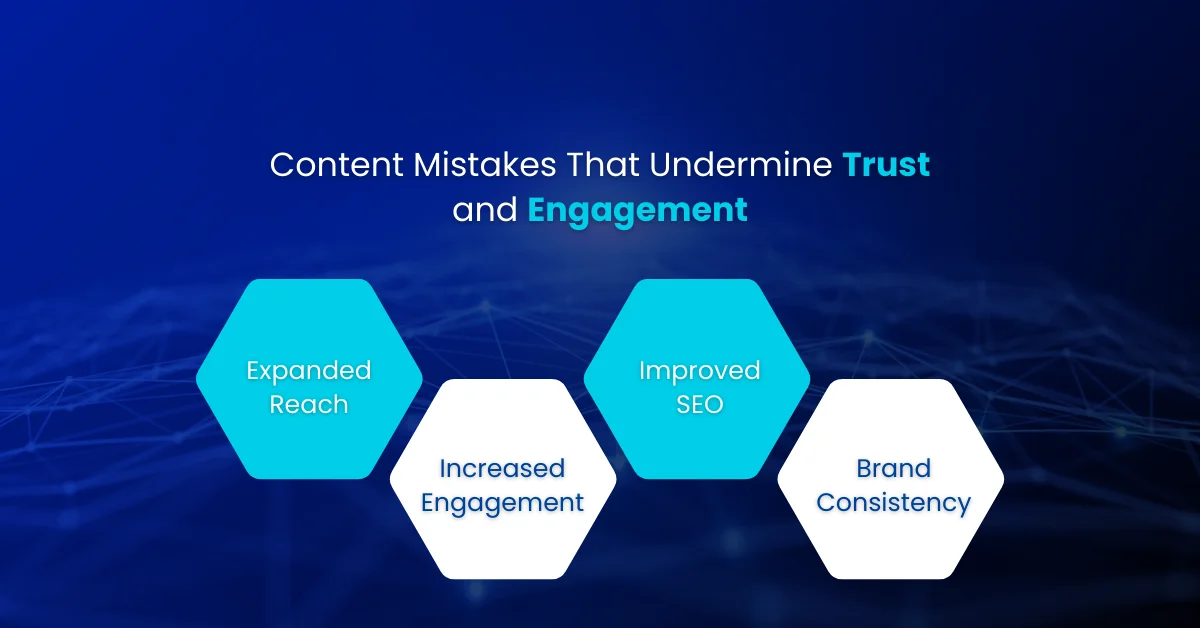
Content is the fuel for every digital marketing channel. These content marketing mistakes are among the most common reasons businesses fail to build organic visibility and convert visitors into customers.
#6 | Chasing Trends Instead of Building Evergreen Value |
Publishing a blog post about every trending topic or viral moment creates a content archive with a very short shelf life. While trend-based content can generate a short-term traffic spike, it rarely attracts the sustained, compounding organic traffic that grows a business over time.
Why Does Google Penalise Trend-Chasing Content in 2026?
Google’s Quality Rater Guidelines, updated in 2025, explicitly assess whether content provides lasting value or was created primarily to attract clicks from trending topics. Trend-chasing articles tend to generate high bounce rates because they attract low-intent visitors which reinforces a negative engagement signal in Google’s ranking algorithm.
How Do You Build an Evergreen Content Foundation?
- Identify the 10–15 core questions your target audience asks most frequently these become your evergreen content priorities
- Create comprehensive in-depth guides on these topics that will remain accurate and useful for 2–3 years with minor updates
- Update evergreen articles every 6 months add new statistics, update screenshots, expand sections based on new search intent signals
- When covering trends, anchor them to evergreen topics: ‘How AI Search Is Changing SEO Strategy’ connects a trend to a permanent subject
- Track evergreen article performance monthly in Search Console declining impressions signal a refresh is needed
#7 | Prioritising Content Quantity Over Quality |
The era of publishing five blog posts per week to feed a content calendar is over. Google’s 2025 Helpful Content System now actively identifies and suppresses content that shows signs of being mass-produced, formulaic, or lacking genuine first-hand expertise.
Content that comprehensively covers a topic in depth is 3x more likely to rank on page 1 than content that only partially covers it. |
What Is the 2026 Content Quality Standard Google Now Requires?
Google’s EEAT framework Experience, Expertise, Authoritativeness, and Trustworthiness is now applied at the page level and site level simultaneously. A site publishing 100 thin articles signals lower overall domain quality than one publishing 20 deeply researched, expert-led guides. Quality is not subjective it is measured by engagement, backlinks earned, and search satisfaction signals.
How Do You Shift to a Quality-First Content Strategy?
- Aim to create the most comprehensive resource available on each topic you cover not just a competent one
- Include original data, proprietary insights, or first-hand client experience in every major content piece
- Invest in professional editing, fact-checking, and visual design presentation is part of quality
- Audit existing content: identify low-performing posts and either significantly improve them or consolidate them into stronger pieces
- Repurpose one excellent article into a video, infographic, social media carousel, and email newsletter rather than creating separate mediocre pieces
#8 | Ignoring Social Proof and Real Customer Case Studies |
Your marketing claims about your own product or service carry the least credibility of all content types. What your customers say about you carries the most. Failing to systematically collect, showcase, and distribute social proof is a conversion mistake that affects every stage of the buyer journey.
76% of B2B buyers require at least three credibility signals including testimonials, case study results, or recognisable client logos before initiating contact with a new vendor. Source: Edelman Trust Barometer 2026 |
How Do You Make Social Proof a Systematic Business Process?
- Automate review requests via email: send 7 days after project completion, include a direct link to Google Business Profile and Trustpilot
- Develop at least 3 detailed case studies per quarter include the client’s specific problem, your solution, and quantified results
- Feature testimonials on your homepage hero section, service pages, and blog sidebars not just on a standalone testimonials page
- Display trusted client logos prominently above the fold on your homepage
- Embed positive social media mentions and LinkedIn recommendations as visual social proof elements
Section 3: What AI and Technology Mistakes Are Businesses Making in 2026?
These two mistakes are new to this guide in 2026 and absent from virtually every competitor article on this topic. They are also the fastest-growing sources of competitive disadvantage for businesses that are slow to adapt. |
#9 | Ignoring AI Tools in Your Marketing Workflow |
Artificial intelligence is no longer a futuristic concept for enterprise businesses. In 2026, AI tools are a practical operational layer used by marketing teams of every size to automate content research, personalise ad creative, analyse campaign data, and optimise customer journeys in real time.
AI-assisted marketing teams report completing content research and creation tasks 4–6x faster than non-AI teams, with 27% higher personalisation scores in email campaigns. |
How Do You Integrate AI Into Your Marketing Workflow Without Losing Quality?
- Use AI writing tools (Claude, ChatGPT, Jasper) for first-draft content, research summaries, and brainstorming always edit and fact-check before publishing
- Leverage AI-powered SEO tools (Surfer SEO, Clearscope, Ahrefs AI) to identify semantic keyword gaps and content structure opportunities
- Use AI image generation for blog visuals, social graphics, and ad creative variations reducing design bottlenecks significantly
- Implement AI chatbots for 24/7 lead qualification and customer support capturing leads outside business hours
- Use AI analytics to identify which content drives revenue and predict which new topics will perform well before you commit to writing them
- Set a clear AI governance policy: define which tasks are AI-assisted vs human-led, and disclose AI use where your industry requires it
#10 | Failing to Build First-Party Customer Data |
This is the single most strategically critical digital marketing mistake a business can make in 2026. If you are still building your marketing strategy primarily around third-party data and platform cookies, you are building on sand. |
The third-party cookie is being phased out across all major browsers, and regulators in the UK, EU, and beyond are tightening data privacy requirements annually. Businesses that have not built a robust first-party data strategy data collected directly and consensually from their own customers will face increasing blind spots in targeting, attribution, and personalisation.
By 2025, 80% of advertisers with mature first-party data strategies reported superior ROI compared to those relying on third-party data a gap that is widening annually. Source: Google / Boston Consulting Group, Privacy-First Marketing Research |
How Do You Build a First-Party Data Infrastructure?
- Prioritise email list growth as your primary owned audience asset every piece of content should include a meaningful lead magnet or newsletter sign-up
- Implement a Customer Data Platform (CDP) or CRM that unifies data from your website, email, ad accounts, and CRM into a single customer profile
- Use on-site surveys, preference centres, and interactive tools (calculators, quizzes) to collect zero-party data data customers give intentionally
- Ensure GA4 is fully configured with first-party signals not relying on deprecated Universal Analytics remnants
- Create a clear cookie consent and data transparency policy trust in your data practices is now a competitive advantage, not just a legal requirement
Section 4: What UX and Experience Mistakes Are Silently Killing Conversions?
You can drive significant traffic to your website and still generate zero leads if the user experience is broken, confusing, or slow. These mistakes represent the gap between visibility and revenue.
#11 | Ignoring Mobile-First Design Still a Blind Spot in 2026 |
As of 2026, over 63% of all global web traffic occurs on mobile devices. Google has operated on a mobile-first indexing policy since 2021, meaning it evaluates and ranks your website based on the mobile version of your content. Despite this, a significant proportion of business websites still deliver a poor mobile experience.
53% of mobile users abandon a page that takes longer than 3 seconds to load and every additional second of delay reduces conversions by approximately 7%. |
What Does Mobile-First Failure Look Like in Practice?
- Text too small to read without zooming
- Buttons and CTAs too close together to tap accurately on a thumb
- Images not resized for mobile viewport causing horizontal scrolling
- Forms triggering the wrong keyboard type for numeric fields
- Page load speeds above 3 seconds on a 4G connection
How Do You Audit and Fix Your Mobile Experience?
- Run Google’s Mobile-Friendly Test and Core Web Vitals assessment for every key page
- Ensure LCP (Largest Contentful Paint) is under 2.5 seconds on mobile compress images, defer non-critical scripts
- Design CTAs as large, thumb-friendly tap targets at least 48px height
- Use a single-column layout for blog posts and landing pages on mobile
- Test every form on real devices not just browser emulators
#12 | Overlooking UX and Funnel Friction Points |
If doing business with your company feels like homework, potential clients leave quietly. They do not complain. They do not fill in a feedback form. They close the tab and go to a competitor whose experience is simpler, clearer, and faster.
What Are the Most Common Funnel Friction Points in 2026?
- Landing pages that do not match the specific promise of the ad or link that brought the visitor
- Contact forms with 8+ required fields when name, email, and message are sufficient
- No clear next step after a visitor reads a blog post no CTA, no related content, no reason to stay
- Checkout or booking flows that require account creation before purchase
- Pricing hidden behind ‘request a quote’ when even a rough range would qualify leads more effectively
How Do You Map and Remove Friction Systematically?
- Use Hotjar or Microsoft Clarity to record real user sessions identify exactly where visitors drop off, hesitate, or abandon
- Review your conversion funnel step-by-step: ad → landing page → CTA → form → confirmation — remove every step that adds no value
- A/B test simplified forms (2–3 fields) against longer forms to measure the conversion impact
- Add a single, clear CTA to every blog post, landing page, and service page remove competing links that dilute focus
- Every paid ad must link to a page that matches its specific promise never send paid traffic to a generic homepage
Section 5: What Social Media and Paid Advertising Mistakes Waste the Most Budget?
Social media and paid advertising represent the largest discretionary budget line in most marketing plans and the area with the highest volume of avoidable waste.
#13 | Posting on Social Media Without a Clear Strategy |
Random acts of content posting sporadically, sharing whatever feels relevant in the moment, reposting competitor articles without commentary are not a social media strategy. They are noise. In 2026, every platform algorithm penalises low-engagement accounts and rewards those that post consistently valuable content.
How Do You Build a Social Media Strategy That Actually Works in 2026?
- Choose 2–3 platforms where your specific audience is most active LinkedIn for B2B, Instagram and TikTok for B2C, YouTube for both
- Define 3–5 content pillars per platform: educational tips, behind-the-scenes, client results, industry news with commentary, team culture
- Build a 30-day content calendar in advance using a tool like Buffer, Later, or Metricool
- Consistency over frequency: 3 high-quality posts per week outperform 7 low-quality ones in every platform algorithm tested
- Engage actively — reply to every comment and DM within 24 hours to boost algorithmic distribution
- Review platform analytics monthly: identify your top 5 posts by reach and engagement, then produce more of that type
#14 Paid Ads · ROI | Wasting Your Paid Ad Budget Without Active Optimisation |
Paid advertising on Google Ads, Meta Ads, and LinkedIn Ads can deliver some of the fastest and most measurable results in digital marketing when managed correctly. Set-and-forget campaign management is one of the most expensive digital marketing mistakes a business can make.
What Are the Most Common Paid Advertising Mistakes in 2026?
- Broad match keywords without negative keyword lists — paying for irrelevant clicks
- Sending all paid traffic to a homepage instead of a dedicated landing page
- Not implementing conversion tracking — optimising for clicks instead of leads or sales
- Running the same ad creative for months without testing variations — creative fatigue kills CTR
- Ignoring the Meta Ads learning phase — making too many changes too quickly resets algorithm learning
- Not using remarketing audiences — warm website visitors are 70% more likely to convert than cold traffic
How Do You Stop Wasting Paid Ad Budget?
- Set up conversion tracking before spending a single pound track form submissions, phone calls, purchases, and micro-conversions in GA4
- Build dedicated landing pages for each campaign with a single clear CTA no navigation, no distractions
- Implement a negative keyword list from day one add to it weekly based on the Search Terms report
- A/B test at least one element per campaign per week: headline, image, CTA copy, or audience segment
- Use retargeting campaigns to re-engage website visitors who did not convert typically the highest-ROI ad spend
- Review campaign performance weekly and adjust bids, budgets, and targeting based on actual conversion data
Section 6: Why Does Failing to Measure ROI Correctly Undermine Everything Else?
What does not get measured does not get managed. The final category of digital marketing mistakes involves the failure to track, attribute, and act on performance data.
#15 | Not Tracking Performance or Attributing ROI Properly |
Tracking page views and social media likes while ignoring conversion rates, cost per acquisition, and revenue attribution is the analytics equivalent of measuring how busy a shop looks without counting how many people bought anything. Vanity metrics create a false sense of momentum.
Only 39% of marketers say they can accurately attribute revenue to specific marketing activities meaning 61% are making budget decisions without knowing which channels are actually working. Source: HubSpot State of Marketing 2026 |
How Do You Build a Measurement Framework That Connects Marketing to Revenue?
- Configure GA4 with custom events for every meaningful user action: form submission, phone click, download, purchase, booking, video plays
- Tag all campaign URLs with UTM parameters: source, medium, campaign, content, and term every link you share must be tagged
- Set up GA4 explorations to view user journeys from first visit to conversion — identify which content and channels are most influential
- Build a weekly dashboard in Looker Studio showing CPL, CAC, MQL-to-SQL rate, and revenue by channel
- Conduct a monthly attribution review: which channels deliver highest-quality leads, not just the most leads
- Implement server-side tracking to reduce data loss from ad blockers and iOS privacy restrictions — increasingly important in 2026
How Do You Audit Your Digital Marketing for These 15 Mistakes?
Use this structured self-audit framework to systematically assess your current digital marketing operation. Rate each area 1 (significant weakness) to 5 (genuine strength) and prioritise the lowest scores.
| Layer | Audit Question | Mapped Mistake |
|---|---|---|
| Strategy Layer | ||
| Strategy | Do we have documented buyer personas built from real client interviews and GA4 behavioural data? | Mistake 1 — No audience definition |
| Strategy | Does every active campaign have a SMART goal with defined KPIs before budget is allocated? | Mistake 2 — No SMART goals |
| Strategy | Do we maintain a keyword map with intent classification for every key landing page? | Mistake 3 — Ignoring keyword research |
| Strategy | Do we have 90-day milestones set, balancing paid and organic growth? | Mistake 4 — Expecting fast results |
| Strategy | Is our channel mix diversified with no single channel generating more than 60% of total leads? | Mistake 5 — Single-channel dependency |
| Content Layer | ||
| Content | Is 80% of our content evergreen, with only 20% trend-based content? | Mistake 6 — Trend-chasing content |
| Content | Do our last 10 published pieces meet a genuine quality benchmark, not just word count? | Mistake 7 — Quantity over quality |
| Content | Do we publish at least 3 quantified case studies per quarter? | Mistake 8 — No social proof |
| Technology & Data Layer | ||
| Technology | Are we actively using at least 3 AI tools across research, creative, analytics, or automation? | Mistake 9 — Ignoring AI tools |
| Data | Do we own a growing first-party email list and collect zero-party data intentionally? | Mistake 10 — No first-party data |
| UX & Experience Layer | ||
| UX | Does our website score 85+ on Google PageSpeed Insights (mobile)? | Mistake 11 — Ignoring mobile-first |
| UX | Have we mapped drop-off points and removed the top 3 friction areas in our conversion funnel? | Mistake 12 — Funnel friction |
| Distribution Layer | ||
| Social | Do we maintain a structured 30-day content calendar with 3–5 content pillars? | Mistake 13 — Unplanned social media |
| Paid Ads | Are all paid campaigns tracked to conversion events and supported by weekly A/B testing? | Mistake 14 — Wasted ad budget |
| Measurement Layer | ||
| Analytics | Is GA4 configured with custom events for all key conversion actions? | Mistake 15 — Poor ROI tracking |
| Analytics | Do we review a revenue-connected marketing dashboard weekly? | Best Practice — Continuous optimisation |
Conclusion: Turn These 15 Digital Marketing Mistakes Into a Competitive Advantage
The 15 digital marketing mistakes covered in this guide share a common thread: they are all the result of operating on assumption rather than data, on habit rather than strategy, and on short-term thinking rather than a long-term growth framework.
The businesses that consistently win online in 2026 are not the ones with the largest budgets. They are the ones who define their audience precisely, create content that genuinely serves that audience, build the technology infrastructure to capture and use data intelligently, and measure everything that connects to revenue.
Start with your self-audit. Identify your two or three most critical weaknesses from the checklist above. Address them with the specific fixes in this guide. Then work through the remaining gaps systematically over the next two quarters. Digital marketing improvement is not a single project it is an ongoing operational discipline.
The cost of continuing to make these mistakes compounds every month. The benefit of fixing them in organic visibility, qualified lead volume, and marketing ROI compounds just as powerfully in the opposite direction.
Ready to Fix These Digital Marketing Mistakes?
Devtrios helps businesses build structured, measurable digital marketing systems that turn traffic into revenue. From SEO-led websites and technical optimisation to GA4 analytics setup and conversion strategy our focus is clarity, accountability, and outcomes.
Contact Devtrios Now →Frequently Asked Questions (FAQs)
The most common digital marketing mistakes in 2026 include failing to define a target audience with research-backed personas, launching campaigns without SMART goals, ignoring keyword research and search intent, over-relying on a single marketing channel, neglecting AI tools in the marketing workflow, failing to build first-party data, and not tracking performance with proper attribution. These errors are more costly than ever as AI-powered search systems, third-party cookie deprecation, and increasingly sophisticated buyers raise the standard for effective digital marketing.
The timeline depends on the type of improvement. Technical and UX fixes such as improving page speed, mobile experience, and Core Web Vitals can show measurable impact on conversions within 2–4 weeks. Content and SEO improvements typically take 2–6 months to affect keyword rankings and 6–12 months to significantly increase organic traffic. Paid advertising optimisations better targeting, landing pages, and conversion tracking can show measurable improvement within 7–30 days.
The content marketing mistakes that most damage ROI are prioritizing quantity over quality and ignoring evergreen topics. Creating large volumes of thin, trend-based content fails to build long-term SEO authority or audience trust, while a few high-quality, evergreen pieces can generate leads and traffic for years.
The most expensive digital marketing mistake is not tracking performance and ROI correctly. When you cannot attribute revenue to its source, you cannot make informed budget decisions. Businesses routinely cut funding to their highest-performing channels while continuing to invest in underperforming ones purely because measurement is absent or inaccurate. The second most expensive mistake is single-channel dependency, which creates catastrophic risk exposure to algorithm changes, platform policy shifts, or ad account suspensions.
Clear indicators include: flat or declining organic traffic over a 3-month period, a cost per lead that is increasing without improvement in lead quality, a bounce rate above 70% on key landing pages, inability to attribute revenue to specific marketing channels, and social media engagement that generates no measurable website traffic or leads. Running a quarterly audit against the 15-point checklist in this guide is the most reliable way to identify which mistakes apply to your business.
Yes. B2B businesses are particularly vulnerable to mistakes in EEAT signalling, long-tail keyword targeting, LinkedIn strategy, and first-party data because buyer journeys are longer and rely heavily on trust signals. B2C businesses are more exposed to mistakes in paid advertising targeting, mobile UX, social media strategy, and conversion rate optimization. Many foundational strategy mistakes, poor audience definition, absent SMART goals, weak performance tracking affect both equally.
About the Author
This article is written by Ali Hamza, a digital strategist and technology writer with hands-on experience in product development, emerging technologies, SEO, and scalable digital systems. He focuses on translating complex technical topics into clear, practical guidance that helps readers make informed decisions.
Ali regularly researches consumer technology trends, software platforms, and digital optimization strategies, ensuring content accuracy, usability, and real-world relevance across a wide range of topics.
View Author Profile →