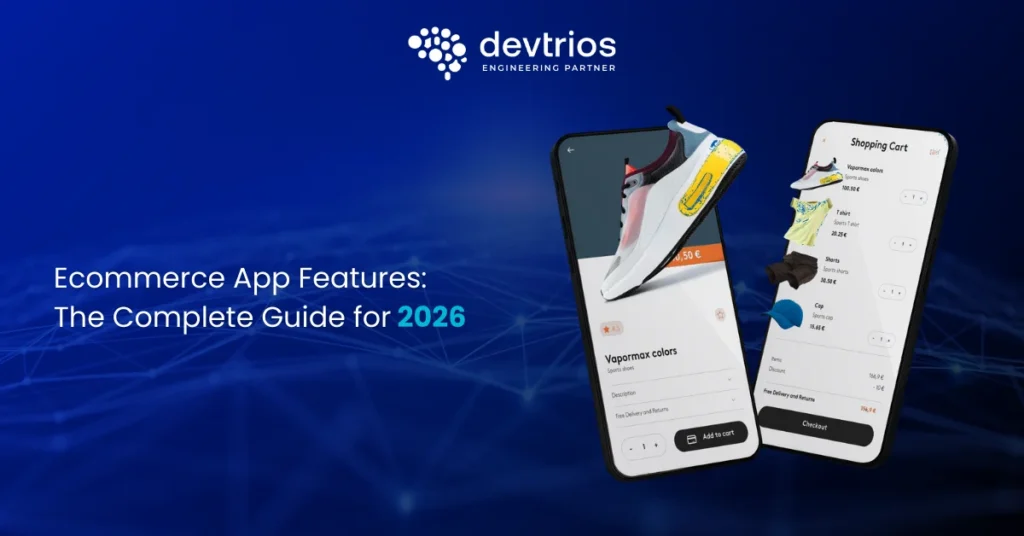

Ecommerce App Features: The Complete Guide for 2026
Ecommerce App Features
Ali Hamza
Quick Answer: What Are Ecommerce App Features? Ecommerce app features are the functional capabilities built into a digital shopping application that allow businesses to list products, process payments, manage orders, and deliver a seamless buying experience to customers. The most important ones include product catalog management, secure checkout, push notifications, order tracking, and AI-powered personalization. |
If you are planning to build or improve an online store, the ecommerce app features you choose will make or break your business. Not just in terms of how the app looks, but in how customers feel while using it, how smoothly your team can manage operations behind the scenes, and whether your store can grow without falling apart at the seams.
This guide covers everything you need to know. Whether you are a small business owner launching your first store, a developer scoping out a build, or a product manager evaluating platforms, this breakdown will help you understand which features matter most, which ones are overrated, and how to prioritize based on your specific goals.
We have organized this guide into logical sections so you can jump to what you need. By the end, you will have a clear picture of the features that drive conversions, retain customers, and scale with your growth.
1. What Are Ecommerce App Features?
At the most basic level, ecommerce app features are the building blocks that give your online store its capabilities. Think of them the way you would think about the rooms in a house. You need a kitchen, a bedroom, a bathroom. Without those, it is not really a home. Without the right features, your ecommerce app is just a pretty interface that cannot do much.
These features span several categories: customer-facing tools that improve the shopping experience, backend tools that help you run operations, marketing tools that drive traffic and repeat purchases, and technical infrastructure that keeps everything running reliably at scale.
What has changed in recent years is how sophisticated these features have become. A product search that used to just match keywords now uses natural language processing to understand what a shopper actually means. A checkout page that used to take five steps can now be completed in one tap. A marketing email that used to be the same for everyone is now personalized based on browsing history, purchase behavior, and even the time of day the customer is most likely to open their phone.
The ecommerce features you invest in are a direct reflection of the experience you are willing to give your customers. And in a market where shoppers have hundreds of alternatives a click away, that experience is everything.
Why Features Matter More Than Design Research consistently shows that 88% of online shoppers say they would not return to a website after a bad user experience. Features drive that experience. A beautiful app with a broken checkout or a slow search function will lose customers that a simpler, better-functioning competitor will keep. |
2. Core Ecommerce App Features Every Business Needs
These are not optional. Whether you are running a one-person Etsy-style boutique or a multi-brand marketplace, the following features form the non-negotiable foundation of any functioning ecommerce application. Skip any of them and you will pay for it in lost conversions, frustrated customers, and operational headaches.
1. Product Catalog Management
Your product catalog is the heart of your ecommerce app. It is where everything your store sells lives, and how well it is organized directly affects whether customers can find what they are looking for. A strong product catalog system lets you manage thousands of SKUs without losing your mind.
Good catalog management includes the ability to add detailed product descriptions, multiple high-resolution images, pricing tiers, size and color variants, and inventory levels per SKU. It should sync automatically with your warehouse or fulfillment system so that stock counts are always accurate. Nothing frustrates a customer more than ordering something that turns out to be out of stock.
- Support for product variants, bundles, and digital products
- Bulk import and export via CSV for large catalogs
- Inventory tracking with low-stock alerts and automatic status updates
- Category and tag organization with custom attributes for faceted filtering
- SEO fields for every product: title, meta description, and URL slug
2. Shopping Cart and Checkout
The checkout experience is where most ecommerce stores leak money. The global average cart abandonment rate sits above 70%, and a significant chunk of those abandonments happen because the checkout process is too complicated, too slow, or does not offer the right payment options.
A well-built shopping cart and checkout system should feel effortless. Customers should be able to add items, review their order, apply discount codes, select a shipping method, and pay without ever feeling like the app is working against them.
- Guest checkout option so new users do not have to create an account to buy
- One-click checkout for returning customers using saved payment details
- Persistent cart that saves items across devices and sessions
- Order summary with clear itemization of products, taxes, and shipping fees
- Coupon and discount code field with real-time validation
- Address autocomplete to reduce typing friction
- Cart abandonment recovery tools including triggered email sequences
3. Payment Gateway Integration
You cannot run an ecommerce business without accepting payments, and the range of payment methods you support directly affects how many customers complete their purchases. A shopper who prefers PayPal and finds you only accept credit cards is likely to leave.
Modern ecommerce apps should support a wide range of payment gateways and methods including Stripe, PayPal, Apple Pay, Google Pay, and buy now pay later services like Klarna or Afterpay. PCI DSS compliance is non-negotiable for handling card data, and tokenization should be used to store payment credentials securely for repeat customers.
- Multiple gateway support with failover capability
- Local payment methods for international markets (UPI for India, iDEAL for Netherlands, etc.)
- Buy now pay later (BNPL) integration to increase average order value
- Fraud detection and 3D Secure authentication
- Automatic currency conversion for multi-currency stores
4. User Authentication and Account Management
Creating an account should feel like a benefit, not a barrier. The best ecommerce apps make registration painless by offering social login with Google or Facebook, one-tap OTP verification, and biometric login on mobile devices.
Once logged in, customers should have a full account dashboard where they can track orders, manage their saved addresses and payment methods, view their purchase history, and manage communication preferences. A well-designed account experience builds loyalty and makes repeat purchases significantly easier.
- Social login (Google, Facebook, Apple) for frictionless signup
- OTP-based and biometric authentication for mobile
- Profile management with saved addresses and payment methods
- Order history with reorder functionality
- Wishlist management and shared wishlists
5. Powerful Search and Filter System
If customers cannot find what they are looking for within seconds, they will leave. Search is one of the highest-intent interactions on any ecommerce app, and investing in a smart, fast search experience delivers some of the best returns of any feature you can build.
A basic keyword search is no longer enough. Shoppers expect autocomplete suggestions, typo tolerance, and results that reflect what they meant rather than just what they typed. Faceted filtering lets shoppers narrow results by price range, brand, rating, size, color, and any other attribute relevant to your catalog.
- Autocomplete with product image previews in the dropdown
- Typo tolerance and synonym matching powered by NLP
- Faceted filter panels that update results in real time
- Voice search support for hands-free browsing
- Personalized search results ranked by individual browsing behavior
- Zero-results page handling with suggestions and category links
6. Order Management System
An is the operational backbone of your ecommerce app. It handles every order from the moment of purchase through fulfillment, shipping, and potential returns. Without a solid OMS, your customer service team will drown in manual work and your customers will constantly wonder where their order is.
- Real-time order status updates with customer-facing tracking pages
- Integration with logistics partners (FedEx, UPS, DHL, local carriers)
- Returns and refund management with automated workflows
- Multi-warehouse and multi-location inventory routing
- Fraud flagging and manual review queue for suspicious orders
7. Product Reviews and Ratings
Shoppers trust other shoppers more than they trust brands. Product reviews and ratings are one of the most powerful conversion tools available to any ecommerce business. They build social proof, surface helpful information, and create fresh user-generated content that supports your SEO.
A good review system goes beyond star ratings. It should allow photo uploads, verified purchase badges, helpful vote sorting, and Q&A sections where potential buyers can ask questions answered by previous customers or the brand.
- Verified purchase badges to establish authenticity
- Photo and video review support for richer social proof
- Review sorting by recency, helpfulness, and rating
- Brand response capability to address negative reviews publicly
- Review syndication to Google Shopping and other channels
8. Mobile-Optimized Experience and PWA Support
More than 70% of ecommerce traffic now comes from mobile devices, and mobile shoppers convert at lower rates than desktop users primarily because most mobile experiences are still not good enough. This is not about having a responsive layout. It is about designing every interaction for a thumb on a 6-inch screen.
Progressive Web Apps (PWAs) are a particularly powerful approach. They load like websites but behave like native apps, including offline functionality, push notification support, and home screen installation without requiring an app store download. For businesses that want broad reach without the overhead of separate iOS and Android development, PWAs are worth serious consideration.
- Sub-3-second load time on 4G connections
- Touch-friendly navigation with large tap targets and swipe gestures
- Offline browsing capability for recently viewed products
- Progressive Web App support for home screen installation
- Optimized image delivery with WebP format and lazy loading
9. Push Notifications
Push notifications are one of the highest-ROI communication channels available to ecommerce businesses. When used correctly, they drive cart recovery, promote flash sales, update customers on order status, and bring lapsed customers back to the app. When used carelessly, they get disabled by users within a week.
The difference between a push notification strategy that works and one that annoys people comes down to relevance and timing. Notifications should be personalized based on behavior, segmented by customer type, and sent at moments when they are likely to be welcome rather than intrusive.
- Cart abandonment reminders triggered after a defined time window
- Price drop alerts for wishlisted items
- Order status updates from dispatch through delivery
- Personalized product recommendations based on purchase history
- Flash sale and limited-time offer announcements with countdown timers
10. SEO and Marketing Tools
An ecommerce app that cannot be found by search engines is invisible to the majority of potential customers who discover products through Google. Every product page, category page, and blog post on your store needs to be built with search engine visibility in mind.
This means clean, crawlable URLs for every page, automatically generated sitemaps, canonical tags to prevent duplicate content issues, schema markup for products and reviews, and open graph tags for social sharing. Your CMS or ecommerce platform should allow you to customize meta titles and descriptions for every page without needing a developer.
- Custom meta titles, descriptions, and URL slugs for every page
- XML sitemap auto-generation and robots.txt control
- Structured data markup for Product, Review, BreadcrumbList, and FAQPage schemas
- Canonical tag management to handle faceted navigation and duplicate content
- UTM parameter support for campaign tracking
- Integrated blog or content hub for SEO content marketing
3. Advanced Ecommerce App Features That Drive Growth
Once you have the core features in place and your store is running reliably, the next layer of features is where real competitive advantage is built. These are the capabilities that the leading ecommerce apps are investing in heavily right now, and they are increasingly accessible to businesses of all sizes thanks to improvements in cloud infrastructure and AI tooling.
AI-Powered Personalization Engine
Personalization at scale is only possible with machine learning. An AI-powered recommendation engine analyzes each customer’s browsing history, purchase behavior, time-on-page data, search queries, and demographic signals to dynamically surface products they are most likely to buy.
Amazon attributes up to 35% of its total revenue to its recommendation engine. While building something comparable from scratch is complex, platforms like Klaviyo, Nosto, and Dynamic Yield make sophisticated AI personalization accessible to mid-market retailers.
- Homepage personalization showing different content to different user segments
- Collaborative filtering showing ‘customers who bought this also bought’ suggestions
- Dynamic pricing adjustments based on demand signals and user behavior
- Personalized email and push notification content based on behavioral triggers
- AI-powered upsell and cross-sell placement on product and cart pages
Loyalty and Rewards Programs
Acquiring a new customer costs five times more than retaining an existing one. Loyalty programs directly address this by giving your best customers a reason to keep coming back. Points systems, tiered membership levels, referral bonuses, and exclusive early access to new products all create emotional attachment to your brand that pure discounting cannot replicate.
- Points-based rewards with transparent earn-and-redeem mechanics
- Tiered loyalty levels (Bronze, Silver, Gold) with escalating benefits
- Referral program with unique shareable links and tracked reward issuance
- Birthday rewards and anniversary surprises for high-value customers
- Gamification elements including progress bars and achievement badges
Social Commerce Integration
Social media is not just a marketing channel anymore. It is a shopping channel. Instagram Shopping, TikTok Shop, and Facebook Marketplace all allow customers to discover and purchase products without leaving their social feed. Connecting your ecommerce app to these channels dramatically expands your reach and reduces the friction between discovery and purchase.
- Product catalog sync with Instagram, TikTok, and Facebook shops
- Live shopping event integration for TikTok and Instagram Live
- User-generated content aggregation and shoppable gallery creation
- Social sharing buttons on product pages with pre-populated captions
Augmented Reality Product Visualization
One of the biggest conversion barriers in ecommerce is the inability to try before you buy. Augmented reality features address this by letting customers visualize products in their real environment or on their body before committing to a purchase. This technology was once the exclusive territory of large luxury brands, but it is becoming mainstream across furniture, eyewear, fashion, beauty, and home decor.
Shopify reports that products with AR content see a 94% higher conversion rate compared to products without it. The impact on return rates is equally significant.
- 3D product viewer with 360-degree rotation
- AR room placement for furniture and home goods
- Virtual try-on for glasses, jewelry, watches, and clothing
- Makeup and hair color simulation using camera overlay
Live Chat and AI-Powered Customer Support
Customers who have questions mid-purchase are more likely to complete that purchase if they can get answers instantly. Live chat fills that gap, and AI-powered chatbots extend that capability to 24 hours a day without requiring a full support team on standby.
The best implementations combine a smart chatbot for common questions with seamless handoff to a human agent for complex issues. Integrating your support tool with order management data allows the chatbot to answer order status questions automatically, which handles a significant portion of incoming inquiries.
- AI chatbot trained on your product catalog, FAQs, and policies
- Human handoff with full conversation context passed to the agent
- WhatsApp and Messenger integration for customers who prefer messaging apps
- Proactive chat triggers based on time-on-page or exit intent signals
- Post-chat satisfaction surveys feeding into quality improvement
Advanced Analytics and Reporting Dashboard
Data without context is just noise. A good analytics dashboard turns the raw data your ecommerce app generates every day into actionable insights that help you make better decisions about your product, marketing, and operations.
Beyond pageviews and revenue totals, you need to understand funnel conversion rates at each step, cohort retention curves, customer lifetime value by acquisition channel, and product performance by category. The more granular your visibility, the faster you can identify problems and opportunities.
- Sales dashboard with real-time revenue, order volume, and AOV
- Funnel visualization from product page through checkout completion
- Customer cohort analysis showing retention curves over time
- Product performance reports by revenue, margin, and return rate
- Marketing attribution showing revenue by channel and campaign
- Heatmaps and session recording integration for UX optimization
Planning an Ecommerce App or Improving an Existing One?
Choosing the right features can dramatically improve conversions, customer retention, and operational efficiency. Our team helps businesses design and build ecommerce apps with scalable architecture, high-performance search, seamless checkout, and AI-driven personalization.
Discuss Your Ecommerce App →4. Ecommerce App Features by Business Size
Not every business needs the same feature set on day one. A solo founder launching a niche product store has fundamentally different needs than a mid-sized retailer managing thousands of SKUs across multiple sales channels. Here is a practical breakdown of which features to prioritize at each stage of growth.
Small Business and Startups
When you are just starting out, speed to launch and cost efficiency matter more than having every feature on the list. Focus on getting a clean, functional store live with the minimum viable feature set, then iterate based on actual customer behavior.
- Essential: product catalog, shopping cart, one or two payment gateways, mobile optimization, basic SEO tools
- Important early additions: product reviews, basic push notifications, email capture and cart abandonment recovery
- Can wait: AI personalization, AR features, loyalty programs, advanced analytics
- Platform recommendation: Shopify Basic or WooCommerce with a lightweight theme keeps costs low while covering all essentials
See our dedicated guide on ecommerce app features for small business for platform-specific recommendations and cost breakdowns tailored to early-stage businesses.
Mid-Market and Growing Retailers
At this stage you have proven product-market fit, you are processing a meaningful volume of orders daily, and you are starting to feel the limitations of your initial setup. The focus shifts from simply operating to optimizing and scaling.
- Priority upgrades: advanced search with AI autocomplete, loyalty program, multi-channel selling, detailed analytics dashboard
- Operational needs: robust OMS with multi-warehouse support, automated return processing, customer segmentation
- Growth features: AI personalization engine, social commerce integration, affiliate or referral program
- Platform consideration: Shopify Plus, BigCommerce, or a headless build on a composable commerce stack
Enterprise and High-Volume Operations
Enterprise ecommerce apps operate at a scale where even marginal improvements in conversion rate or operational efficiency translate to significant revenue impact. At this level, custom development often makes more sense than relying on a single platform’s limitations.
- Must-have: real-time inventory sync across all channels and warehouses, headless commerce architecture, enterprise-grade OMS
- Competitive requirements: advanced AI personalization, AR visualization, predictive analytics, dynamic pricing
- Technical infrastructure: CDN-delivered performance, microservices architecture, API-first design for omnichannel integration
- Support and compliance: dedicated account management, SLA-backed uptime, GDPR and CCPA compliance tooling
5. How to Choose the Right Ecommerce App Features for Your Business
There is no universal feature checklist that works for every ecommerce business. The right feature set depends on your product type, your customers, your operational model, and your growth stage. Here is a decision framework that helps you prioritize without wasting budget on features that will not move the needle for your specific situation.
Step 1: Define Your Customer Journey
Map every step a customer takes from discovering your brand to completing a purchase and potentially returning for a second one. At each stage, identify where friction exists or where an experience gap could cost you a conversion. The features you prioritize should directly address those friction points.
Step 2: Segment Your Feature List by Impact and Effort
Not every feature delivers equal return on investment. Score each potential feature by its likely impact on conversion rate, average order value, customer retention, or operational efficiency. Then score it by the effort and cost to implement. Prioritize high-impact, low-effort features first.
Step 3: Validate With Data Before Building
Before committing resources to building a complex feature like an AI recommendation engine or a loyalty program, validate the need with data or customer research. Talk to your existing customers. Review your analytics to find where users are dropping off. Build features that solve documented problems, not features that seem impressive.
Step 4: Consider Platform Versus Custom Build
Many ecommerce features are available out of the box through platforms like Shopify, BigCommerce, or WooCommerce. Building custom versions of these features only makes sense when your needs are genuinely outside what platforms can offer, or when the volume of transactions makes the per-transaction fees of hosted platforms prohibitively expensive.
Step 5: Plan for Integration From Day One
The features you build or enable do not exist in isolation. Your payment gateway needs to talk to your fraud detection tool. Your email marketing platform needs data from your OMS. Your analytics dashboard needs to pull from every customer touchpoint. Plan your integration architecture early so you are not rebuilding everything when you want to connect a new tool.
Pro Tip: Start With Conversion, Then Retention Most businesses should prioritize features that improve checkout conversion first, because those improvements have an immediate impact on revenue. Once conversion is optimized, shift focus to retention features like loyalty programs, personalized push notifications, and repeat-purchase incentives. |
6. Platform Comparison: Shopify vs WooCommerce vs Custom Build
Choosing where to build your ecommerce app is one of the most consequential decisions you will make. Each option has real trade-offs across cost, flexibility, development speed, and long-term scalability. Here is an honest comparison to help you decide.
| Feature / Capability | Shopify | WooCommerce | Custom Build |
|---|---|---|---|
| Setup Speed | Fastest (hours) | Moderate (days) | Slowest (weeks to months) |
| Monthly Cost | $29 to $299+ platform fee | $0 platform + hosting fees | Development + infrastructure cost |
| Product Catalog Management | Excellent, built-in | Excellent via plugins | Fully custom, full control |
| Payment Gateways | 100+ native integrations | Most major gateways via plugins | Any gateway via custom API |
| SEO Capabilities | Good, some limitations on URL structure | Excellent, full control | Excellent, total control |
| AI Personalization | Via apps (Nosto, LimeSpot) | Via plugins | Custom ML models possible |
| Mobile App / PWA | Shopify app available; PWA via third party | PWA via plugins | Full native app or PWA |
| Multi-Language and Multi-Currency | Built-in with Shopify Markets | Via WPML + plugins | Fully custom implementation |
| Scalability | Excellent for most scales | Requires infrastructure management at scale | Unlimited with the right architecture |
| Development Flexibility | Limited to Shopify ecosystem | High flexibility in WordPress | Unlimited |
| Ownership and Portability | Platform-dependent | Full ownership on your server | Full ownership |
| Best For | Startups to mid-market stores | Content-heavy stores and blogs | Enterprise or highly unique platforms |
The right choice depends on your timeline, budget, and long-term vision. Shopify wins on speed and ease. WooCommerce wins on content integration and cost at low volumes. A custom build wins on flexibility and long-term ownership but requires significantly more upfront investment.
Final Thoughts: Building an Ecommerce App That Lasts
Building a successful ecommerce app is not about having the most features. It is about having the right ones, implemented well, with a clear understanding of what your customers actually need at each stage of their journey with your brand.
Start with a solid foundation: product catalog, checkout, payments, mobile optimization, and search. Get those right before you expand. Then layer in the growth features that your data tells you will have the most impact. Push notifications if your retention metrics are low. Loyalty programs if you have repeat customers who would respond to incentives. AI personalization when your catalog and traffic volumes justify it.
The businesses that win in ecommerce are not necessarily the ones with the biggest budgets or the most sophisticated technology. They are the ones that understand their customers deeply, move fast to solve real problems, and build experiences that make people want to come back.
Planning to Build or Upgrade Your Ecommerce App?
Devtrios helps businesses design and build high-performance ecommerce applications with scalable architecture, seamless checkout, intelligent search, and AI-driven personalization. From MVP launches to enterprise platforms, we focus on building apps that convert, scale, and deliver measurable business growth.
Talk to an Ecommerce App Expert →Frequently Asked Questions (FAQs)
At minimum, every ecommerce app needs a product catalog with search and filtering, a secure shopping cart and checkout, at least two or three payment gateway options, user account management, mobile optimization, and basic SEO tools. These form the foundation everything else builds on.
You do not need every feature from day one. A successful launch can be done with 8 to 12 well-executed core features. The goal at launch is to prove that customers want to buy your product and that they can do so without friction. You can layer in advanced features like personalization, loyalty programs, and social commerce after validating your core offering.
For mobile, the most critical features are a fast, lightweight interface with sub-3-second load times, a simplified checkout flow ideally with Apple Pay or Google Pay support, biometric login, push notification support, and a touch-optimized product browsing experience. Mobile users are less patient than desktop users, so every second and every tap matters more.
Ecommerce features have a direct impact on SEO in multiple ways. Your URL structure, schema markup implementation, page load speed, mobile optimization, and content depth all influence how Google ranks your pages. Features that support user engagement metrics like time on site, bounce rate, and return visits also send indirect SEO signals. Investing in search-friendly architecture from the start is far more cost-effective than trying to retrofit SEO onto a poorly structured app later.
The line between app and website has blurred significantly with the rise of Progressive Web Apps. However, native mobile apps (iOS and Android) offer advantages in push notification delivery, biometric authentication, device hardware access for AR features, and offline functionality. A website optimized for mobile can cover most customer needs, but a native app or PWA tends to deliver better engagement and repeat usage metrics for brands with a loyal customer base.
Cost varies widely based on your approach. A Shopify or WooCommerce setup with plugins can cover most core features for a few hundred dollars per month. A custom-built ecommerce app with advanced features including AI personalization, AR visualization, and a custom OMS typically ranges from $50,000 to $300,000 or more in development costs depending on the scope and your development team's rates.
Based on industry data, the features with the most direct and measurable impact on conversion rate are: a simplified one-page checkout, guest checkout availability, trust badges and security indicators at checkout, product reviews and ratings, cart abandonment push notifications, and real-time inventory status showing low-stock warnings. Together, these features can improve conversion rates by 20 to 40 percent compared to a baseline implementation.
For businesses processing more than a few hundred orders per month, yes. AI-powered personalization, smart search, and predictive analytics start delivering meaningful ROI once you have enough behavioral data to train the algorithms. At low volumes, simpler rule-based approaches often perform similarly for a fraction of the cost. The right time to invest in AI features is when you have enough transaction history to make the personalization genuinely relevant.
About the Author
This article is written by Ali Hamza, a digital strategist and technology writer with hands-on experience in product development, emerging technologies, SEO, and scalable digital systems. He focuses on translating complex technical topics into clear, practical guidance that helps readers make informed decisions.
Ali regularly researches consumer technology trends, software platforms, and digital optimization strategies, ensuring content accuracy, usability, and real-world relevance across a wide range of topics.
View Author Profile →