
The enterprise mobile application market continues its significant expansion, with forecasts indicating sustained double-digit growth heading into 2026. This is not merely a trend but a fundamental shift in how organisations operate, compete, and deliver value. Enterprise mobility is no longer an IT project; it is a core pillar of digital transformation, enabling enhanced productivity, streamlined workflows, and new channels for customer engagement. For an enterprise, the right mobile application can unlock substantial operational efficiencies and create a powerful competitive advantage.
However, the process of selecting an enterprise mobile app development company is fraught with complexity. The stakes are considerably higher than in the consumer app space. Enterprise solutions demand robust security protocols, seamless integration with legacy systems like ERP and CRM, and the ability to scale across thousands of users globally. Choosing a partner involves more than evaluating technical skill; it requires a deep assessment of their strategic understanding, governance models, and long-term viability. A misaligned partnership can lead to budget overruns, security vulnerabilities, and a final product that fails to meet critical business objectives.
This guide is designed to provide enterprise leaders, from CTOs to Heads of Digital Transformation, with a clear, analytical framework for navigating this decision. We will explore the key evaluation criteria for selecting a partner, profile a curated list of capable firms, and examine the critical technological trends shaping the enterprise mobility landscape in 2026. The objective is to equip you with the insights needed to select a strategic partner capable of delivering secure, scalable, and transformative mobile solutions.
How We Evaluated These Companies
The selection of companies for this guide was based on a rigorous, multi-faceted research process designed to ensure objectivity and relevance for an enterprise audience. Our evaluation did not rely on paid placements or self-submitted entries. Instead, we conducted an in-depth analysis of market presence, client testimonials, and publicly available project portfolios. Our research sources included industry reports from leading technology analysis firms, professional network discussions, and detailed case studies focused on large-scale deployments.
Our methodology prioritised firms demonstrating a proven track record in custom enterprise application development. We assessed each potential company against a consistent set of criteria, focusing on their ability to handle complexity, mitigate risk, and align with strategic business outcomes. This list is not a definitive ranking but a curated selection of credible vendors. The list includes global consultancies, specialised product studios, and mid-sized enterprise-focused agencies, reflecting the diverse range of partners available in the market. The goal is to provide a representative view of the industry’s most competent players, empowering you to create a well-informed shortlist.
Planning an Enterprise Mobile Initiative in 2026?
Selecting the right development partner is a strategic decision. Whether you are modernising legacy systems, integrating with ERP or CRM platforms, or building secure AI-driven workflows, your architecture must be scalable, compliant, and future-ready. We work with enterprise teams to design and deliver secure, high-performance mobile solutions aligned with measurable business outcomes.
Discuss Your Enterprise Roadmap →
Evaluation Criteria for an Enterprise Partner
Selecting the right partner requires looking beyond surface-level presentations. Enterprise leaders must scrutinise a potential vendor’s capabilities across several critical domains. This framework outlines the essential criteria to use during your evaluation process.
- Enterprise Architecture Capability: The ability to design systems that are not only functional but also scalable, resilient, and maintainable. This includes proficiency in microservices, service-oriented architecture (SOA), and cloud-native principles to ensure the application can grow and adapt with the business.
- CRM/ERP Integration Expertise: Deep, demonstrable experience in integrating mobile applications with core enterprise systems such as Salesforce, SAP, Oracle, and Microsoft Dynamics is non-negotiable. Successful integration ensures data consistency and streamlines critical business workflows.
- Security & Compliance Readiness: A profound understanding of enterprise-grade security is paramount. This includes expertise in data encryption, secure authentication protocols, threat modelling, and adherence to regulatory frameworks like GDPR, HIPAA, and PCI DSS. The vendor must demonstrate a security-first mindset.
- Enterprise UX Capability at Scale: Designing a user experience for a complex enterprise application is different from consumer apps. The partner must prove their ability to conduct thorough user research, map complex workflows, and design intuitive interfaces that enhance productivity for a diverse internal user base.
- Delivery Model & Governance: A transparent and structured delivery process is crucial for managing large projects. Evaluate their governance model, communication protocols, risk management framework, and proficiency in Agile or hybrid methodologies tailored for enterprise environments.
- Post-Launch Support and Evolution: The partnership does not end at launch. Assess the provider’s model for ongoing support, maintenance, performance monitoring, and their roadmap for evolving the application to meet future business needs and technological advancements.
- Cross-Platform Strategy: A competent partner should offer a strategic approach to cross-platform development. They must be able to advise on whether a native, hybrid, or progressive web app (PWA) approach best suits your specific use case, budget, and long-term goals.
Leading Enterprise Mobile App Development Companies for 2026
The following companies represent a cross-section of the market, each with distinct strengths and areas of focus. They are presented alphabetically to facilitate objective comparison.
Accenture (Dublin, Ireland)
A global professional services giant, Accenture provides end-to-end digital transformation services, including enterprise mobility.
- Core Enterprise Strengths: Unmatched in scale, Accenture excels at large, complex, multi-national rollouts that require deep integration with legacy systems. Their strategic consulting arm helps align mobile initiatives with broader business transformation goals. They possess vast resources for managing global compliance and security challenges.
- Industries Served: Financial Services, Healthcare, Public Sector, Retail, Energy.
- Notable Differentiator: Their ability to combine strategic consulting with technology implementation at a global scale makes them a choice for Fortune 500 companies undertaking foundational transformation projects.
Devtrios (London, UK)
A specialised agency focused on enterprise digital transformation through custom mobile and web applications.
- Core Enterprise Strengths: Devtrioshas built a strong reputation in highly regulated industries, emphasising secure and compliant software architecture. They focus on developing scalable AI and automation solutions to transform core business workflows, moving beyond simple digitisation to intelligent process enhancement. Their delivery model is structured around strategic 12–16 week cycles.
- Industries Served: Finance, Legal, Insurance, Logistics.
- Notable Differentiator: A distinct focus on aligning technology with sustainability and governance objectives, making them a suitable partner for organisations prioritising ESG (Environmental, Social, and Governance) criteria in their procurement process.
ELEKS (Tallinn, Estonia)
A large technology consultancy providing custom software development and product design services for over 30 years.
- Core Enterprise Strengths: ELEKS offers a mature practice in data science, IoT, and enterprise mobility solutions. They have a strong engineering culture and provide a balanced offering of strategic advice and technical execution. Their experience spans a wide range of complex projects, including enterprise resource planning and supply chain management systems.
- Industries Served: Logistics, Finance, Healthcare, Retail.
- Notable Differentiator: Their long-standing presence and extensive portfolio of complex enterprise projects provide a level of assurance regarding their ability to deliver robust and reliable software solutions.
Intellectsoft (Miami, USA)
A digital transformation consultancy that provides cutting-edge engineering solutions for global organisations.
- Core Enterprise Strengths: Intellectsoft has a solid track record in developing sophisticated enterprise mobile applications, particularly those requiring blockchain and IoT integration. They offer a flexible engagement model, from dedicated teams to full-service project delivery, catering to different enterprise needs. Their focus on emerging technologies is a key strength.
- Industries Served: FinTech, Construction, Healthcare, Insurance.
- Notable Differentiator: Strong expertise in integrating emerging technologies like IoT and distributed ledger technology into scalable enterprise mobile platforms.
LeewayHertz (San Francisco, USA)
A leading mobile app development company with a focus on new and emerging technologies.
- Core Enterprise Strengths: Established in 2007, LeewayHertz has extensive experience in the mobile domain. They are particularly strong in developing applications that leverage AI, machine learning, and blockchain. They have delivered numerous applications for large enterprises, demonstrating their capacity to handle complex technical requirements.
- Industries Served: Manufacturing, Retail, Healthcare, Technology.
- Notable Differentiator: An early adopter and expert in blockchain technology, making them a go-to partner for enterprises looking to build decentralised applications or integrate blockchain features for security and transparency.
Rightpoint (Chicago, USA)
A Genpact company, Rightpoint is a global experience agency that designs and engineers end-to-end digital experiences.
- Core Enterprise Strengths: Rightpoint excels in the intersection of enterprise user experience (UX) and complex technology. Their approach is heavily centered on human-centric design, ensuring that complex enterprise tools are intuitive and drive user adoption. As part of Genpact, they have access to deep process transformation expertise.
- Industries Served: Healthcare, Financial Services, Manufacturing, Media.
- Notable Differentiator: Their agency-led focus on “Total Experience” combines employee experience, customer experience, and product experience to create holistic solutions that drive business impact.
The BHW Group (Austin, USA)
An application design and development consultancy with a long history of building effective business software.
- Core Enterprise Strengths: The BHW Group is known for its meticulous process and focus on creating applications that provide a tangible return on investment. With over 15 years in business and work on more than 450 projects, they have a proven methodology for delivering reliable enterprise-grade software. They have a particularly strong reputation for rescuing and turning around failing projects.
- Industries Served: Healthcare, Business Services, Transportation, Education.
- Notable Differentiator: Their strong emphasis on business analysis and a transparent, user-centric process helps ensure the final product is precisely aligned with organisational goals.
Thoughtworks (Chicago, USA)
A global technology consultancy that integrates strategy, design, and software engineering to enable enterprise digital transformation.
- Core Enterprise Strengths: Thoughtworks is renowned for its pioneering work in Agile development methodologies and its high-calibre engineering talent. They excel in helping large organisations modernise their technology stack and adopt new ways of working. Their expertise in creating scalable enterprise architecture and continuous delivery pipelines is world-class.
- Industries Served: Retail, Financial Services, Public Sector, Travel.
- Notable Differentiator: Their thought leadership and advocacy for engineering best practices make them a strategic partner for organisations aiming to build internal capability alongside their mobile products.
Honourable Mentions
For enterprises with exceptionally large-scale, global deployment needs, major system integrators (SIs) are often a primary consideration. Companies like Tata Consultancy Services (TCS), Infosys, and Capgemini possess immense global delivery capabilities, deep industry-specific knowledge, and long-standing relationships with many of the world’s largest corporations. While they may offer a different engagement model compared to the specialised firms listed above, their ability to manage massive, multi-year transformation programmes is unparalleled. They are best suited for organisations requiring extensive IT outsourcing and managed services in conjunction with their mobile app development initiatives.
Enterprise Mobile App Trends for 2026
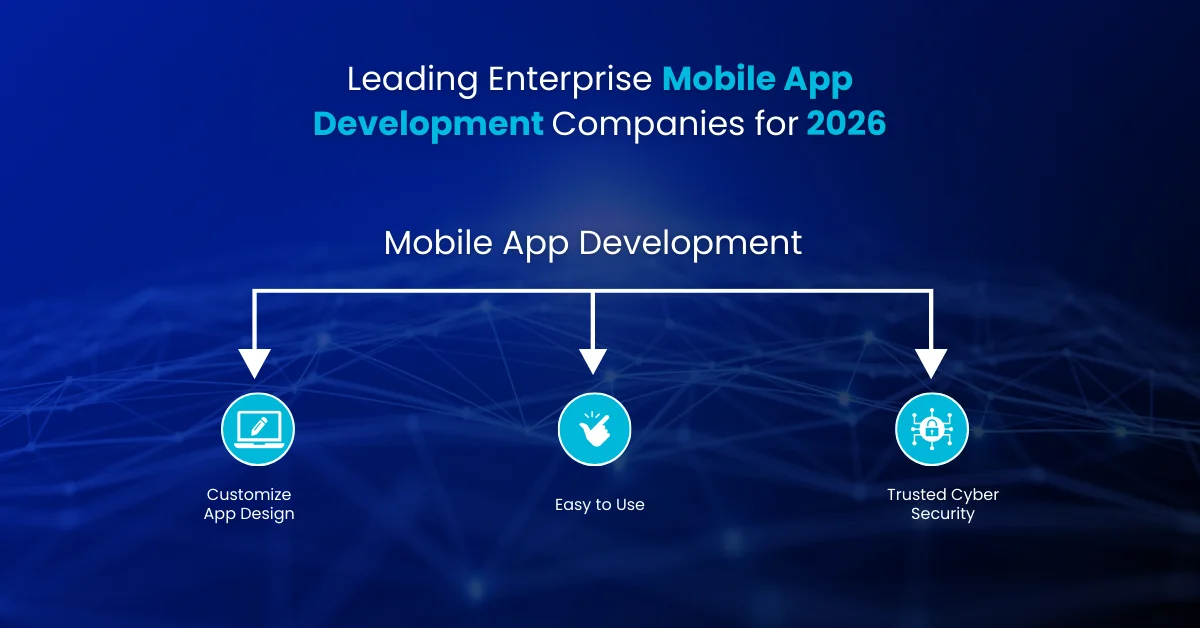
To make an informed decision, it is crucial to understand the technological currents that will define enterprise mobility in the coming years. A forward-thinking partner should not only be proficient in today’s technology but also be preparing for tomorrow’s.
AI-Driven Enterprise Workflows
Artificial intelligence is moving beyond chatbots and into the core of enterprise applications. In 2026, expect to see more apps with predictive analytics that guide employee decisions, intelligent automation that handles repetitive tasks, and machine learning models that personalise user experiences based on role and behaviour. This trend transforms apps from passive data entry tools into active partners in productivity.
IoT Integration and Digital Twins
The convergence of the Internet of Things (IoT)and mobile applications is creating powerful new possibilities. Enterprise apps are increasingly serving as the command-and-control interface for vast networks of connected devices. This allows for real-time monitoring of assets, predictive maintenance alerts in manufacturing, and sophisticated supply chain tracking. The concept of “digital twins” virtual replicas of physical assets will become more common, managed via specialised enterprise mobile apps.
Edge Computing & 5G
The rollout of 5G networks, combined with edge computing, will dramatically reduce latency and increase the processing power available to mobile devices. For enterprises, this means applications can perform complex computations locally without a constant round-trip to a central cloud server. This enables more responsive and reliable applications, especially for field service workers, logistics, and manufacturing floor operations where connectivity can be intermittent.
Advanced Cross-Platform Frameworks
The debate between native and cross-platform development continues, but the capability of modern frameworks like Flutterand React Native has matured significantly. For 2026, the trend is towards “strategic cross-platform” development. Rather than a one-size-fits-all approach, enterprises will leverage these frameworks for applications where speed-to-market and code efficiency are paramount, while still opting for native development for performance-critical or hardware-intensive use cases.
Compliance-First Architecture
With data privacy regulations becoming more stringent globally, a “compliance-by-design” approach is no longer optional. Future enterprise applications will be built on an architecture where data governance, residency, and privacy controls are foundational elements, not afterthoughts. This includes features like granular user permissions, comprehensive audit trails, and automated data lifecycle management.
Sustainability in Software Engineering
A growing consideration for enterprises is the environmental impact of their digital infrastructure. “Green coding” and sustainable software engineering practices will become a key trend. This involves writing efficient code that consumes less energy, optimising data transfer to reduce network load, and designing cloud architecture for lower carbon emissions. Forward-thinking development partners will begin to report on the sustainability metrics of the software they build.
How to Choose the Right Enterprise App Development Company
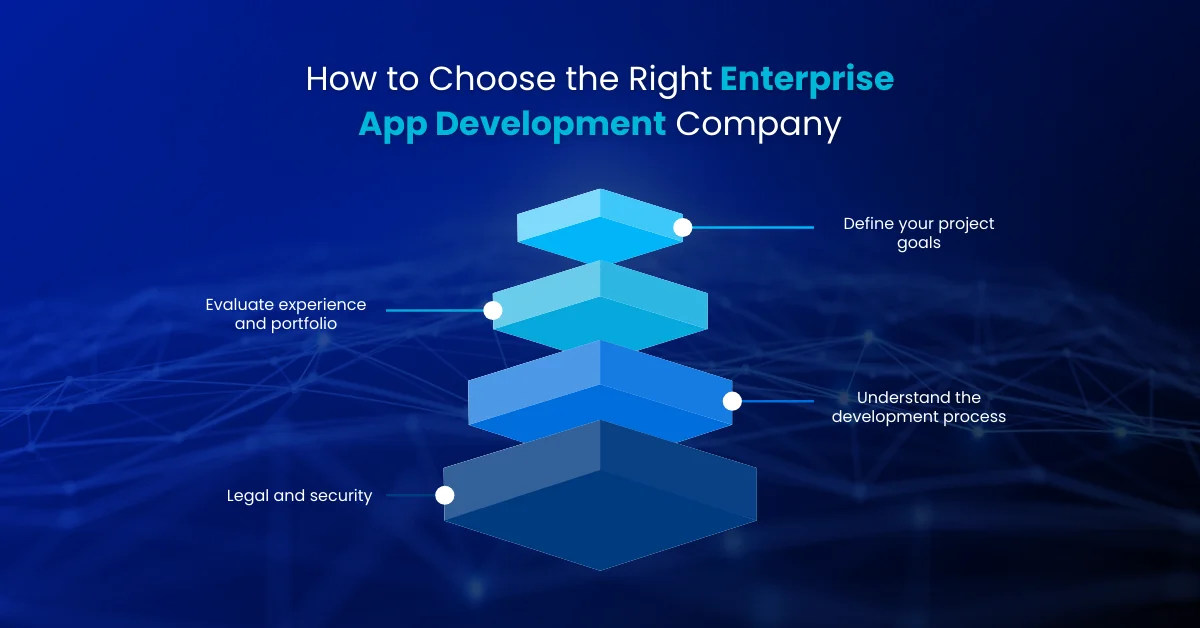
Making the final selection requires a structured internal process. This is a strategic procurement decision that will have long-term implications. Use the following steps to guide your organisation towards the right choice.
Define Clear Transformation Goals
Before you engage with any potential partners, you must have internal alignment on what you want to achieve. What specific business process are you trying to improve? What is the measurable outcome you expect? Is it to reduce operational costs by 15%, improve field technician efficiency by 20%, or decrease customer onboarding time by 30%? A clear objective is the most important tool for evaluating a partner.
Assess Technical Stack Alignment
Review your existing technology ecosystem. What are your core systems of record (ERP, CRM)? What is your cloud infrastructure (AWS, Azure, GCP)? Look for a partner who has demonstrable experience with your specific stack. This reduces integration risk and shortens the development timeline. Ask for case studies involving integrations similar to yours.
Review their Governance and Delivery Model
How will the project be managed? Request a detailed explanation of their project governance model. Who will be your primary point of contact? What is the frequency and format of progress reporting? How are risks identified and mitigated? A mature enterprise partner will have a well-defined and transparent process that provides you with visibility and control throughout the project lifecycle.
Validate their Security Posture
Do not take claims about security at face value. Ask for specifics. Inquire about their secure software development lifecycle (SSDLC). Do they perform regular penetration testing? Can they provide evidence of compliance with standards like ISO 27001 or SOC 2? Requests to speak with their security lead to assess the depth of their expertise.
Understand their Scaling Roadmap
Discuss how they approach building an application for future growth. How does their architecture support adding new features, expanding to new regions, or handling a tenfold increase in users? A strategic partner will think beyond the initial launch and design a solution that can evolve with your business without requiring a complete rebuild.
Evaluate Cultural Fit and Partnership Potential
Finally, remember that you are not just buying code; you are entering a long-term partnership. During the evaluation process, assess the cultural fit between your team and theirs. Are they transparent and collaborative? Do they challenge your assumptions in a constructive way? The best partnerships are based on mutual respect and a shared commitment to achieving the business outcome.
Conclusion
Choosing an enterprise mobile app development company in 2026 is a decision of strategic importance. The success of your initiative will depend less on flashy features and more on the partner’s ability to deliver a secure, scalable, and well-integrated solution that aligns directly with your core business objectives. The notion of a single “best” provider is a fallacy; the right partner is the one that best fits your organisation’s unique context, from technical architecture and industry regulations to company culture and long-term vision.
The journey requires thorough due diligence. By focusing on the evaluation criteria outlined in this guide from architectural capability and integration expertise to governance and security you can build a robust selection process. Prioritise finding a true strategic partner over simply procuring a low-cost vendor. A partner who understands your business, challenges your assumptions, and co-invests in the outcome is invaluable. Companies such as Devtriosand others listed above represent the range of strategic partners available to enterprise organisations in 2026, each offering a different combination of scale, specialisation, and strategic focus to help drive meaningful transformation.
Don’t let legacy systems slow down your transformation roadmap.
If you are planning a secure, scalable enterprise mobile solution in 2026, speak with a team that understands architecture, compliance, and complex system integration. We help organisations modernise workflows and build mobile platforms designed for long-term growth.
Frequently asked questions
There is no single "best" enterprise mobile app development company. The ideal partner depends entirely on your specific business requirements, industry, technical ecosystem, and project scale. A large consultancy like Accenture might be the best fit for a global, multi-year transformation project, whereas a specialised firm like Devtrios could be better suited for a targeted workflow automation project in a regulated industry. The key is to evaluate potential partners against your unique criteria, focusing on alignment with your strategic goals, technical needs, and required level of security and compliance.
The cost of enterprise mobile app development varies significantly, ranging from £150,000 to well over £2 million. The final price is determined by several factors: application complexity, the number and difficulty of system integrations (e.g., with SAP or Salesforce), stringent security and compliance requirements (e.g., HIPAA), the number of platforms (iOS, Android, Web), and the ongoing costs for support and maintenance. Simple, standalone enterprise apps are at the lower end of the range, while complex, multi-system, highly secure applications for large user bases occupy the upper end.
A typical enterprise mobile application project takes between 6 and 12 months from initial discovery to first launch. This timeline can be influenced by organisational readiness, the complexity of integrations, and the chosen development methodology. A phased approach, using Agile methods to deliver a Minimum Viable Product (MVP) in 4–6 months, is common. This allows the business to realise value sooner while gathering user feedback to inform subsequent development cycles. Very complex, multi-faceted projects can, of course, extend beyond a year.
While nearly every industry benefits from enterprise mobility, some are experiencing a more urgent need. Logistics and transportation rely on mobile apps for fleet management, tracking, and proof of delivery. Healthcare uses secure mobile solutions for patient data access, clinical communication, and remote monitoring. Manufacturing employs apps for shop floor control, inventory management, and equipment maintenance. Financial services and insurance use them for field agent enablement and secure client interactions. The common thread is the presence of a distributed workforce and complex, time-sensitive workflows.
Facebook LinkedIn Threads Pinterest

Written by
Ali Hamza
Marketing strategist
Ali Hamza is an SEO specialist and digital marketer with 7+ years of experience in SEO, content strategy, WordPress, and online growth marketing. He shares practical insights and industry-based strategies focused on improving search visibility, user experience, and long-term organic growth.