Launching a new product as a startup comes with immense pressure. Indeed, speed is crucial but delivering value fast without missteps is even more critical. That’s why a well-crafted MVP roadmap becomes your startup’s best strategy for rapid, efficient, and user-focused product development. In this in-depth guide from Devtrios, you’ll get a practical, actionable 6-step MVP roadmap that helps you quickly validate your ideas, optimize resources, and build products your users genuinely want while staying ahead in a competitive market.
What is an MVP and Why Build One?
First and foremost, an MVP, or Minimum Viable Product, represents the simplest version of your product designed to address a core user problem with minimal effort and investment. Using an MVP roadmap lets startups validate their concepts early, learn directly from real users, and avoid wasting time and money on unnecessary features.
More importantly, creating a clear and focused MVP roadmap ensures your development efforts aim squarely at what drives growth and user adoption rather than chasing distractions.
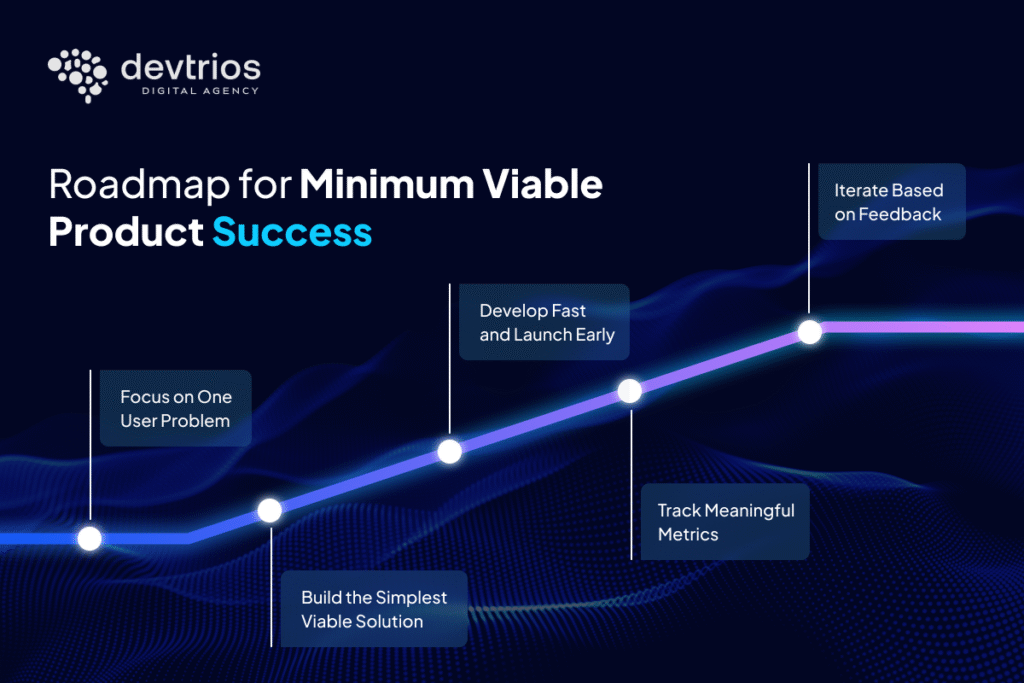
Six Steps to MVP Success
1. Define the Core Problem and Target Audience
To begin with, every effective MVP starts by zeroing in on two critical questions:
- What pressing problem will your product solve?
- Who exactly faces this problem?
Therefore, you must dive deep into market research with surveys, interviews, and competitive analysis to understand your target audience’s pain points and unmet needs. Tools like the Lean Canvas simplify your strategy by turning complex plans into living, adaptable documents aligned with your vision.
If you don’t solve a real pain, even the most elegant product will fail. Startups that nail this step execute faster and smarter.
Consequently, it is essential to take a deeper dive into defining your core problem and audience. By doing so, you will build a solid foundation that powers the rest of your MVP roadmap. Moreover, as you gain clearer insights, you can iteratively refine your understanding and ensure that every subsequent step is directly informed by this critical groundwork. Thus, not only do you reduce the likelihood of costly missteps, but you also accelerate your path toward achieving genuine product-market fit.
2. Map Out the User Journey
Next, understanding your users’ interaction from awareness to continued use is critical. This customer journey mapping stage visually represents all touchpoints your MVP should support to create a seamless user experience.
Specifically, focus on:
- Discoverability: How users find your product
- Decision-making: What encourages sign-up or purchase
- Onboarding: How users get real value quickly
- Retention: How to keep users engaged over time
Furthermore, it is important to carefully mark where frustration or drop-off happens along the user journey. By systematically identifying these pain points, you can gain invaluable insights that allow you to design intuitive, value-driven flows. Additionally, this approach not only streamlines the user experience but also increases retention and satisfaction levels. As a result, your MVP roadmap becomes even more effective in guiding users smoothly from their first interaction to long-term engagement. Moreover, addressing these obstacles early on will help you optimize development resources and foster user loyalty right from the start.
You can learn more about user journey mapping in MVP development to maximize engagement from day one.
3. Prioritize MVP Features
Moreover, resist the urge to include every possible feature at the outset. The core of a successful MVP is ruthless focus. Use prioritization frameworks like MoSCoW or impact vs. effort analysis to include only what delivers the essential value.
To do this effectively:
- List all potential features and user stories
- Score each for user value, technical feasibility, and problem relevance
- Defer “nice-to-haves” for later stages
Additionally, check out expert guidance on MVP feature prioritization and strategic feature selection to sharpen your choices.
4. Design and Develop the MVP
Now that you have a clear feature set, it’s time to focus on building smart and lean. Prioritize usability and functionality over perfection in design. Rapid wireframes and prototypes help your team align and validate user flows before heavy development investment.
To proceed correctly, approach MVP design by:
- Creating simple wireframes outlining key workflows
- Mocking or skipping non-essential functionalities initially
- Involving users early for quick usability tests
- Maintaining close collaboration between designers, developers, and stakeholders for agility
Also, use wireframing techniques to keep your development tightly focused on the user journey.
Remember, your MVP isn’t about a beautiful UI. Instead, it’s about solving the right problem, fast, and validating that solution with users.
5. Launch and Gather Feedback
Once the MVP is ready, launching it means entering the real market with a tested, focused version of your product. Therefore, choose a small, relevant test group or early adopters and collect invaluable insights through surveys, interviews, and usage analytics.
The most effective feedback channels include:
- In-app surveys and prompts
- Direct user interviews
- Social media and community engagement
- Analytics tracking real behaviors
By doing so, getting honest, detailed feedback turns assumptions into actionable data and accelerates learning.
You can learn how to implement a robust post-launch MVP feedback loop.
6. Iterate Based on User Feedback
Finally, the strength of an MVP lies in its iterative nature. You must analyze, prioritize, and implement improvements continuously to move your product toward real product-market fit.
The key iteration practices include:
- Grouping feedback into themes and prioritizing enhancements
- Adjusting features, interface, and performance flexibly
- Retesting with users frequently to confirm impact
- Being ready to pivot if core assumptions change
Therefore, continuous iteration is the heartbeat of a successful MVP roadmap that leverages real user needs to evolve naturally.
Explore advanced MVP feedback and iteration strategies that keep your startup adaptive and relevant.
Why Devtrios for Your MVP Roadmap Journey?
At Devtrios, we don’t just code MVPs; instead, we become your strategic partner on the path from concept to launch. Our approach integrates a deep understanding of startup dynamics, design thinking, and rapid agile development to help your MVP reach the market faster and smarter.
Specifically, we offer:
- Speed: From idea to launch in weeks, not months
- User-Centric: Grounded in empathy, ensuring the MVP solves real problems
- Agility: Quick turns based on validated user insights, not guesswork
- Partnership: Transparent, collaborative workflow that keeps you in control
Therefore, let Devtrios guide your MVP roadmap with proven frameworks and hands-on expertise. Together, we’ll turn your startup vision into a successful, scalable product that customers love.
Building and launching your product without a structured MVP roadmap often leads to wasted time, resources, and missed opportunities. On the contrary, the disciplined cycle of defining, building, launching, learning, and iterating is how the best startups win.
Devtrios stands ready to accelerate your journey. So, partner with us to leverage a powerful, tested MVP roadmap that brings your vision to life faster, smarter, and with real user impact. Start your MVP journey now and unlock the fastest path to product-market fit.
If you want to discuss how Devtrios can help tailor your startup’s MVP roadmap, don’t hesitate reach out today, and let’s build your success story together!
Frequently asked questions
A Minimum Viable Product is the simplest version of a product that solves one core user problem with the least effort and investment. It exists to validate the idea with real users early, before money goes into features nobody has asked for.
Define the core problem and the audience who has it, map the user journey, prioritise the feature set, design and build lean, launch to a small group and gather feedback, then iterate on what that feedback shows.
List every candidate feature and user story, score each one for user value, technical feasibility and how directly it addresses the core problem, then defer the nice-to-haves. Frameworks such as MoSCoW or an impact-versus-effort matrix make those trade-offs explicit.
From a small group of relevant early adopters, through in-app surveys and prompts, direct interviews, community and social channels, and analytics that record what people actually do rather than what they say they do.
No. An MVP is judged on whether it solves the right problem quickly and proves that solution with users. Usability matters, but visual perfection at this stage usually costs time that validation needs more.

Written by
Ali Hamza
Marketing strategist
Ali Hamza is an SEO specialist and digital marketer with 7+ years of experience in SEO, content strategy, WordPress, and online growth marketing. He shares practical insights and industry-based strategies focused on improving search visibility, user experience, and long-term organic growth.